
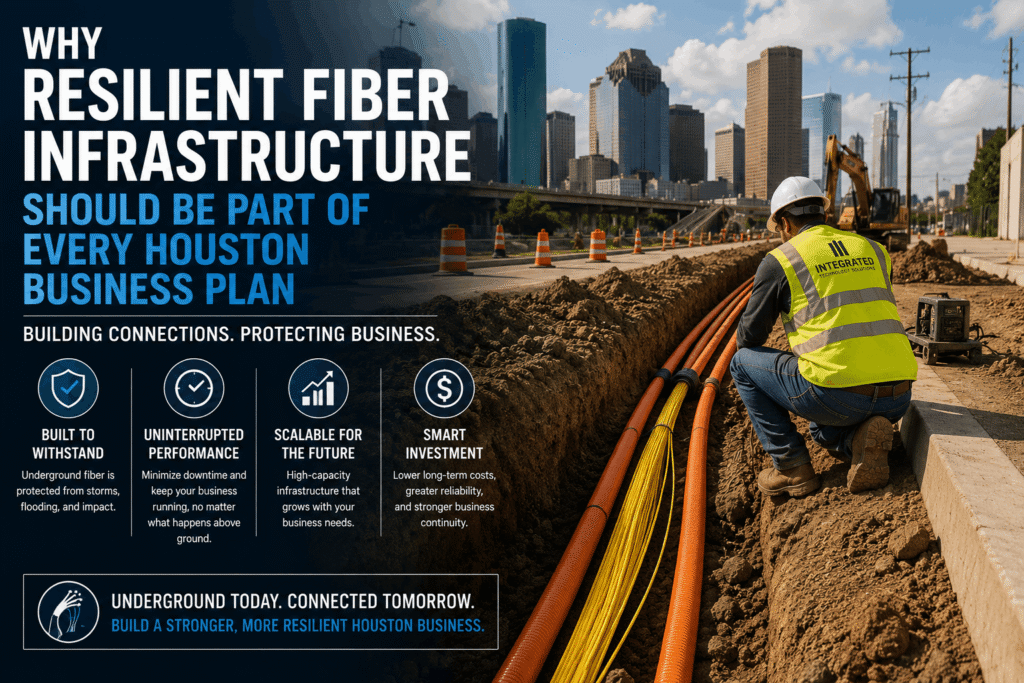
Houston knows storms. Every hurricane season, local business owners ask the same question: will we stay online when the weather turns bad? A recent Houston Business Journal column put this question back in the spotlight. In it, the CEO of Blue Stream Fiber made the case that underground fiber networks hold up better in severe weather than older, above-ground lines. He argued that resilient fiber infrastructure should sit at the center of the city’s storm planning, not as an afterthought.
That is a smart point for city planners. But it is an even bigger point for individual businesses. You cannot wait for citywide upgrades to protect your own operations. If your office, warehouse, or data center loses its network connection during a storm, the citywide plan will not save your sales calls, your security cameras, or your customer data. Fiber infrastructure resilience has to start at the building level, not just the city level.
This guide breaks down what resilient fiber infrastructure really means for a single business. We will cover why fiber infrastructure resilience matters in Houston, how underground fiber compares to older cabling, what role structured cabling plays, and how data center design fits into the picture. By the end, you will have a clear checklist you can use to check your own building’s readiness, plus a simple plan for closing any gaps you find.
Whether you run a small office, a warehouse, or a multi-site company with locations across Texas, the same core idea applies. A resilient fiber network is not a luxury. It is part of how a modern business stays open during hard weather.
Why Houston Businesses Need a Resilience Plan
Houston sits in a high-risk zone for severe weather. Hurricanes, tropical storms, and heavy flooding are part of life here. Harvey in 2017 showed how fast a single storm can shut down entire business districts. Power lines go down. Streets flood. Old copper and aerial cable lines snap or get soaked.
When your network goes down, more than your Wi-Fi stops working. Phone systems fail. Security cameras go dark. Access control doors may stop working. Point-of-sale systems freeze. Data backups can stall mid-cycle. For many businesses, a few days of downtime costs more than a full year of network upgrades.
This is why fiber infrastructure resilience is not just a technical topic. It is a business survival topic. A network built for fiber infrastructure resilience protects your revenue, your staff, and your customers, even when the weather does not cooperate.
Insurance costs are rising too. Some Houston insurers now ask about backup power and network redundancy before writing commercial policies. A resilient network is becoming part of how the market judges a well-run business.
The Real Cost of Network Downtime
Most business owners underestimate what an outage actually costs. It is not just the lost sales during the hours you are offline. It is the missed calls that never get returned, the delayed shipments, and the staff hours spent working around broken systems instead of doing their jobs.
For a small office, a two-day outage might mean a stack of missed orders and frustrated customers. For a larger operation, it can mean stalled production lines, lost payroll processing, or a security gap while cameras and access control sit offline. Data loss adds another layer of risk. If backups were mid-cycle when the outage hit, you may lose more than just the day.
This is the real argument for fiber infrastructure resilience. The upfront cost of a stronger network is small compared to the cost of even one bad outage during a busy season. Businesses that plan ahead spend less, in the long run, than businesses that rebuild after the storm has already caused damage.
What Is Fiber Infrastructure Resilience?
Fiber infrastructure resilience means your network can survive stress and keep working. Stress can come from wind, flooding, heat, power loss, or even simple wear over time. A resilient network is built with strong materials, smart design, and backup paths.
Three things make a fiber network resilient:
- Physical protection. The cable itself is shielded from weather, water, and physical damage.
- Path redundancy. If one line is damaged, traffic can move through a backup path.
- Standards-based installation. The work follows proven industry rules, not shortcuts.
Fiber optic cable is already stronger than copper cable in many ways. It does not carry electricity, so it will not short out from water the way copper can. It also handles heat better. But where and how that fiber is installed still matters a great deal. This is where the underground vs. aerial debate comes in.
True fiber infrastructure resilience is not about one single fix. It is a mix of good materials, smart placement, and proven installation standards, all working together. Skip any one piece, and the whole system becomes weaker than it needs to be.
Underground Fiber vs. Aerial Fiber: The Durability Difference
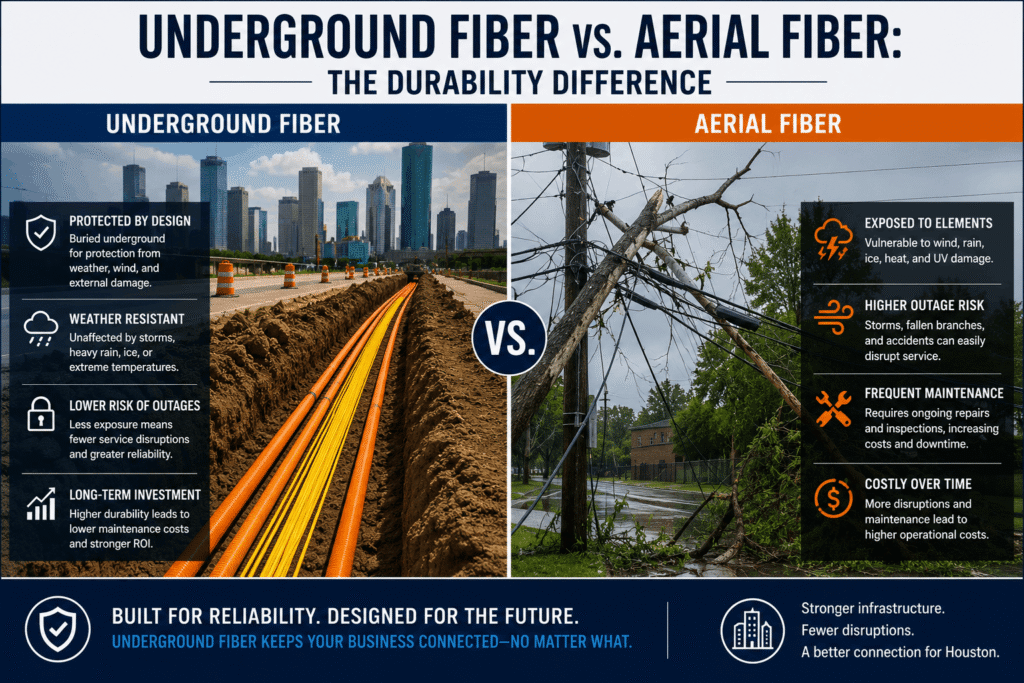
Aerial fiber runs on poles above ground, often next to power lines. It is cheaper and faster to install. But it is also exposed. High winds can snap lines or tear down poles. Falling tree limbs are a common cause of outages during storms. Ice, in the rare years Houston sees it, adds extra weight that can also cause breaks.
Underground fiber runs through conduit buried below the surface. It is protected from wind, falling debris, and most weather events. This is the main point behind the recent Houston Business Journal column: underground lines simply survive storms better than lines hanging in the open air.
Underground installation costs more upfront. Trenching, conduit, and permitting all add expense. But for many businesses, especially those that cannot afford any downtime, the extra cost pays for itself the first time a storm rolls through and competitors lose service while you stay connected.
There is a middle path too. Not every business can dig a full underground run to the street. But you can still control what happens once fiber enters your building. Good conduit protection, proper entry points, and solid pathway design inside your building all reduce your risk, even if the outside line is aerial.
How Changing Weather Patterns Raise the Stakes
Houston’s weather has always been unpredictable. But recent years have brought heavier rainfall, longer flood windows, and storms that intensify faster than older forecast models expected. This makes fiber infrastructure resilience even more important than it was a decade ago.
Older buildings across the Houston area were often wired long before today’s storm patterns were common. Many still rely on aerial lines or outdated internal cabling that was never designed with flood risk in mind. As storms grow more intense, that gap between old infrastructure and current risk keeps widening.
This does not mean every business needs a full rebuild right away. It means resilience planning should be a normal part of running a business in this region, the same way fire drills and insurance reviews are normal. Fiber infrastructure resilience deserves a spot on that same checklist.
Structured Cabling: The Backbone of a Resilient Network
Fiber lines get most of the attention, but the cabling inside your building matters just as much. This is called structured cabling. It is the organized system of cables, racks, and connection points that carries data through your walls, ceilings, and floors.
Poor structured cabling creates weak points. Loose connections, overloaded cable runs, and outdated wiring can all fail under stress, even if your outside fiber line is solid. A storm can knock out power, cause a voltage spike, or force a fast reboot of your systems. Weak internal cabling is far more likely to fail during that kind of event.
This is why BICSI-certified installation matters. BICSI is the leading standards body for structured cabling. Certified technicians follow strict rules for cable pathways, labeling, grounding, and testing. This is not paperwork for its own sake. It is what keeps your network stable under real-world stress, and it is a core part of true fiber infrastructure resilience at the building level.
At Integrated Technology Solutions, our team builds every project around these standards. Our structured network cabling services cover both new builds and upgrades to older systems that were never designed with storm resilience in mind.
Two areas matter most for resilience:
Fiber optic installation inside the building. Even if your provider’s outside line is solid, your internal fiber optic installation needs proper pathway protection, correct bend radius, and secure termination points. Bad internal fiber work can undo the benefit of a strong outside line.
Copper cabling where it still applies. Not every connection need fiber. Many devices, phones, and access points still run on copper. Our copper cabling solutions follow the same certified standards, so weak links do not appear anywhere in your system.
Data Center Resilience: Beyond the Cabling
If your business runs its own server room or data center, resilience goes beyond cabling alone. A full data center installation plan needs to account for power, cooling, fire risk, and monitoring. This is where fiber infrastructure resilience meets facility design, and where many businesses find their biggest gaps.
Here is what a resilient data center setup should include:
Backup power. Uninterruptible power supplies and generators keep systems running through short outages and give you time to shut down safely during longer ones.
Cooling redundancy. Servers overheat fast without cooling. A single point of failure in your cooling system can take down your whole room, storm or no storm.
Environmental monitoring. Sensors that track temperature, humidity, and water intrusion give you an early warning before small problems become big failures. Our environmental monitoring and DCIM services give facility managers real-time visibility into these risks.
Fire detection. Storms bring power surges, and power surges can cause electrical fires. Early smoke detection technology, sometimes called VESDA, can catch a fire before it spreads. Our advanced fire sensing systems are built for exactly this kind of early warning.
Grounding and bonding. Proper grounding protects your equipment from power surges, which are common during storms with lightning and grid instability. Learn more about our grounding, bonding, and certification process.
A resilient data center is not one single upgrade. It is a set of layered protections working together. Miss one layer, and the rest cannot fully protect you.
Resilience Is an Ongoing Process, Not a One-Time Project
Many businesses treat network upgrades as a one-time task. Install it, forget it, move on. But true fiber infrastructure resilience needs regular checkups, not just a strong first build.
Cables age. Connections loosen. Backup batteries lose capacity over time. Sensors can drift out of calibration. A system that was fully resilient five years ago may have quiet weak points today that nobody has tested.
A simple yearly review can catch most of these issues before they become real problems. This review should test backup power under load, check environmental sensors against real readings, and inspect cable pathways for wear or damage. Businesses that build this habit into their yearly planning avoid most of the surprise outages that catch others off guard during storm season.
Building Your Business Continuity Plan Around Network Infrastructure
Business continuity planning often focuses on data backups and insurance. Network infrastructure deserves the same level of attention. Here is a simple way to think about it.
Step 1: Map your risk. Walk through your building and note where your fiber or copper lines enter, where your main equipment racks sit, and whether they are above or below likely flood levels.
Step 2: Check your redundancy. Ask your provider if you have a single point of failure. If one line goes down, do you have any backup path at all?
Step 3: Review your internal cabling age. If your building’s cabling is more than ten years old, it was likely not designed with today’s storm patterns or bandwidth needs in mind.
Step 4: Test your power backup. A UPS system that has never been tested may fail exactly when you need it most.
Step 5: Schedule a professional assessment. A trained technician can spot weak points that are not visible during a normal walk-through.
This process does not need to happen all at once. Many businesses tackle it in phases, starting with the areas most likely to fail first.
A Simple Checklist for IT and Facility Managers
Use this quick list to gauge your current resilience level:
- Is your main fiber entry point underground or aerial?
- Do you have a backup path if your primary line fails?
- Was your internal cabling installed to BICSI standards?
- Is your data center or server room above flood level?
- Do you have backup power that has been tested in the last six months?
- Do you have environmental sensors for temperature, humidity, and water?
- Is your fire detection system rated for early warning, not just smoke?
- Are your grounding and bonding systems up to current code?
- Do you have a written plan for what happens if your main line goes down?
- Have you had a professional infrastructure review in the last two years?
If you answered no to three or more of these, it is worth scheduling a review soon, ideally before the next storm season peaks.
Why Work With a Certified, Local Partner
Storm resilience is not a one-size-fits-all project. Every building has a different age, layout, and risk factors. A national call center cannot walk your site or see where your risks actually sit. A local, certified team can.
Integrated Technology Solutions has served Houston, and the wider Texas market for more than 35 years combined team experience. Our technicians are BICSI-certified, and our projects span commercial AV systems, structured cabling, data center builds, and security and electrical services. We have supported organizations from local offices to national brands, always with the same standard of workmanship.
We also serve clients across the Houston area and beyond, including nationwide rollouts for multi-site companies that need the same level of quality no matter where they are located.
Conclusion: Do Not Wait for the Next Storm
The Houston Business Journal column made a strong point about the city’s broader fiber strategy. But your business does not have to wait for city-level change to protect itself. Resilient fiber infrastructure, strong structured cabling, and a well-designed data center are all things you can control today.
Storm season will come again. The only question is whether your network is ready for it. A short assessment now can save you days of downtime, lost sales, and stress later.
Ready to check your building’s resilience? Contact our team for a free consultation or call us at +1 888-985-5334 to talk through your project.
Frequently Asked Questions
Does underground fiber really survive storms better than aerial fiber? Yes. Underground lines are shielded from wind, falling trees, and flying debris, which are the most common causes of storm-related outages for above-ground lines.
How much does it cost to upgrade to more resilient network infrastructure? Cost depends on your building size, current setup, and how much of the work involves new trenching versus internal upgrades. A professional assessment gives you an accurate quote based on your actual risk points.
What is the first step if I think my network is not storm-ready? Start with a professional infrastructure review. A trained technician can walk your site, check your cabling age, and point out the highest-risk areas first.
Can I improve resilience without a full network rebuild? Yes. Many businesses improve resilience in phases, starting with backup power, environmental monitoring, or fixing the weakest internal cabling runs, before tackling larger structural changes.
