
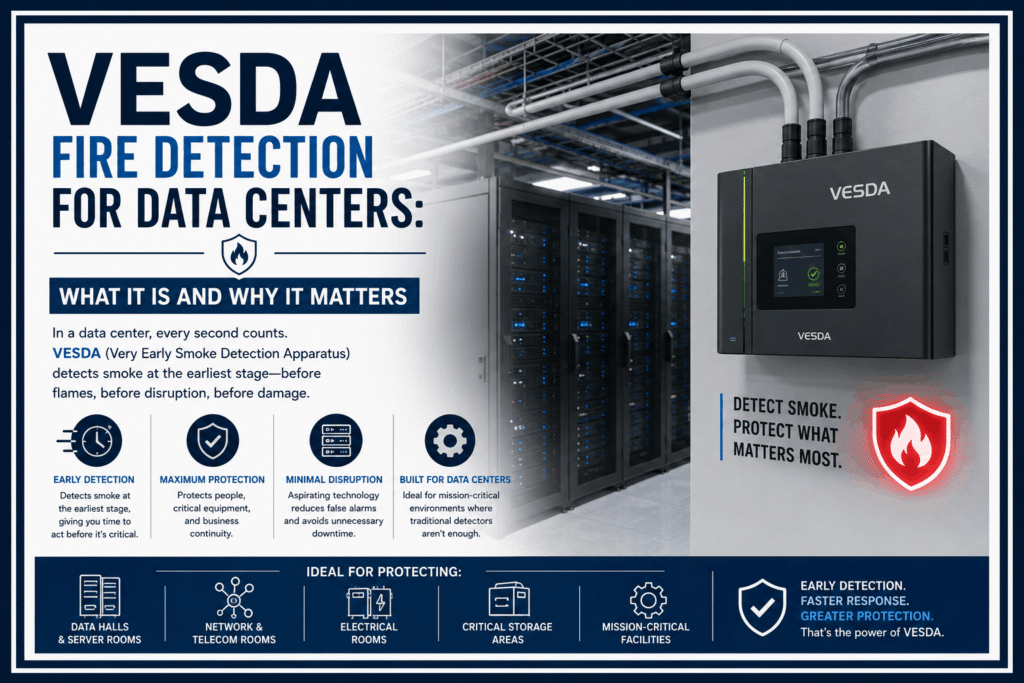
A data center fire does not start with flames. It starts with heat, with a slight change in air chemistry, with microscopic particles of smoke that no standard detector can sense until it is too late. By the time a conventional alarm sounds, you may already be facing millions of dollars in equipment damage, data loss, and downtime.
VESDA fire detection data center systems are built to change that outcome. VESDA stands for Very Early Smoke Detection Apparatus. It is a category of aspirating smoke detection technology that actively samples air from throughout a facility and identifies the very earliest signs of fire, often minutes or even hours before conventional detectors respond.
For data center managers, IT directors, and facility engineers in Texas, understanding VESDA fire detection is not optional. It is a professional responsibility. This guide explains how VESDA systems work, why they outperform standard smoke detectors in data center environments, how they are installed, and what to look for when specifying one for your facility.
Why Standard Smoke Detectors Fall Short in Data Centers
Most commercial buildings rely on conventional spot-type smoke detectors. These devices sit in the ceiling and wait for smoke to drift up and enter the detector chamber. In a standard office or retail environment, this approach is adequate. In a data center, it is dangerously insufficient.
The Problem With Passive Detection
Conventional detectors are passive. They wait for smoke to come to them. In a data center, airflow patterns are carefully engineered to move air in specific directions for cooling. That same airflow can carry smoke particles away from ceiling-mounted detectors and toward exhaust systems before the detector ever triggers.
Hot aisle containment systems, raised floor plenums, and overhead cooling all create complex airflow environments that work against passive detection. A smoldering component in a server rack may produce smoke for a significant time before any conventional detector registers it.
Data Centers Cannot Afford Late Detection
In most environments, a delayed fire alarm is serious. In a data center, it can be catastrophic. Server racks are densely packed with hardware worth hundreds of thousands of dollars. Cooling and power systems are interconnected. One ignition point can cascade quickly across adjacent equipment.
Beyond hardware replacement costs, data center fires cause operational downtime that can cost businesses millions per hour. Recovery timelines depend on backup systems, but the physical damage to hardware, cabling, and infrastructure can extend rebuilds for weeks.
Standard smoke detectors respond at the visible smoke stage of fire development. VESDA fire detection data center systems respond at the incipient stage, the very beginning of thermal degradation, before visible smoke or flames appear. That difference in response time is the difference between a minor incident and a major disaster.
What Is VESDA? Understanding the Technology
VESDA is the most widely recognized brand name for aspirating smoke detection systems. While VESDA is technically a trademark of Xtralis (now part of Honeywell), the term has become broadly used to describe the entire category of Very Early Smoke Detection Apparatus systems in data center fire protection conversations.
VESDA fire detection data center systems work on a fundamentally different principle from conventional detectors. Instead of waiting for smoke to reach a sensor, a VESDA system actively pulls air samples from throughout the protected space through a network of small-diameter pipes.
How VESDA Fire Detection Works Step by Step
Here is the basic process a VESDA system follows in a data center environment:
• Air sampling: A network of small perforated pipes is installed throughout the data center, including above ceiling tiles, below raised floors, inside equipment aisles, and within cable trays. Each pipe has sampling holes positioned to draw air from critical locations.
• Active aspiration: A high-efficiency aspirator fan pulls air continuously through the pipe network toward the central detection unit. Air is not waiting to drift to a sensor. It is actively drawn from where the risk is.
• Filtration: Air passes through a dual-stage filter that removes dust and debris before it reaches the sensing chamber. This prevents false alarms and keeps the detection laser clean, maintaining sensitivity over time.
• Laser detection: Air enters a laser detection chamber. Any smoke particles scatter the laser beam. The system measures the degree of scattering and translates it into a smoke concentration reading.
• Alert levels: VESDA systems use a tiered alert structure rather than a simple alarm or no-alarm output. Multiple thresholds allow graduated responses from early warning through pre-alarm to fire alarm.
• Integration: The VESDA control unit connects to the building fire alarm system, suppression systems, building management systems, and monitoring platforms, triggering the appropriate response at each alert level.
What VESDA Can Detect That Standard Detectors Cannot
VESDA fire detection data center systems can detect combustion byproducts at concentrations far below what is visible to the naked eye or detectable by conventional ionization or photoelectric detectors. The laser-based sensing chamber can respond to particle concentrations measured in parts per million.
In practical terms, this means VESDA can detect a failing circuit board, an overheating cable bundle, or a compromised power supply unit in the very early stages of thermal stress, before any visible smoke or detectable heat signature appears. That warning gives facility managers time to investigate, isolate the problem, and respond before it becomes a fire.
VESDA Alert Levels Explained
One of the key advantages of VESDA fire detection data center systems over conventional alarms is the tiered alert structure. Instead of a binary alarm or no alarm output, VESDA systems provide graduated warning levels that allow a proportional response.
Alert Level 1: Action
The lowest threshold. A very slight increase in airborne particles has been detected. No visible smoke. No immediate danger. This level prompts a staff member to investigate the area and identify whether there is a developing issue such as a failing component or dust accumulation near a heat source.
Alert Level 2: Pre-Alarm 1
Particle concentration is rising. The condition is progressing. This level prompts escalation of the investigation and may trigger notifications to on-call technical staff. A careful review of the suspected zone is urgent.
Alert Level 3: Pre-Alarm 2
The situation is deteriorating further. This level may trigger automated responses such as increasing cooling airflow, powering down a suspected rack zone, or alerting a monitoring center. Evacuation planning may begin at this stage.
Alert Level 4: Fire Alarm
Full fire alarm activation. At this threshold, visible smoke or significant combustion is occurring. The building fire alarm system activates, suppression systems engage, and emergency services are notified. In most conventional alarm systems, this is the only level that exists. In a VESDA fire detection data center system, reaching this level means every earlier opportunity to intervene has passed.
VESDA vs Conventional Smoke Detectors: A Direct Comparison
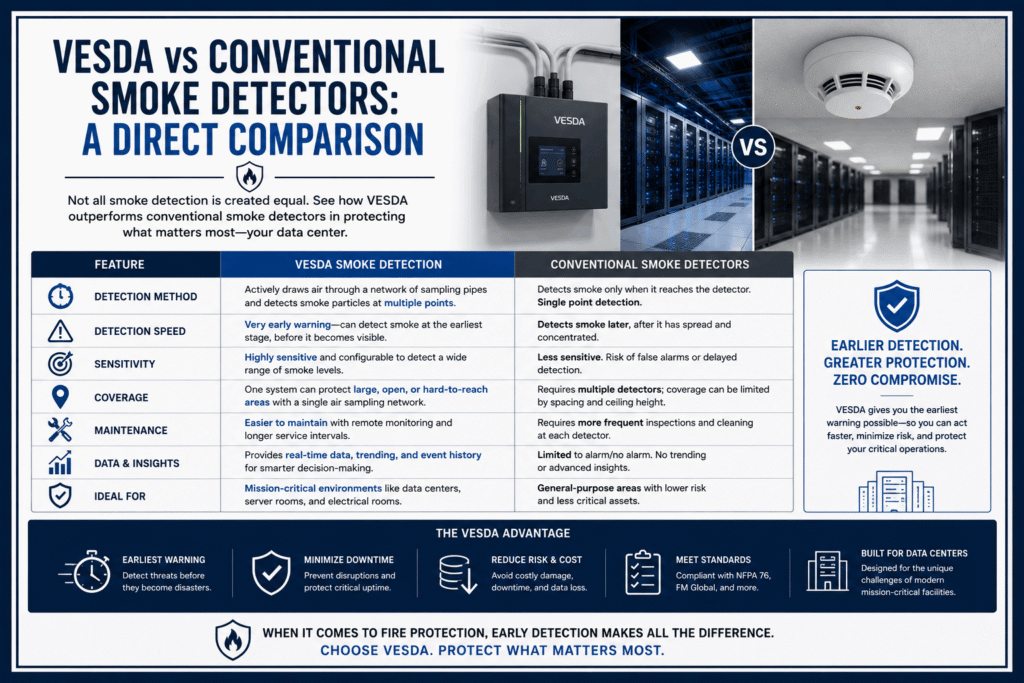
To understand why VESDA fire detection data center installations are becoming standard practice in mission-critical facilities, it helps to compare the two technologies directly.
Detection Speed
Conventional detector: Responds when smoke reaches a visible density and physically drifts to the detector location. This can take many minutes after the onset of thermal degradation.
VESDA system: Actively samples air from throughout the space continuously. Detection can occur within seconds to minutes of the very earliest combustion byproducts being present. In tested scenarios, VESDA fire detection has identified incipient fire conditions up to 30 minutes before conventional detectors triggered.
False Alarm Rate
Conventional detector: Susceptible to nuisance alarms from dust, steam, or airflow changes near the sensor.
VESDA system: The dual-stage filter removes dust and debris before air reaches the sensing chamber. Combined with the tiered alert structure, false alarm rates are significantly lower. The graduated alert levels mean that an unusual air sample triggers investigation, not an immediate evacuation alarm.
Coverage Flexibility
Conventional detector: Must be positioned within the direct airflow path of potential smoke. In data centers with complex airflow management, this is difficult to achieve reliably. Areas under raised floors and inside cable trays are essentially unprotectable with conventional spot detectors.
VESDA system: Sampling pipes can be routed anywhere. Under raised floors, above suspended ceilings, inside equipment aisles, within cable trays, and even inside individual rack enclosures. Every high-risk area can be sampled directly rather than relying on smoke drifting to a nearby sensor.
Maintenance
Conventional detector: Each sensor must be individually tested and maintained. In a large data center with hundreds of detectors, this is labor-intensive.
VESDA system: Centralized detection unit with distributed pipe network. Maintenance is performed at the central unit. The filtration system protects the laser chamber from contamination, extending service intervals and maintaining consistent sensitivity over the life of the system.
Response Granularity
Conventional detector: Binary output. Either alarm or no alarm.
VESDA system: Four to five graduated alert levels. Each level triggers a specific response appropriate to the severity of the condition. This allows investigation and early intervention without triggering a disruptive full facility evacuation for a minor developing issue.
Where VESDA Sampling Pipes Are Installed in a Data Center
The effectiveness of VESDA fire detection data center installations depends heavily on pipe placement. Every zone of a data center presents different fire risk characteristics and requires a tailored sampling approach.
Above Suspended Ceiling Tiles
The plenum space above ceiling tiles is a common pathway for electrical conduit, low voltage cabling, and HVAC ductwork. Electrical faults in this space can smolder for extended periods. Sampling pipes in the plenum catch early signs of developing fires that would be completely invisible to any floor-level or ceiling-mounted conventional detector.
Under Raised Floors
Many data centers use raised floor systems for cold air distribution and cable routing. The underfloor plenum contains power distribution cables, copper and fiber data cabling, and cooling infrastructure. This is a high-risk zone that is completely inaccessible to conventional ceiling-mounted detectors.
VESDA sampling pipes run under the raised floor, drawing air directly from where the risk exists. A failing power cable or an overheating PDU connection in this hidden space is detectable through VESDA fire detection long before any above-floor detector could respond.
Equipment Aisles and Rack Rows
Cold aisles and hot aisles each present different sampling considerations. Cold aisles contain the intake side of server equipment. Hot aisles contain the exhaust. VESDA sampling pipes can be positioned to draw air from both sides, providing coverage across the full thermal environment of every rack row.
Inside High-Value Equipment Enclosures
For the highest-value assets in a data center, VESDA sampling can be extended directly inside sealed cabinet enclosures. Micro-bore sampling tubes draw air from inside the cabinet to the main detection system, providing component-level early warning for the equipment that matters most.
MDF and IDF Rooms
Main and intermediate distribution frame rooms house core network switching equipment and fiber termination infrastructure. These spaces are critical to building-wide connectivity and deserve dedicated VESDA coverage separate from the main floor system. Sampling pipes in these rooms provide protection for the network core that everything else depends on.
VESDA Fire Detection and Fire Suppression: How They Work Together
VESDA fire detection data center systems do not suppress fire on their own. They detect and alert. The suppression response is a separate system. But the two are designed to work together, and VESDA’s early warning capability fundamentally changes how suppression systems are managed.
Clean Agent Suppression Systems
Most data centers use clean agent fire suppression rather than water-based systems. Clean agents such as FM-200, Novec 1230, or inert gas blends suppress fire by reducing oxygen levels or interrupting the chemical reaction of combustion, without damaging electronic equipment.
VESDA fire detection allows clean agent suppression to be held back until the fire alarm threshold is confirmed, rather than triggering at a pre-alarm level. This prevents unnecessary suppressant discharge events, which are extremely expensive to recharge and temporarily take the suppression system offline.
With a conventional fire alarm system, by the time the alarm triggers, suppressant discharge is often unavoidable. With VESDA fire detection data center integration, facility managers frequently have time to investigate, identify the source, and isolate it before suppression is needed at all.
Integration With Building Management Systems
VESDA systems integrate with building management systems (BMS) to coordinate responses across multiple building systems. At the pre-alarm level, cooling airflow may be modified to limit the spread of smoke. Power to the affected zone may be reduced. At the fire alarm level, HVAC dampers close to prevent smoke propagation, access control locks down, and suppression activates automatically.
VESDA Installation: What to Expect
Installing a VESDA fire detection data center system is not a simple plug-and-play process. It requires careful design, professional installation, and precise calibration to perform as intended. Here is what a professional VESDA installation involves.
Site Survey and Risk Assessment
The installer begins with a thorough site survey. Room dimensions, airflow patterns, cooling configurations, raised floor depth, ceiling plenum accessibility, and equipment layout all affect pipe routing and sampling point placement. A well-designed VESDA system is specific to the facility it protects.
Hydraulic Calculation and Pipe Network Design
VESDA pipe networks must be hydraulically balanced. The aspiration fan must create consistent airflow through every sampling point. Pipes that are too long, too narrow, or have too many sampling holes will have reduced suction at the most remote points. Professional design software calculates pipe sizing, sampling hole diameter, and network layout to achieve balanced airflow throughout.
Physical Installation
Pipes are typically fabricated from rigid CPVC or high-density polyethylene. They are routed through the data center in a way that gives consistent access to all critical zones. Installation requires coordination with existing cabling, cooling equipment, and structural elements. All pipes are labeled and documented for maintenance purposes.
Commissioning and Sensitivity Setting
After installation, the system is commissioned. Each alert threshold is set according to the specific environment, normal airborne particle levels, and the sensitivity required. The aspiration flow rate is measured at each sampling point to confirm the hydraulic design is performing as calculated.
A smoke challenge test is performed to verify that the system detects and responds within the required time. All alert levels are tested and documented. Integration with the fire alarm panel and suppression system is verified. Full commissioning documentation is provided as a project deliverable.
Compliance and Standards for VESDA Fire Detection in Data Centers
VESDA fire detection data center installations must comply with relevant fire codes and standards. In Texas, data centers fall under NFPA 75 (Standard for the Fire Protection of Information Technology Equipment) and NFPA 76 (Standard for the Fire Protection of Telecommunications Facilities) depending on the facility type.
Key compliance considerations include:
• NFPA 75: Requires smoke detection in all spaces of an IT equipment room, including under raised floors and above suspended ceilings. VESDA aspirating smoke detection is explicitly recognized as an acceptable means of compliance.
• NFPA 72: The National Fire Alarm and Signaling Code governs how VESDA systems are connected to and monitored by the building fire alarm system. The VESDA control unit must be listed and integrated in compliance with this standard.
• ANSI/TIA-942: The data center infrastructure standard references fire detection requirements for each tier level. Higher tier data centers have stricter fire detection requirements that VESDA systems are well-positioned to meet.
• Insurance requirements: Many commercial property insurers require or incentivize aspirating smoke detection in data centers. VESDA fire detection systems may qualify your facility for reduced insurance premiums.
• Uptime Institute Tier certification: Tier 3 and Tier 4 certification programs include fire detection requirements that aspirating smoke detection systems can satisfy.
For a detailed look at NFPA standards governing data center fire protection, the National Fire Protection Association (NFPA) publishes NFPA 75 and NFPA 72. These documents are the authoritative references for fire detection system design in IT equipment environments across the United States.
How VESDA Fits Into a Complete Data Center Security and Monitoring Strategy
VESDA fire detection data center systems do not operate in isolation. They are one layer in a complete environmental monitoring and security strategy. The most protected data centers combine VESDA with several other systems.
• Temperature and humidity monitoring: Sensor networks track thermal conditions throughout the facility. Abnormal heat readings can complement VESDA alerts to confirm a developing issue and its location.
• Water leak detection: Rope-style water sensors under raised floors catch cooling system leaks that could damage hardware and create electrical hazards.
• Access control and CCTV: Physical security systems log who is in the facility at any moment. During a VESDA alert, security footage can help identify who was working in the affected zone and what activity may have triggered the reading.
• 24/7 monitoring platform: All sensor systems, including VESDA, should feed into a centralized monitoring platform with off-site alert capability. Someone needs to receive and act on VESDA alerts around the clock, not just during business hours.
ITS designs and installs complete data center monitoring and security infrastructure. Our data center installation services cover cabling, environmental monitoring, and security system integration as part of a complete build-out approach. We also coordinate with specialist fire protection contractors to ensure VESDA and suppression systems are integrated correctly with the broader infrastructure.
Frequently Asked Questions About VESDA Fire Detection in Data Centers
Is VESDA required in all data centers?
NFPA 75 requires smoke detection under raised floors and above suspended ceilings in IT equipment rooms, which effectively requires aspirating or sampling-type detection in most modern data center configurations. While a specific brand is not mandated, VESDA fire detection systems are the most widely used and specified solution in the industry.
How often does a VESDA system need maintenance?
Most manufacturers recommend annual maintenance, which includes filter replacement, laser chamber inspection, airflow verification, and sensitivity testing. Some high-particulate environments may require more frequent filter changes. The filtration system is what makes VESDA maintenance significantly simpler than maintaining hundreds of individual conventional detectors.
Can VESDA be integrated with an existing fire alarm system?
Yes. VESDA control units provide relay outputs that connect to conventional fire alarm panels. The system can be configured to trigger specific inputs on the fire alarm panel at each alert level. This integration must be designed and tested in compliance with NFPA 72 requirements.
How does VESDA perform in a data center with high airflow from cooling systems?
VESDA systems are specifically designed for environments with managed airflow. The pipe network is designed hydraulically to maintain consistent sampling regardless of ambient airflow conditions. In fact, data centers with strong, consistent airflow from cooling systems can actually improve VESDA response times by drawing combustion particles toward sampling points more quickly.
Does ITS install VESDA systems in Texas?
ITS works with specialist fire protection contractors on data center projects that require VESDA fire detection integration. We coordinate the cabling, conduit, and building infrastructure that VESDA systems require, and we ensure that VESDA integration points are built into the broader data center design from the start. Contact us to discuss your project’s fire detection requirements alongside our commercial security and electrical services.
The Uptime Institute publishes guidelines on fire protection requirements for each tier classification, including the detection and suppression standards that Tier 3 and Tier 4 data centers must meet. Their resources are useful for any facility manager specifying a VESDA fire detection data center system as part of a tier certification project.
Protect Your Data Center With the Right Fire Detection Technology
VESDA fire detection data center systems represent the current gold standard for early fire warning in mission-critical facilities. They detect what conventional detectors cannot, respond before visible smoke appears, and give facility managers time to investigate and intervene before a minor issue becomes a major disaster.
For Texas data center managers, the case for aspirating smoke detection is straightforward. The cost of a VESDA system is modest relative to the value of the equipment and data it protects. The cost of a data center fire without early detection is not.
ITS supports data center fire protection as part of our complete infrastructure design and installation services. Whether you are planning a new build or upgrading an existing facility, our team can help you design the cabling, conduit, monitoring, and security infrastructure that gives your VESDA fire detection system the foundation it needs. Explore our data center installation services and our structured network cabling services to learn more about what we deliver on every project.
Contact Integrated Technology Solutions today to discuss your data center fire protection and infrastructure requirements. Call us at +1 888-985-5334 or visit our contact page to schedule a consultation with our team.
