
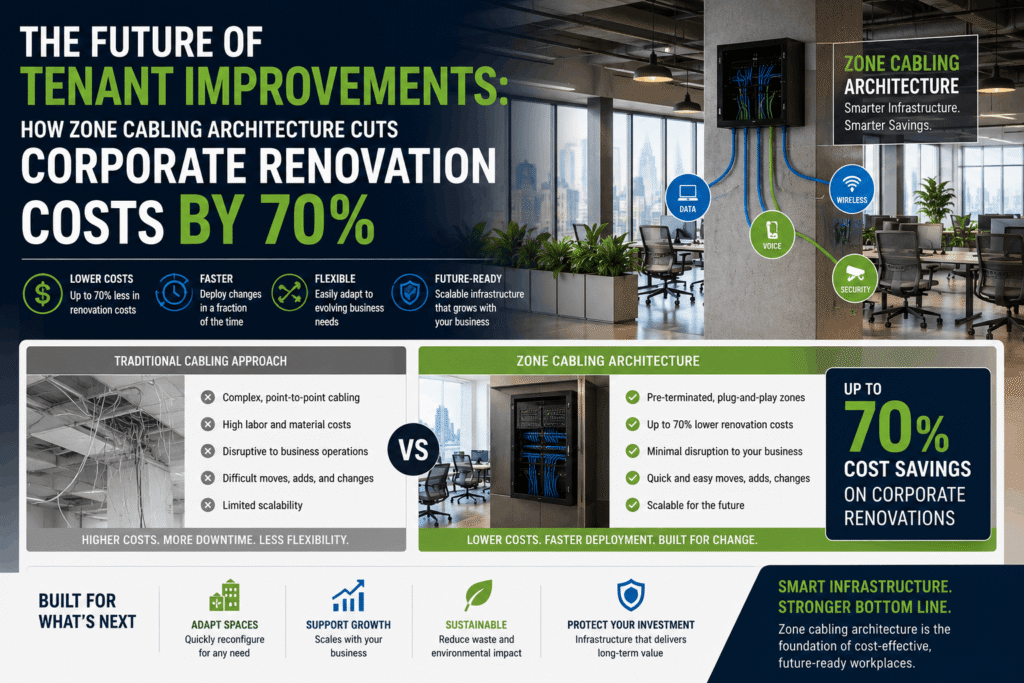
Corporate office moves and renovations drain budgets faster than almost any other business expense. Traditional cabling methods lock you into rigid floor plans and expensive change orders. Every workstation move requires technicians, downtime, and substantial labor costs. This outdated approach wastes money and limits workplace flexibility.
Zone cabling architecture changes everything. This innovative structured cabling approach delivers tenant improvement cost reduction of up to 70% compared to traditional methods. Companies adopting zone cabling architecture gain unprecedented flexibility while slashing renovation expenses.
This comprehensive guide explains how zone cabling architecture works, why it delivers massive tenant improvement cost reduction, and how to implement it in your next office project. You’ll discover why forward-thinking organizations are abandoning traditional structured cabling in favor of this smarter approach.
Understanding Traditional Cabling Limitations
Before exploring zone cabling architecture benefits, you need to understand what makes traditional cabling so expensive and inflexible.
The Traditional Approach:
Conventional structured cabling runs individual cables from a central telecommunications room directly to each workstation. Every desk has dedicated cable runs extending hundreds of feet through walls, ceilings, and conduits.
Critical Problems:
Fixed Floor Plans: Once cables are installed, changing office layouts becomes prohibitively expensive. Moving one workstation means:
- Hiring cabling contractors
- Running new cables through ceilings
- Removing old cables (often required by code)
- Patching and repairing ceilings
- Testing and certifying new connections
- Substantial downtime for affected areas
High Initial Costs: Traditional structured cabling for a 10,000 square foot office typically costs:
- Cable materials: $15,000-$25,000
- Installation labor: $35,000-$55,000
- Testing and certification: $8,000-$12,000
- Total: $58,000-$92,000
Renovation Nightmares: Every office reconfiguration triggers expensive cabling changes. Businesses spend thousands per workstation move. This creates resistance to workplace optimization and limits organizational agility.
Wasted Infrastructure: When employees relocate, abandoned cables remain in ceilings. Building codes often require removal, adding disposal costs. Alternatively, they create fire hazards and code violations.
These limitations make traditional structured cabling increasingly obsolete in today’s dynamic workplace environments.
What Is Zone Cabling Architecture?
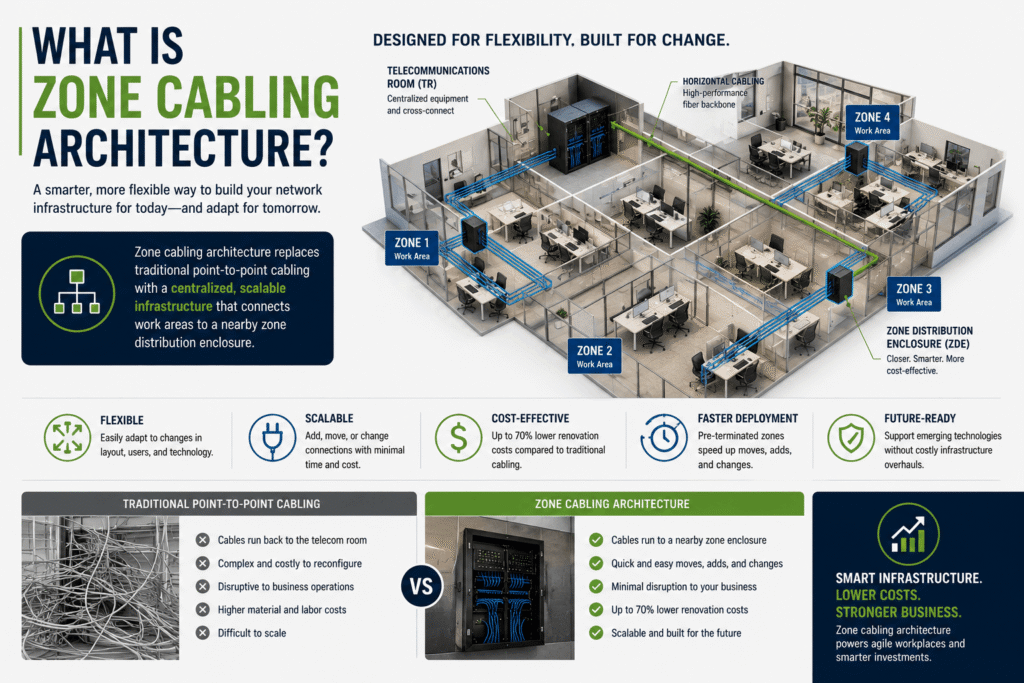
Zone cabling architecture revolutionizes how organizations approach structured cabling for tenant improvements. This innovative system delivers extraordinary tenant improvement cost reduction through smarter design principles.
Core Concept:
Instead of running cables directly from telecommunications rooms to individual workstations, zone cabling architecture creates intermediate distribution points throughout your space. Short, flexible cables connect workstations to these nearby zones.
How It Works:
Permanent Infrastructure Layer: High-capacity backbone cabling connects your main telecommunications room to strategically placed zone enclosures. This infrastructure rarely changes, even during major renovations.
Flexible Access Layer: Short cables (typically 10-50 feet) connect workstations to the nearest zone enclosure. These cables are easy to add, remove, or relocate without specialized contractors.
Zone Enclosure Locations: Small wall-mounted or ceiling-based enclosures are placed throughout your office, typically:
- One zone per 500-1,000 square feet
- Located in columns, closets, or above drop ceilings
- Strategically positioned for balanced coverage
- Accessible for moves and changes
Key Advantages:
Zone cabling architecture delivers tenant improvement cost reduction through:
- Simplified workstation moves (no contractor required)
- Reduced cable quantities and labor
- Faster installation timelines
- Future-proof flexibility
- Lower ongoing maintenance costs
Professional structured network cabling specialists design zone cabling architecture that maximizes these benefits for your specific space.
The 70% Cost Reduction Breakdown
Understanding exactly how zone cabling architecture achieves dramatic tenant improvement cost reduction helps justify the investment to stakeholders.
Initial Installation Savings:
Traditional Structured Cabling (10,000 sq ft office):
- 100 workstation drops
- Average cable run: 150 feet per drop
- Total cable required: 15,000 feet
- Installation time: 200-300 hours
- Material cost: $22,000-$35,000
- Labor cost: $40,000-$60,000
- Total: $62,000-$95,000
Zone Cabling Architecture (same office):
- 12 zone locations
- Backbone cable: 1,500 feet
- Zone cables: 3,000 feet (short runs)
- Installation time: 80-120 hours
- Material cost: $12,000-$18,000
- Labor cost: $16,000-$24,000
- Total: $28,000-$42,000
Initial Savings: $34,000-$53,000 (55-60%)
Moves, Adds, and Changes Savings:
Real tenant improvement cost reduction appears over time through reduced change costs.
Traditional Method (per workstation move):
- Contractor service call: $150-$300
- New cable installation: $200-$400
- Old cable removal: $100-$200
- Testing and certification: $75-$150
- Ceiling repair and painting: $150-$300
- Total per move: $675-$1,350
Zone Cabling Architecture (per workstation move):
- Facilities staff disconnects/reconnects: $50-$100
- New patch cable if needed: $20-$40
- No ceiling work required
- No contractor required
- Total per move: $70-$140
Savings per move: $605-$1,210 (90%)
Annual Impact:
Typical 100-person office experiences:
- 15-25 workstation moves per year
- 5-10 new installations
- 3-5 department relocations
Traditional annual cost: $15,000-$35,000 Zone cabling architecture annual cost: $2,000-$5,000 Annual savings: $13,000-$30,000
Over a standard 7-year lease, zone cabling architecture delivers $91,000-$210,000 in tenant improvement cost reduction from change management alone.
Planning Zone Cabling Architecture for Your Space
Successful implementation requires thoughtful planning and design. Zone cabling architecture works best when properly tailored to your specific environment.
Initial Assessment:
Space Analysis:
- Measure total square footage
- Identify permanent walls and columns
- Locate telecommunications rooms
- Map power distribution
- Note ceiling heights and types
- Document HVAC and lighting layouts
Density Planning: Calculate workstation density:
- Open office: 1 workstation per 100-150 sq ft
- Standard office: 1 workstation per 150-200 sq ft
- Executive areas: 1 workstation per 300+ sq ft
Zone Placement Strategy:
Coverage Calculation: Each zone typically serves:
- Open office: 8-15 workstations
- Mixed office: 6-12 workstations
- Private office areas: 4-8 workstations
Optimal Zone Locations:
Structural Columns:
- Natural distribution points
- Structurally sound mounting
- Often near power distribution
- Minimal aesthetic impact
Dedicated Closets:
- Secure and accessible
- Temperature controlled
- Good for high-density zones
- Protection from damage
Above Ceiling Tiles:
- Invisible installation
- Easy future access
- Good for open office areas
- Requires accessible ceiling grid
Wall-Mounted Enclosures:
- Clean installation in finished spaces
- Direct access for changes
- Works in renovation projects
- May require aesthetic considerations
Future Flexibility Planning:
Zone cabling architecture enables tenant improvement cost reduction through adaptability. Design for future scenarios:
Anticipated Growth:
- Plan zone capacity 25-30% above current needs
- Include expansion points in backbone design
- Consider future department relocations
- Account for technology upgrades
Probable Reconfigurations:
- Identify likely reconfiguration areas
- Place zones at natural flex points
- Avoid zones in potential demolition areas
- Enable multiple layout scenarios
Quality technology build-outs incorporate zone cabling architecture planning from the earliest design phases.
Implementation Process and Timeline
Understanding the zone cabling architecture installation process helps you plan accurately and manage expectations.
Phase 1: Design and Engineering (2-3 weeks)
Detailed Space Planning:
- Finalize zone locations
- Calculate capacity requirements
- Design backbone pathways
- Specify equipment and materials
- Create installation drawings
Coordination Requirements:
- Architect and designer alignment
- Electrical contractor coordination
- HVAC considerations
- Fire protection integration
- IT equipment planning
Phase 2: Backbone Installation (1-2 weeks)
Primary Infrastructure: Install permanent structured cabling backbone:
- Main telecommunications room setup
- Backbone cable installation to zones
- Zone enclosure mounting
- Patch panel terminations
- Testing and certification
This phase occurs during initial construction or major renovation. Once complete, the backbone rarely requires modification.
Phase 3: Zone Cable Distribution (1-2 weeks)
Workstation Connections: Install flexible zone cables:
- Cable runs from zones to work areas
- Outlet installation or surface mounting
- Patch panel connections
- Labeling and documentation
- Final testing
This work adapts easily to floor plan changes during construction. Last-minute adjustments cost far less than traditional structured cabling modifications.
Phase 4: Testing and Commissioning (3-5 days)
Quality Assurance:
- Comprehensive cable testing
- Performance certification
- Documentation completion
- As-built drawing updates
- Staff training on system use
Total Timeline: 4-7 weeks from design to completion
Compare this to traditional structured cabling: 6-10 weeks. Zone cabling architecture delivers tenant improvement cost reduction through faster installation.
Technology Standards and Compliance
Zone cabling architecture must meet industry standards to ensure performance and maintain warranty coverage.
Applicable Standards:
TIA-568 Series: The Telecommunications Industry Association defines structured cabling standards. Zone cabling architecture complies with:
- TIA-568.0: Generic telecommunications cabling
- TIA-568.1: Commercial building cabling
- TIA-568.2: Balanced twisted-pair components
Specific Zone Standards:
- TIA-568.0-D Annex D: Zone cabling distribution
- Maximum zone cable length: 50 feet
- Backbone specifications
- Testing requirements
- Documentation standards
Performance Requirements:
Category 6A Compliance: Modern zone cabling architecture uses Cat6A for both backbone and zone cables:
- 10 Gigabit Ethernet support
- 500 MHz bandwidth
- Full 100-meter channel support
- PoE++ power delivery (90W)
Testing Certification: All installations require:
- Fluke or similar certified testers
- Link performance verification
- Return loss measurements
- Documentation for warranty
Code Compliance:
Fire Safety:
- Plenum-rated cables in air-handling spaces
- Riser-rated cables in vertical shafts
- Proper cable support and dressing
- Fire stopping at penetrations
Building Codes: Zone cabling architecture must satisfy:
- Local electrical codes
- Telecommunications regulations
- Fire marshal requirements
- Accessibility standards
Professional commercial electrical services ensure zone cabling architecture installations meet all applicable codes and standards.
Real-World Case Studies
Actual implementations demonstrate how zone cabling architecture delivers tenant improvement cost reduction in diverse environments.
Case Study 1: 15,000 Sq Ft Tech Company
Challenge: Fast-growing software company needed flexible office supporting frequent team reorganizations. Traditional structured cabling quoted at $135,000 with limited flexibility.
Zone Cabling Architecture Solution:
- 18 zones strategically placed
- 150 workstation capacity
- Modular furniture integration
- Investment: $52,000
Results:
- Initial savings: $83,000 (61%)
- 12 major reorganizations in first 2 years
- Zero contractor calls for moves
- Facilities team handles all changes
- Estimated ongoing savings: $45,000/year
Case Study 2: 25,000 Sq Ft Professional Services Firm
Challenge: Law firm relocating to new space. Traditional approach estimated $195,000. Wanted maximum flexibility for growth and client confidentiality requirements.
Zone Cabling Architecture Solution:
- 28 zones including private office areas
- 220 workstation capacity
- Integration with secure access zones
- Investment: $68,000
Results:
- Initial savings: $127,000 (65%)
- Added 45 employees without infrastructure changes
- Reconfigured 3 departments at zero cabling cost
- 5-year projected savings: $215,000
Case Study 3: 40,000 Sq Ft Multi-Tenant Building
Challenge: Building owner wanted modern infrastructure attracting quality tenants. Traditional per-tenant buildouts are costly and inflexible.
Zone Cabling Architecture Solution:
- Common backbone serving all suites
- Flexible zone distribution per floor
- Shared infrastructure reducing tenant costs
- Investment: $145,000
Results:
- Attracts premium tenants seeking flexibility
- Reduced tenant improvement allowances
- Faster tenant move-ins (2-3 weeks vs 6-8 weeks)
- Increased building valuation
- Competitive advantage in market
These examples demonstrate real tenant improvement cost reduction across different organization types and sizes.
Integration with Modern Workplace Trends
Zone cabling architecture aligns perfectly with contemporary workplace strategies, delivering tenant improvement cost reduction while supporting organizational objectives.
Hot Desking and Hoteling:
Traditional Cabling Challenges: Fixed desk assignments waste space and infrastructure. Hot desking requires active ports everywhere, dramatically increasing costs.
Zone Cabling Architecture Benefits:
- Dense zone coverage supports any desk usage
- Easy activation of dormant locations
- Flexibility matches scheduling systems
- No wasted infrastructure
Activity-Based Working:
Concept: Employees choose work locations based on tasks: collaborative spaces, focus areas, meeting rooms, or social zones.
Zone Cabling Architecture Advantages:
- Infrastructure supports multiple use cases
- Easy reconfiguration as needs evolve
- Technology follows people, not fixed desks
- Rapid adaptation to usage patterns
Hybrid Workforce Models:
New Reality: Fluctuating office attendance requires flexibility. Companies reduce physical footprint while maintaining full functionality.
Zone Cabling Architecture Support:
- Scale infrastructure to actual needs
- Accommodate changing density
- Support temporary team spaces
- Enable cost-effective flex areas
Integration with commercial AV systems becomes simpler when zone cabling architecture provides flexible infrastructure throughout your space.
Overcoming Implementation Concerns
Decision-makers often raise valid questions about zone cabling architecture. Addressing these concerns facilitates adoption.
Concern 1: “Our space is already built out”
Reality: Zone cabling architecture works in renovations, not just new construction. Retrofit installations deliver significant tenant improvement cost reduction even with existing infrastructure.
Approach:
- Incorporate zones during planned renovations
- Phase installation across multiple projects
- Supplement existing infrastructure strategically
- Focus on high-change areas first
Concern 2: “Initial costs seem higher”
Reality: Zone enclosures and design costs can exceed basic traditional structured cabling initially. However, total cost of ownership dramatically favors zone cabling architecture.
Counter-Analysis:
- Calculate 5-7 year total costs
- Include predicted moves and changes
- Factor flexibility value
- Consider avoided disruption costs
Concern 3: “Our IT team doesn’t know this system”
Reality: Zone cabling architecture uses standard Category 6A cables and connectors. No special skills required for basic moves.
Solutions:
- Training during installation (2-3 hours)
- Clear documentation and labeling
- Vendor support available
- Simpler than traditional systems
Concern 4: “What about future technology?”
Reality: Zone cabling architecture using Cat6A structured cabling supports all foreseeable network technologies.
Future-Proofing:
- 10 Gigabit Ethernet support
- PoE++ for advanced devices (90W)
- Short cable runs easily upgraded
- Backbone rarely requires modification
Concern 5: “Will this work with our security requirements?”
Reality: Zone cabling architecture enhances security by reducing vulnerability points and simplifying secure zone creation.
Security Benefits:
- Fewer telecommunications rooms to secure
- Zone-based access control integration
- Simplified VLAN segmentation
- Better network monitoring points
Working with experienced structured cabling professionals addresses these concerns through proven implementation strategies.
Calculating Your ROI
Determining zone cabling architecture return on investment helps justify the approach to financial stakeholders.
ROI Calculation Factors:
Initial Investment Comparison:
- Traditional structured cabling quote: $_______
- Zone cabling architecture quote: $_______
- Difference: $_______
Annual Change Cost Estimates:
- Expected workstation moves per year: _______
- Average traditional cost per move: $800
- Average zone cabling cost per move: $100
- Annual savings: _______
Productivity Impact:
- Traditional move downtime: 4-8 hours per workstation
- Zone cabling move downtime: 30 minutes per workstation
- Productivity value per hour: $_______
- Annual productivity savings: $_______
Total 7-Year Savings: (Annual savings × 7) + Initial difference = $_______
Example Calculation:
100-Person Office:
- Initial zone cabling premium: $8,000 higher
- 20 moves annually
- Traditional cost: 20 × $800 = $16,000/year
- Zone cabling cost: 20 × $100 = $2,000/year
- Annual savings: $14,000
- 7-year savings: $98,000 – $8,000 = $90,000 net
Payback Period: 7 months
This dramatic tenant improvement cost reduction comes from zone cabling architecture flexibility and simplified change management.
Best Practices for Maximum Value
Optimizing zone cabling architecture implementation ensures you realize full tenant improvement cost reduction potential.
Design Principles:
Strategic Zone Placement:
- Align zones with furniture systems
- Consider power distribution locations
- Plan for natural growth areas
- Avoid zones in transient spaces
Capacity Planning:
- Size zones 25-30% above current needs
- Use high-capacity backbone cables
- Plan for technology evolution
- Include expansion pathways
Documentation Standards:
Essential Information:
- Detailed zone maps and locations
- Cable identification systems
- Port assignments and availability
- As-built drawings and photos
- Contact information for support
Format Requirements:
- Digital and printed copies
- CAD files for facility management
- Database for port tracking
- QR codes on enclosures
Maintenance Protocols:
Regular Inspections:
- Quarterly zone enclosure checks
- Annual cable testing
- Capacity utilization reviews
- Documentation updates
Change Management:
- Port assignment tracking
- Move documentation
- Cable inventory management
- Performance monitoring
Staff Training:
Facilities Team Education:
- Basic cable identification
- Proper connection techniques
- Testing procedures
- When to call professionals
IT Department Training:
- Zone architecture concepts
- Network configuration
- Troubleshooting approaches
- Vendor coordination
Comprehensive technology build-outs include training and documentation ensuring long-term success.
Future Trends in Zone Cabling Architecture
Staying informed about evolving zone cabling architecture capabilities helps you plan for long-term tenant improvement cost reduction.
Emerging Technologies:
Smart Zone Enclosures:
- Automated port management
- Remote monitoring and alerts
- Energy usage tracking
- Predictive maintenance
Wireless Integration: Zone cabling architecture increasingly supports wireless infrastructure:
- WiFi 6E access point distribution
- 5G small cell connectivity
- IoT device integration
- Converged wired/wireless design
Power over Ethernet Evolution:
Current Capabilities:
- PoE++ delivers 90W per port
- Powers advanced devices without dedicated circuits
- Simplifies deployment and changes
Future Developments:
- Higher wattage standards emerging
- More devices powered via structured cabling
- Reduced electrical infrastructure needs
- Enhanced tenant improvement cost reduction
Modular Building Systems:
Zone cabling architecture aligns with:
- Prefabricated office modules
- Flexible wall systems
- Modular furniture integration
- Rapid reconfiguration capabilities
Sustainability Focus:
Environmental Benefits:
- Reduced cable waste
- Lower energy consumption
- Longer infrastructure lifespan
- Simplified recycling and disposal
Green Building Credits: Zone cabling architecture supports LEED and other certifications through:
- Material efficiency
- Adaptability and durability
- Waste reduction
- Energy performance
These trends will amplify zone cabling architecture advantages and tenant improvement cost reduction in coming years.
Making the Transition
Moving from traditional structured cabling thinking to zone cabling architecture requires strategic planning.
Decision Framework:
When Zone Cabling Architecture Makes Sense:
- New office buildouts or major renovations
- Spaces exceeding 5,000 square feet
- Organizations expecting growth or change
- Companies embracing workplace flexibility
- Multi-tenant building infrastructure
When Traditional Might Suffice:
- Very small offices (under 2,000 sq ft)
- Completely static environments
- Single-room installations
- Temporary spaces
Implementation Steps:
1. Education Phase:
- Share this information with stakeholders
- Calculate projected ROI
- Visit existing installations
- Interview reference customers
2. Planning Phase:
- Engage qualified design professionals
- Conduct detailed space assessment
- Develop preliminary zone layout
- Obtain budget estimates
3. Approval Phase:
- Present business case to decision-makers
- Compare alternatives clearly
- Address concerns and questions
- Secure project authorization
4. Execution Phase:
- Select experienced installer
- Coordinate with other trades
- Monitor installation progress
- Verify quality and documentation
5. Transition Phase:
- Train facilities and IT staff
- Document all procedures
- Establish change processes
- Begin using flexibility benefits
Your Path to Smarter Infrastructure
Zone cabling architecture represents the future of office infrastructure. Traditional structured cabling made sense when workplaces were static and changes were rare. Today’s dynamic business environment demands flexibility, and zone cabling architecture delivers.
The 70% tenant improvement cost reduction comes from multiple sources: lower initial installation costs, dramatically reduced change expenses, faster project timelines, and enhanced organizational agility. These benefits compound over time, creating extraordinary value.
Organizations planning office moves, expansions, or renovations should seriously evaluate zone cabling architecture. The approach works in new construction and renovation projects. It adapts to various space types and organizational needs. Most importantly, it positions you for workplace evolution without infrastructure constraints.
Success requires working with professionals who understand both zone cabling architecture technical requirements and your business objectives. The right partner guides you through planning, delivers quality installation, and ensures you realize full tenant improvement cost reduction potential.
Don’t let outdated infrastructure thinking lock you into expensive, inflexible solutions. Zone cabling architecture offers a smarter path forward, proven across thousands of installations worldwide.
Contact Integrated Technology Solutions to discuss zone cabling architecture for your next project. Our BICSI-certified team specializes in designing and installing structured cabling systems that maximize flexibility while minimizing costs. We’ll assess your space, demonstrate potential savings, and deliver a professional installation that positions your organization for long-term success. Let us show you how zone cabling architecture can transform your tenant improvement, cost reduction and workplace flexibility.
