
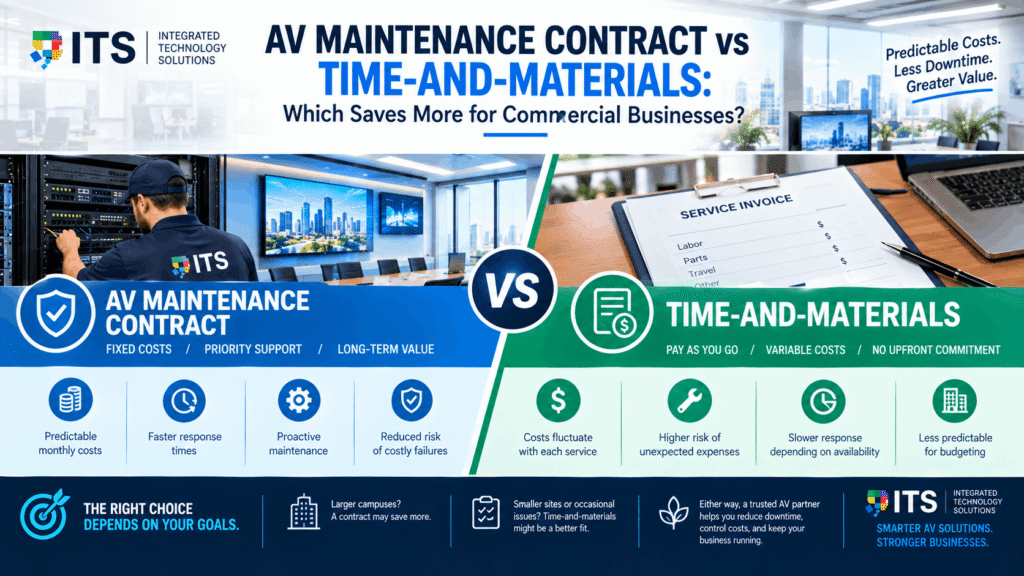
Your commercial AV systems are working today. The conference rooms are functional, the lobby display is running, and the sound masking in the open office is doing its job. But what happens when something goes wrong? And more importantly, what are you paying, or going to pay, for the support that keeps those systems running?
This is the decision that sits in front of most facility managers and IT directors after an AV installation is complete: commit to an AV maintenance contract with fixed, predictable costs, or handle service needs as they arise on a time-and-materials basis. Both approaches have real advantages and real drawbacks.
This guide breaks down both options in plain terms. It explains what an AV maintenance contract actually covers, how time-and-materials billing works, and where each approach delivers better value. By the end, you will have a clear framework for choosing the right support model for your specific AV environment.
Why AV Support Planning Matters More Than Most Businesses Expect
AV systems are not set-and-forget installations. Conference room displays need firmware updates. Control systems need software patches. Cameras need lens cleaning and firmware maintenance. Sound masking systems need periodic retuning when office layouts change. Video conferencing platforms push updates that require hardware configuration adjustments.
Without a plan for handling these ongoing needs, AV systems slowly degrade. Firmware falls behind. Minor issues that would have been caught early become larger problems. Employees start working around failing technology instead of reporting it. Conference room reliability drops, and with it, the productivity and impression value the AV investment was meant to deliver.
The question is not whether you need AV support. You do. The question is whether a structured AV maintenance contract or a pay-as-you-go approach serves your organization better.
How Time-and-Materials AV Support Works
Time-and-materials (T&M) support is the simplest approach. When something goes wrong with an AV system, you call your integrator, they dispatch a technician, and you pay for the time spent plus the cost of any parts or materials used. There is no upfront commitment, no ongoing fee, and no contract to manage.
How T&M Billing Is Structured
A typical time-and-materials billing structure for commercial AV service includes:
• Hourly labor rate: Typically billed in one-hour or half-hour minimums. Rates for experienced AV technicians in Texas commercial markets generally range from $95 to $175 per hour depending on the complexity of the work and the contractor’s overhead.
• Travel charge: Many contractors charge a flat travel or trip fee in addition to hourly labor, particularly for sites outside their immediate service area.
• Parts and materials: Replacement parts are billed at cost plus a markup, typically 15 to 30 percent above the contractor’s purchase price.
• Emergency or after-hours premium: Service calls outside normal business hours typically carry a premium of 1.5x to 2x the standard hourly rate.
The Genuine Advantages of T&M
• No upfront commitment: You pay nothing when systems are working. If your AV systems are new, reliable, and well-designed, your T&M costs in the first year or two may be very low.
• Flexibility: You can use different contractors for different needs. You are not locked into one provider.
• Pay only for what you use: If your AV systems have a particularly good year with no issues, you spend nothing on support.
• Simple procurement: No contract negotiation required. Call when you need help.
The Real Risks of T&M
• Unpredictable costs: A major AV failure requiring multiple technician visits and expensive parts replacement can generate a large unexpected invoice. Budgeting for AV support under T&M is an exercise in guessing.
• Reactive rather than proactive: T&M is by definition reactive. You respond to failures. You do not prevent them. Systems that would have been caught early through regular preventive maintenance instead fail at the worst possible moment.
• Response time uncertainty: Without a contract, you have no guaranteed response time. A contractor under contract with other clients will prioritize those clients over a T&M account when scheduling is tight.
• Higher per-incident cost: T&M customers typically pay higher hourly rates than contracted clients. Contractors offer discounted rates in exchange for the predictable revenue that a maintenance contract provides.
• No remote monitoring: T&M support does not include proactive remote monitoring. You only know there is a problem when an employee reports it, often after a meeting has already been disrupted.
How an AV Maintenance Contract Works
An AV maintenance contract is a formal agreement between a business and an AV service provider that defines the scope of support, the response times, and the cost for a fixed period, typically one to three years. In exchange for a predictable annual or monthly fee, the service provider commits to a defined set of services and service levels.
What a Typical AV Maintenance Contract Covers
Coverage varies between providers and contract tiers, but a comprehensive AV maintenance contract for commercial environments typically includes:
• Remote monitoring: Continuous monitoring of networked AV devices. The service provider receives alerts when devices go offline, report errors, or exhibit abnormal behavior before those issues cause visible failures.
• Preventive maintenance visits: Scheduled on-site visits, typically semi-annual or annual, where technicians physically inspect equipment, clean connections, test all room functions, apply firmware updates, and document system condition.
• Firmware and software updates: Keeping AV hardware and control systems current with manufacturer-recommended firmware. This is critical for security and for maintaining compatibility with evolving conferencing platforms.
• Help desk support: A defined support channel, typically phone, email, or ticketing system, where staff can report issues and receive guidance before a technician dispatch is needed.
• Guaranteed response times: Contractually defined response times for service requests. A typical commercial AV maintenance contract might specify 4-hour response for critical failures and next-business-day response for non-critical issues.
• Discounted on-site labor: On-site service calls that fall outside the covered scope are billed at a contracted rate, typically 15 to 25 percent below the standard T&M rate.
• Reporting and documentation: Regular reporting on system health, incident history, and maintenance activities. This documentation supports asset management and helps plan future technology investments.
The Genuine Advantages of an AV Maintenance Contract
• Predictable costs: A fixed annual fee makes AV support a known line item in the budget rather than a variable that surprises the finance team.
• Proactive rather than reactive: Remote monitoring and preventive maintenance catch problems before they become failures. A firmware issue that would have crashed a conference room system gets patched before the executive meeting.
• Guaranteed response time: When a critical AV system fails before an important meeting, a contracted client gets prioritized. A T&M account gets in the queue.
• Lower per-incident cost: Contracted labor rates are lower than T&M rates. Over a full year, this discount can more than offset the contract fee for organizations with moderate service needs.
• Relationship and institutional knowledge: A provider under an AV maintenance contract learns your systems, your building, and your team’s patterns. That institutional knowledge makes every service interaction faster and more effective.
• Lifecycle planning support: A provider who monitors and maintains your AV systems can identify equipment approaching end of life and help you plan replacement before you face a sudden failure with no budget allocated.
The Real Risks of an AV Maintenance Contract
• Upfront cost commitment: You pay even in years when very little goes wrong. If your systems have an unusually trouble-free year, the contract fee may exceed what T&M would have cost.
• Contract scope debates: Poorly written AV maintenance contracts create disputes about what is and is not covered. Clear scope definitions are essential.
• Provider quality dependence: A bad AV maintenance contract with a poor provider is worse than T&M. The value depends entirely on the provider’s capability and commitment.
• Multi-year commitment risk: A three-year AV maintenance contract locks you in. If your space changes significantly, the contract scope may no longer match your needs.
AV Maintenance Contract vs T&M: A Direct Financial Comparison
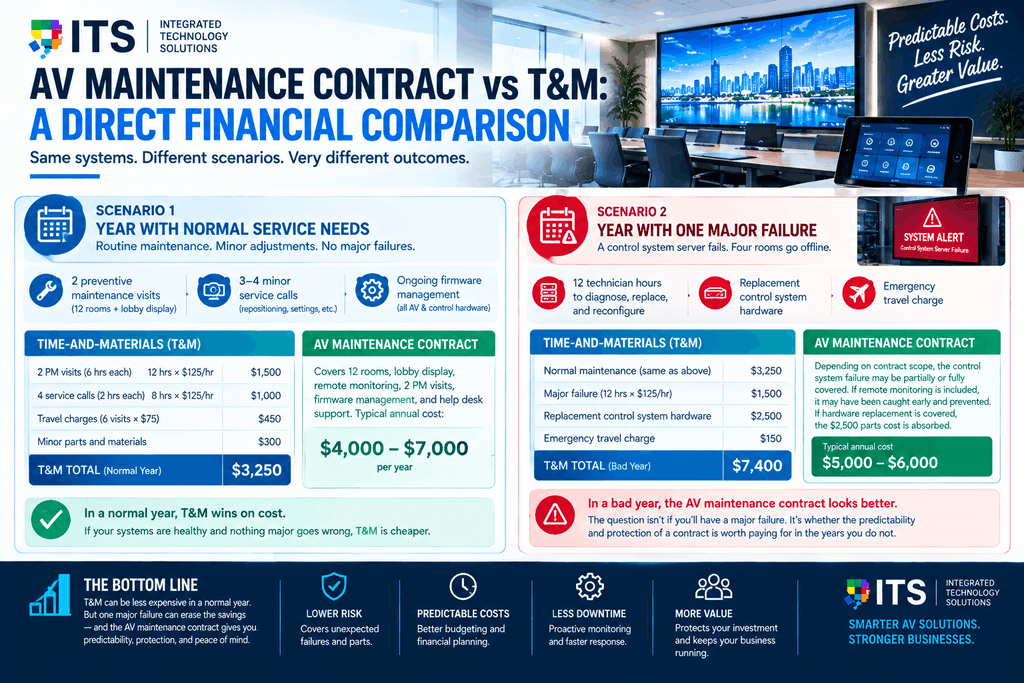
Let us put numbers to this comparison with a realistic example. Consider a mid-size Texas corporate office with 12 conference rooms, a lobby LED display, and a sound masking system. Here is how the annual support cost breaks down under each model.
Scenario: Year With Normal Service Needs
In a typical year with no major failures, this office might need:
• Two preventive maintenance visits covering all 12 rooms and the lobby display
• Three to four minor service calls for things like a camera that needs repositioning, a display that loses its room settings, or a control system that needs reconfiguration after a software update
• Ongoing firmware management for all AV and control hardware
Time-and-materials cost estimate:
Two PM visits at 6 hours each: 12 hours at $125/hr = $1,500
Four service calls at 2 hours each: 8 hours at $125/hr = $1,000
Travel charges for 6 visits at $75 each: $450
Minor parts and materials: $300
T&M total for a normal year: approximately $3,250
AV maintenance contract cost estimate:
A comprehensive AV maintenance contract covering 12 rooms, lobby display, remote monitoring, two PM visits, firmware management, and help desk support for a facility of this size would typically run $4,000 to $7,000 per year depending on system complexity and response time commitments.
In a normal year, T&M wins on cost. This is the honest answer that many AV maintenance contract comparisons skip. If your systems are healthy and nothing major goes wrong, T&M is cheaper.
Scenario: Year With One Major Failure
Now change one variable. A control system server fails mid-year, taking four conference rooms offline. Diagnosis, replacement hardware, and reconfiguration take 12 technician hours plus a replacement unit.
T&M cost estimate for the same year:
Normal maintenance: $3,250 (same as above)
Major failure: 12 hours at $125/hr = $1,500
Replacement control system hardware: $2,500
Emergency travel charge: $150
T&M total for a bad year: approximately $7,400
AV maintenance contract:
Depending on contract scope, the control system failure may be partially or fully covered. If the contract includes remote monitoring, the issue may have been caught early and prevented entirely. If hardware replacement is covered, the $2,500 parts cost is absorbed. The annual contract cost of $5,000 to $6,000 looks significantly better against a $7,400 T&M bill.
This is where the AV maintenance contract comparison shifts. The question is not whether you will have a major AV failure. You will, eventually. The question is whether the predictability and protection of a contract is worth paying for in the years you do not.
What Managed AV Services Commercial Programs Include
Beyond standard AV maintenance contracts, some organizations opt for fully managed AV services commercial programs. This is a more comprehensive engagement where the service provider takes on full operational responsibility for the AV environment.
Managed AV services commercial programs typically include everything in a standard AV maintenance contract plus:
• 24/7 remote monitoring: Round-the-clock visibility into every AV device across all locations. Alerts are responded to immediately, not on the next business day.
• Content management for digital signage: The managed services team handles digital signage content updates, scheduling, and platform management on behalf of the client.
• User support and end-user help desk: Employees can call or submit tickets for AV support. Issues are triaged and resolved remotely where possible.
• Technology refresh planning: The managed services provider tracks equipment age and performance to help the client plan and budget for AV refreshes before systems fail.
• Platform management: Ongoing management of video conferencing platform settings, room configurations, and integration with enterprise directories.
• Multi-site portfolio management: For organizations with AV systems at multiple locations, managed AV services commercial programs provide consistent support across the entire portfolio from a single provider.
Managed AV services commercial programs are priced higher than standard maintenance contracts because of the broader scope and higher level of commitment. But for organizations with large AV estates, multiple locations, or limited internal IT resources, they often represent the most cost-effective way to maintain AV performance across the portfolio.
Which Option Is Right for Your Organization?
There is no universal right answer between an AV maintenance contract and T&M. The correct choice depends on your specific environment, risk tolerance, and operational priorities. Here is a practical decision framework.
Choose T&M If:
• Your AV installation is new, high quality, and under manufacturer warranty for most components
• You have a small number of AV systems with low criticality to daily operations
• Your IT team is capable of handling basic AV troubleshooting and firmware updates internally
• AV failure would be an inconvenience but not a serious business impact
• Your AV usage is low-intensity and systems are not in constant daily use
Choose an AV Maintenance Contract If:
• Your AV systems are used heavily every day and downtime directly impacts business operations
• You have conference rooms used for client meetings where AV failure is embarrassing and costly
• You want predictable AV support costs that can be budgeted annually
• Guaranteed response times are important to your operations
• Your systems include aging equipment that is past its initial warranty period
• You want proactive monitoring rather than reactive break-fix support
Choose Managed AV Services Commercial If:
• You have AV systems at multiple locations that need consistent support
• Your internal IT team does not have AV expertise and should not be spending time on AV support
• You operate digital signage that needs regular content management
• 24/7 monitoring and support is required for your operational environment
• You want a single accountable partner for all AV support across your portfolio
How to Evaluate an AV Maintenance Contract Before Signing
Not all AV maintenance contracts are created equal. A poorly written contract with a weak provider is worse than T&M. Here is what to look for before committing.
Scope Clarity
Every item covered by the AV maintenance contract should be named explicitly. Vague language like ‘general AV maintenance’ creates disputes. Ask for a specific list of covered equipment, covered service types, and what is explicitly excluded. Hardware replacement costs are commonly excluded from maintenance contracts. Know that before you sign.
Response Time Commitments
The AV maintenance contract should define response times in writing. How long does the provider have to acknowledge a service request? How long before a technician is on site for a critical failure? For non-critical issues? Verbal commitments from sales conversations do not survive the relationship long-term. Get them in writing.
Escalation Procedures
What happens if the first response does not resolve the issue? An AV maintenance contract should define an escalation path that brings in more senior technical resources when needed. A contract that has no escalation procedure leaves you without recourse when a problem exceeds the first technician’s capability.
Reporting and Transparency
Ask what reporting the provider delivers under the AV maintenance contract. Monthly system health reports, incident logs, firmware version tracking, and maintenance visit summaries are all reasonable expectations. A provider who cannot or will not provide regular reporting is not managing your systems as a partner.
Contract Term and Exit Conditions
Understand how long the AV maintenance contract runs and what happens if you need to exit early. A one-year contract is lower risk than a three-year commitment. If you sign a multi-year contract, understand what fees or conditions apply if you need to terminate before the end of the term.
AV Maintenance for Different Commercial Environment Types
The right support model also depends on your environment type. Here is how the analysis plays out across common commercial settings.
Corporate Offices
Corporate offices with multiple conference rooms used daily for video conferencing are strong candidates for an AV maintenance contract. The cost of a failed conference room during a client presentation or executive meeting far exceeds any annual contract fee. Proactive monitoring and guaranteed response times are meaningful operational protections in this environment.
Healthcare Facilities
Healthcare AV systems, from patient communication displays to staff conference room AV, run on networks with strict security and compliance requirements. Firmware management is particularly important in healthcare because outdated AV device firmware can create security vulnerabilities on networks that handle protected health information. A comprehensive AV maintenance contract is strongly recommended for healthcare environments.
Retail and Hospitality
Retail and hospitality AV systems, particularly digital signage and background music systems, need to run reliably every day. A dark screen in a retail display or a silent restaurant kills the atmosphere that operators spend significant resources creating. An AV maintenance contract that ensures rapid response and regular preventive checks is a sound investment for high-visibility retail and hospitality environments.
Multi-Site Enterprises
Organizations with AV systems at multiple locations should almost always opt for a managed AV services commercial program rather than individual contracts or T&M at each site. The consistency, portfolio visibility, and single-point accountability that managed AV services commercial provides across a multi-location estate is nearly impossible to replicate with site-by-site T&M support.
Frequently Asked Questions: AV Maintenance Contract vs T&M
What does a typical AV maintenance contract cost per year?
Costs vary significantly by the number of rooms, system complexity, geographic location, and response time commitments. A basic AV maintenance contract covering a handful of conference rooms might run $2,000 to $4,000 per year. A comprehensive contract covering 20 or more rooms with remote monitoring and fast response guarantees could run $10,000 or more annually. Request a site-specific proposal for an accurate number.
Is T&M cheaper in the short term?
Often yes, particularly for newer systems in a trouble-free period. The cost advantage of T&M disappears quickly when a major failure occurs. Over a three-to-five year period, organizations with moderately complex AV systems typically find that AV maintenance contract costs are comparable to or lower than cumulative T&M costs when major failures are included.
Does an AV maintenance contract cover hardware replacement?
It depends on the contract. Many AV maintenance contracts cover labor for diagnosis and replacement but not the cost of the replacement hardware itself. Some premium contracts include hardware coverage for specific components. Read the contract scope carefully and ask specifically about hardware replacement before signing.
Can I mix T&M and contract support?
Yes. Many organizations use an AV maintenance contract for their most critical AV systems and T&M for lower-priority areas. A hybrid approach allows you to concentrate contract protection where system uptime matters most while keeping support costs lower in areas where downtime is less impactful.
Does ITS offer AV maintenance contracts?
Yes. ITS provides AV maintenance contracts and managed AV services commercial programs for commercial clients across Texas and nationwide. Our service programs include remote monitoring, preventive maintenance, firmware management, help desk support, and defined response times. Contact us to discuss a support program for your specific AV environment. Learn more about our commercial AV systems services.
For industry standards governing AV service delivery and support programs, AVIXA (InfoComm International) publishes standards and best practices for commercial AV service and support, including the ANSI/AVIXA standards for AV system performance and the CTS-I credential for installation professionals.
For broader context on IT and technology service management frameworks that apply to AV support programs, the ITIL service management framework provides widely adopted guidelines for service level agreements, incident management, and proactive maintenance practices that experienced AV maintenance contract providers apply to their commercial support programs.
Get the Right AV Support Program From ITS
The honest answer to the AV maintenance contract vs T&M question is: it depends. For light-use AV in newer systems, T&M is often fine. For business-critical conference rooms, multi-site AV estates, or any environment where downtime is genuinely costly, an AV maintenance contract or managed AV services commercial program almost always delivers better value over time.
The math becomes clearest over three to five years. When you include the reactive labor costs, parts premiums, emergency rates, and the real cost of downtime in the T&M column, and compare it to a proactive, monitored, guaranteed-response AV maintenance contract, the contract wins in most commercial environments.
ITS designs custom AV maintenance programs for commercial clients across Texas and nationwide. We align the scope, response times, and cost to your specific environment and risk tolerance. Explore how our commercial AV services and our full technology services portfolio can support your business.
Contact Integrated Technology Solutions today to discuss an AV maintenance contract for your commercial space. Call us at +1 888-985-5334 or visit our contact page to speak with our service team.
