
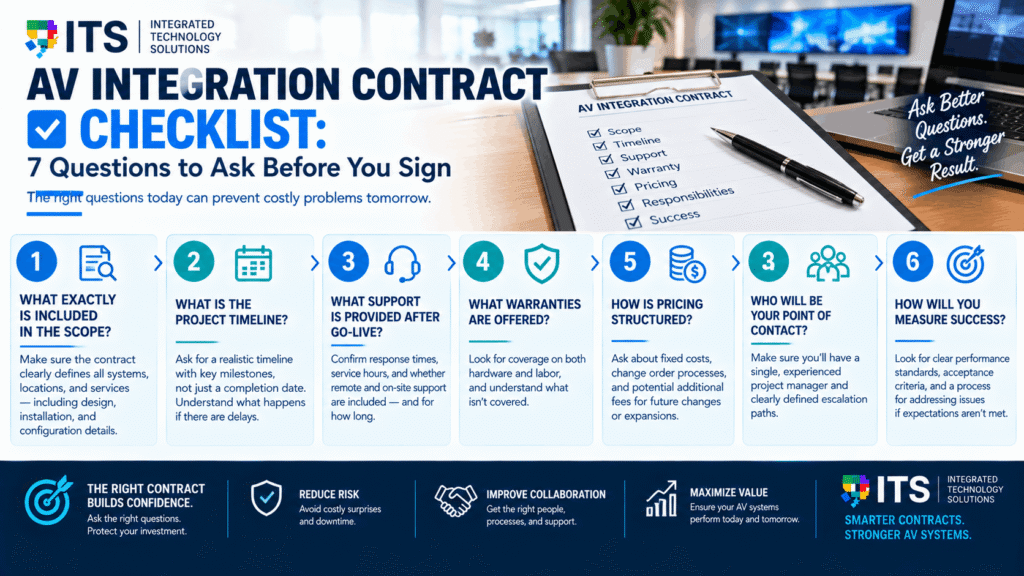
You found a contractor you like. You got a quote that fits your budget. Now there is one more step that matters more than people realize. Before you sign anything, run through a real AV integration contract checklist. The contract itself, not just the contractor, determines how smoothly your project goes.
This guide is different from a typical “how to choose a contractor” article. It is not about certifications or references, though those matter too. This is about the actual document you are about to sign. We will walk through seven specific questions every business should ask before they hire AV contractor services for a conference room, training center, or full office build-out.
Most businesses spend weeks comparing quotes and carefully researching contractors, then spend five quick minutes skimming the actual contract before signing it. That order of priorities is backwards. The contract is the document that governs your project if anything goes wrong, so it deserves at least as much attention as the quote itself.
Why You Need an AV Integration Contract Checklist
Most contract problems do not come from bad intentions. They come from assumptions that were never written down. A contractor assumes you already knew conduit work was not included in the price. You assumed it was. Nobody put it in writing, so now you are arguing about an invoice instead of enjoying your new system.
A clear AV integration contract checklist protects both sides. It turns vague expectations into specific, written terms. It gives you a document to point back to if something does not go as planned. And it forces a conversation before the work starts, which is always cheaper and far less stressful than a disagreement after the work is already done.
Question 1: Is the Scope of Work Clearly Defined?
This is the single most important item on any AV integration contract checklist. The scope of work should list every piece of equipment, every room, and every task included in the price. It should also state what is not included.
Vague scope language causes most disputes. A contract that says “install AV system in conference room” leaves too much open to interpretation. A strong contract says exactly which displays, speakers, control systems, and cabling are included, down to the model numbers where possible, along with which room or rooms the work covers.
Ask your contractor to walk through the scope line by line before you sign. If something sounds vague, ask them to rewrite it in plain, specific language. A good contractor will not mind. A vague scope benefits them, not you, if a dispute comes up later.
Pay close attention to infrastructure work too. Conduit, electrical, and network cabling often sit at the boundary between trades. Confirm in writing whether your AV contractor handles this work directly, subcontracts it, or expects you to arrange it separately through your general contractor or facilities team. This single detail causes more scheduling confusion than almost anything else in a typical AV build-out.
Question 2: What Are the Payment Terms?
Payment structure affects your cash flow and your leverage if something goes wrong. Most AV integration contracts use a milestone-based structure. You might pay a deposit to start, a progress payment partway through, and a final payment once the system passes testing.
Ask these specific questions about payment terms. What percentage is due upfront? What triggers each progress payment? Is the final payment tied to a successful test, or just to the installation being physically complete? A contract that collects full payment before testing removes your biggest point of leverage if problems show up during commissioning.
Question 3: How Are Change Orders Handled?
Projects change. A client requests an extra display. A wall turns out to need different conduit than expected. These changes are normal, but they need a clear process, not a verbal agreement in the hallway.
A solid AV integration contract checklist includes a change order clause that requires written approval before any extra work begins. This clause should state who can approve a change, how pricing gets calculated, and how the change affects your timeline. Never allow work to proceed on a verbal “just go ahead and do it.” Get it in writing, even if it is a quick email, before the work happens.
Without this clause, you risk a final invoice full of surprise charges for work you never formally approved. With it, you keep full control over your budget from start to finish.
Question 4: What Warranty Coverage Is Included?
Warranty terms vary more than most clients expect. Some contracts cover labor only. Others cover both labor and equipment for a set period. Still others leave equipment warranty entirely to the manufacturer, with no extra coverage from the installer.
Ask exactly what the warranty covers, how long it lasts, and what voids it. Also ask whether the warranty covers a full system failure or only individual components. A projector that fails under warranty does you little good if the mounting hardware or cabling connecting it is not covered under the same terms.
Question 5: Who Carries Liability and Insurance?
This question gets skipped more than any other on an AV integration contract checklist, and it is one of the most important. Ask your contractor to confirm they carry general liability insurance and workers’ compensation coverage, and ask for a certificate of insurance before work begins, not after.
If a technician damages your building during installation, or gets injured on your property, proper insurance determines who is financially responsible. A contractor without current coverage can leave your business exposed to costs that have nothing to do with the AV system itself.
Question 6: What Is the Completion Timeline, and What Happens If It Slips?
A contract without dates is not much of a contract. Ask for a specific start date, a specific completion date, and clear language about what happens if either one slips.
Timeline delays are rarely malicious. Equipment shipments get delayed. Weather pushes back a site visit. Permits take longer than expected. None of this is unusual. What matters is whether your contract addresses these realities in advance, rather than leaving you to negotiate a new timeline from scratch every time something shifts.
Some contracts include a penalty clause for missed deadlines. Others simply state a target date with no consequence attached. Either approach can work, but you should know which one you are signing before your project starts, not after a deadline has already passed. If your business has a hard deadline, like an event date or a lease start date, make sure the contract reflects that urgency directly.
Question 7: What Support Comes After Installation?
The relationship should not end the moment the installer packs up their tools. Ask what happens if something breaks a week after handoff, a month after, or a year after. Is there a included warranty period for labor? Is ongoing support available, and at what cost?
Some AV integration contracts include a short post-installation support window at no extra charge. Others treat every future visit as a brand new service call. Neither approach is wrong, but you should know which one applies before you need support, not when you are already dealing with a problem.
If your business depends heavily on your AV systems day to day, ask whether a maintenance agreement makes more sense than relying on one-off support calls after installation. The right answer depends on how often you use the system and how much downtime actually costs your business if something fails.
Red Flags to Watch For in an AV Integration Contract
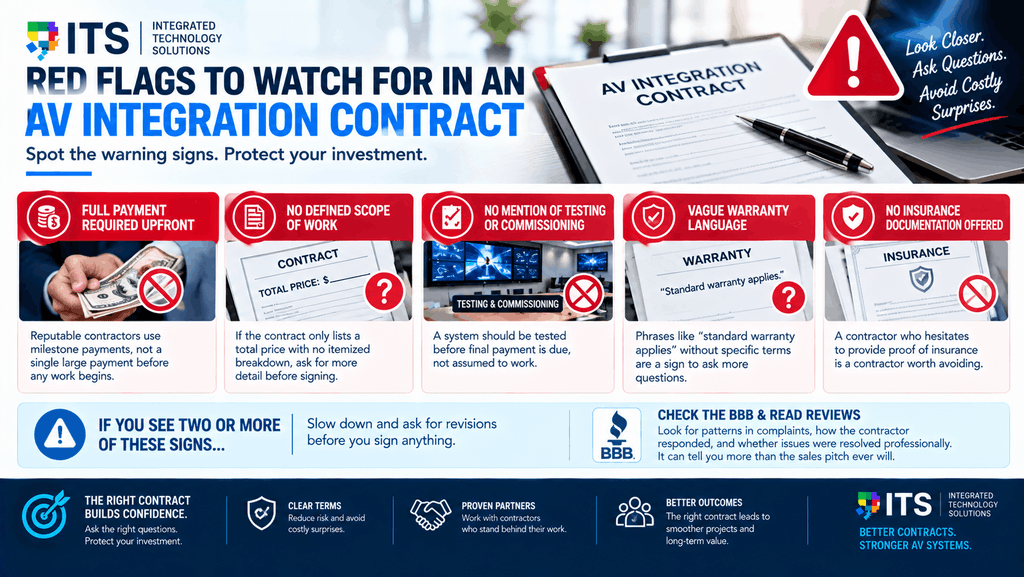
A few warning signs suggest a contract needs more scrutiny before you decide to sign anything at all.
- Full payment required upfront. Reputable contractors use milestone payments, not a single large payment before any work begins.
- No defined scope of work. If the contract only lists a total price with no itemized breakdown, ask for more detail before signing.
- No mention of testing or commissioning. A system should be tested before final payment is due, not assumed to work.
- Vague warranty language. Phrases like “standard warranty applies” without specific terms are a sign to ask more questions.
- No insurance documentation offered. A contractor who hesitates to provide proof of insurance is a contractor worth avoiding.
If you notice two or more of these signs, slow down and ask for revisions before you sign anything.
Organizations like the Better Business Bureau also maintain contractor reviews and complaint histories that can help you spot a pattern of problems before you sign. A single negative review is not necessarily a dealbreaker, but a consistent pattern around missed deadlines, unclear pricing, or unresponsive support after the sale is worth taking seriously.
It is also worth checking how a contractor responded to past complaints, not just whether complaints exist. A business that resolved issues professionally and promptly shows a different character than one that ignored or disputed every concern raised against them. This pattern often tells you more about how your own project will be handled than the sales pitch ever will.
Common Contract Mistakes Businesses Make
Even careful buyers fall into a few predictable traps. Knowing them ahead of time helps you avoid repeating them.
Assuming verbal promises carry the same weight as written terms. A salesperson’s friendly assurance means nothing once a dispute reaches the contract. If something was promised, make sure it appears in writing before you sign.
Signing under time pressure. Some contractors push for a signature by offering a limited-time discount. A legitimate business does not need to rush you into a decision this significant. Take the time you need, even if it means losing a small discount.
Not reading exclusions closely. Contracts often list what is excluded in smaller print than the included scope. Read this section as carefully as the scope of work itself, since it tells you what you will still need to budget for separately.
Forgetting to confirm who owns the documentation. Ask who keeps the as-built drawings, test results, and equipment manuals after the project wraps up. You want copies of all of it, not just verbal confirmation that it exists somewhere.
Frequently Asked Questions About AV Integration Contracts
Do I need a lawyer to review an AV integration contract? For smaller projects, most businesses can review the contract themselves using a checklist like this one. For larger investments, especially multi-room or multi-site projects, a quick legal review is a reasonable extra step.
Can I negotiate contract terms, or are they fixed? Most terms are negotiable, especially payment milestones and warranty length. A contractor who refuses to discuss any part of the contract is worth a second look before you commit.
What happens if I need to cancel the project after signing? Ask about cancellation terms before you sign, not after you need them. A fair contract explains what portion of any deposit is refundable and under what conditions.
How long should a typical AV integration contract warranty last? This varies by project size and equipment type, but one year on labor is a common baseline. Always confirm equipment warranty terms separately, since manufacturers often set their own coverage periods independent of the installer’s labor warranty.
How to Use This AV Integration Contract Checklist
Print this list or save it before your next contract review. Go through each of the seven questions with your contractor directly, not just with yourself. A contractor who answers clearly and without hesitation is showing you how they will handle communication throughout the project. A contractor who gets defensive or vague is showing you that too.
It also helps to have a second set of eyes review the contract, especially for larger projects. A colleague, a facilities manager, or even outside counsel for a significant investment can catch language you might read past on your own.
This same discipline applies to the cabling and low voltage infrastructure that often accompanies an AV project. Our guide on what to look for in a structured cabling contractor covers similar contract and scope questions specific to cabling work, which pairs well with this checklist if your project includes both AV and network infrastructure.
What to Do Before You Hire AV Contractor Services
Before you even get to the contract stage, a little preparation makes the whole process smoother. Walk your own space and write down what you actually need, room by room. Set a realistic budget range before you start requesting quotes. Ask every contractor you are considering the same seven questions from this checklist, so you can compare answers side by side instead of comparing vague impressions.
When you hire AV contractor services without asking these questions, you are trusting a stranger with your budget and your timeline based on hope rather than facts. A few extra questions upfront, backed by a written contract that reflects the answers, protects you for the life of the project and beyond.
If you are also evaluating contractors on experience and certification, not just contract terms, our guide on choosing an AV contractor in greater Houston covers that side of the decision in more depth.
Why Work With Integrated Technology Solutions
Integrated Technology Solutions writes every contract with a clear, itemized scope of work, transparent payment milestones, and a documented change order process built in from the start. We carry full liability insurance and provide documentation before any work begins, not after you ask twice. Our commercial audio visual systems installations include defined warranty terms in writing, so you know exactly what is covered before you sign anything.
We also believe support should not end at handoff. Our approach to managed AV services means clients know exactly what post-installation coverage looks like, whether that is a maintenance contract or a clear time-and-materials rate for occasional support. Following standards set by groups like AVIXA and the National Systems Contractors Association, our contracts reflect industry best practices, not just internal preference.
Final Thoughts on Your AV Integration Contract Checklist
A strong AV integration contract checklist protects your budget, your timeline, and your relationship with the contractor you hire. Scope of work, payment terms, change orders, warranty, insurance, timeline, and post-installation support: these seven questions cover the areas where most project disputes actually begin, long before anyone picks up a tool.
Before you hire AV contractor services for your next project, take the time to ask these questions and get the answers in writing. It takes an extra hour upfront and can save you weeks of frustration later, especially once equipment is already on order and a crew is already on your calendar.
Ready to see what a transparent AV integration contract looks like? Contact Integrated Technology Solutions today, and we will walk you through our process, our scope of work, and our contract terms before you ever have to sign anything. We would rather answer every question on this checklist upfront than leave you guessing once the work has already started.
