
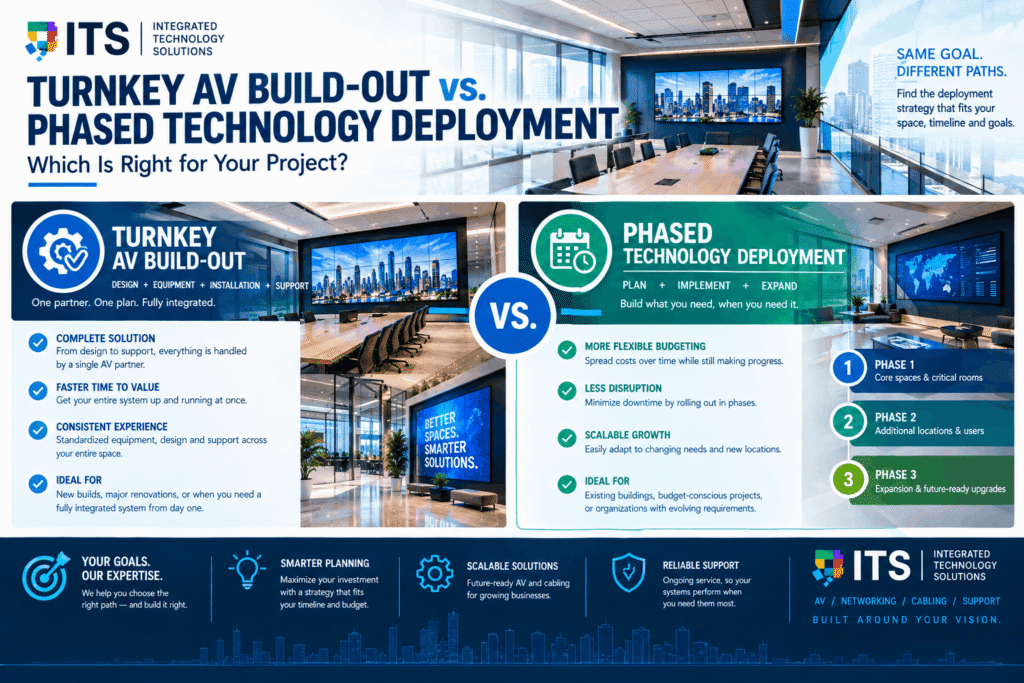
When you start planning a commercial technology project, one of the first strategic decisions you face has nothing to do with hardware or software. It has to do with how the project gets delivered.
Do you want everything designed, installed, and commissioned at once? Or do you build out your technology infrastructure in stages, prioritizing what you need now and adding capabilities over time?
This is the turnkey AV build-out versus phased technology deployment question. Both approaches work. Both have real advantages. Choosing the wrong one for your situation can cost you time, money, or both.
This guide breaks down exactly what each approach means, what drives the decision, and how to think through the choice for your specific project. Whether you are fitting out a new office, upgrading an existing facility, or rolling out technology across multiple locations, this framework applies.
What Is a Turnkey AV Build-Out?
A turnkey AV build-out is a complete, single-scope delivery. One contractor designs and installs all technology systems across a facility or project in one coordinated effort. When the work is done, the client receives a fully operational environment. Everything is working from day one.
The term “turnkey” reflects the intent: you turn the key, and it works. You do not inherit a partially finished project or a punchlist of systems still to come. The full scope is delivered, tested, commissioned, and handed over together.
A turnkey AV build-out typically covers the full low voltage scope of a commercial space:
• Commercial AV systems — conference rooms, lobbies, collaboration spaces, digital signage
• Structured network cabling — horizontal cabling, fiber backbone, MDF and IDF build-out
• Managed wireless — enterprise Wi-Fi design, access point installation, network validation
• Security and access control — cameras, card readers, intercom, alarm integration
• Data center infrastructure — rack integration, cabling, environmental monitoring
All of these systems are designed together, installed together, and commissioned together under a single contract. The result is a fully integrated environment where every system has been planned to work alongside the others from the start.
What Is a Phased Technology Deployment?
A phased technology deployment breaks the same scope into sequential stages delivered over time. Phase one might cover foundational infrastructure. Phase two adds core AV systems. Phase three completes advanced capabilities, specialized rooms, or expanded locations.
Each phase is a complete, functional deliverable on its own. The space is usable after each phase, even if it is not fully built out. The client gains capability incrementally and spreads cost, disruption, and decision-making across the project timeline.
Phased technology deployment does not mean lower quality or incomplete planning. A well-executed phased program is fully designed upfront — the phasing is a delivery strategy, not a planning shortcut. Systems installed in phase one are specified knowing what phases two and three will add, so the infrastructure supports future expansion without rework.
The Core Tradeoffs: Turnkey AV Build-Out vs. Phased Technology Deployment
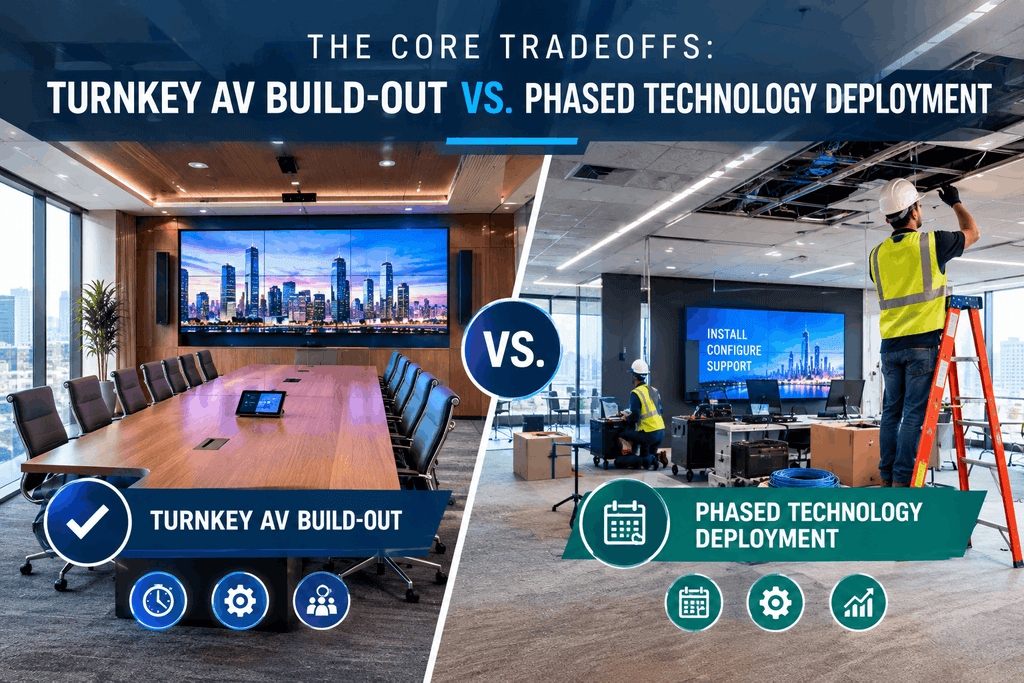
Both approaches are legitimate. The right choice depends on your project conditions, not on which one sounds better in the abstract. Here are the key dimensions where the two approaches differ.
Budget: Upfront Commitment vs. Staged Investment
A turnkey AV build-out requires committing the full project budget before work begins. That budget is locked in at design time, which is both a risk and a benefit. You know the total cost. You avoid the price volatility that can affect phased projects when costs change between phases. But you need the full capital available at the start.
A phased technology deployment spreads capital expenditure over time. Phase one is a smaller commitment. Phase two comes later, when you have had time to evaluate phase one performance, refine requirements, and potentially access budget that was not available at the outset. For organizations with constrained capital budgets or uncertain future requirements, phasing creates real financial flexibility.
The caveat: phased programs often cost more in total than a comparable turnkey AV build-out. Mobilization costs are incurred multiple times. Design updates between phases add fees. If infrastructure has to be revisited because phase one did not fully anticipate phase two, there is rework cost. If budget control is the primary driver, model the total cost of a phased program honestly before committing to it as a cost-saving strategy.
Timeline: Single Delivery vs. Staged Handoff
A turnkey AV build-out has a single completion date. There is one final walkthrough, one commissioning event, one project closeout. Everything goes live at once. This is the right approach when the client has a fixed occupancy date, a grand opening, or an operational deadline that requires full functionality from day one.
A phased technology deployment means living with an incomplete environment between phases. Conference rooms in phase two are not available until phase two is done. Security systems in phase three are not operational until the third mobilization. For organizations that can tolerate incremental completion and do not have a hard deadline requiring full functionality, phasing gives more scheduling flexibility.
Phasing also creates natural opportunities to pause between phases. If the business changes direction, if a lease is restructured, or if priorities shift, a phased program can be adjusted before the next phase begins. A turnkey build-out does not have those natural pause points.
Disruption: One Concentrated Period vs. Multiple Disruptions
This is where the turnkey AV build-out versus phased technology deployment question becomes most visible for the people working in the space. Construction and installation work is disruptive. Noise, dust, contractors moving through the building, systems temporarily offline — all of this affects the people using the facility.
A turnkey build-out concentrates all of that disruption into one period. It may be intense, but it ends. After it is over, the environment is stable and the technology is complete.
A phased program distributes disruption across multiple mobilizations over months or years. Each phase is less disruptive than a full build-out, but the disruptions keep coming. For organizations where operational continuity is critical and repeated construction presence is difficult to manage, the concentrated disruption of a turnkey program can actually be the less painful option.
For organizations that genuinely cannot absorb a full build-out disruption — healthcare facilities, 24/7 operations, occupied buildings with very limited access windows — phased deployment with careful scheduling often makes more practical sense.
Integration Quality: Designed Together vs. Built in Stages
A turnkey AV build-out produces a fully integrated environment because every system is designed and installed with full knowledge of every other system. The cabling infrastructure supports the AV systems that will be installed on it. The network is provisioned for the wireless design, the access control system, and the AV devices simultaneously. Everything fits together because everything was planned together.
In a phased technology deployment, integration quality depends on how well phase one anticipates the requirements of phases two and three. A poorly planned phased program installs phase one infrastructure that is inadequate for phase two systems, resulting in expensive rework. A well-planned phased program specifies phase one with full knowledge of future phases, even though those systems are not being installed yet.
This is where experienced program management matters most in a phased deployment. The design that governs phase one must account for the total program. A contractor who only designs phase one in isolation is setting up the client for rework costs.
Vendor and Coordination Risk
A turnkey AV build-out concentrates coordination with a single contractor managing the full scope. There is one project manager, one contract, one accountability relationship. If something goes wrong, there is no ambiguity about who is responsible.
A phased technology deployment introduces the possibility of changes in the contracting relationship between phases. The original contractor may not be available for phase two. Pricing may have changed. Key project staff may have moved on. The institutional knowledge of the phase one design may not transfer cleanly to a new team doing phase two.
If you are planning a phased program, consider structuring the contract to include options on future phases at the time of phase one engagement. This locks in the contractor relationship and protects against knowledge loss between phases. It also gives the contractor an incentive to do phase one in a way that sets phase two up for success.
When a Turnkey AV Build-Out Is the Right Choice
A turnkey AV build-out is the better choice when most of these conditions apply:
• Fixed move-in or occupancy deadline. A new lease, a building handover date, or a planned opening that requires full technology functionality on a specific day. Phasing is not compatible with a hard deadline requiring everything operational at once.
• New construction or full renovation. When the building is not occupied and construction access is unrestricted, there is no operational disruption argument for phasing. A turnkey build-out is more efficient and produces a better integrated result.
• Full budget available. When the capital for the complete project scope has been approved and allocated, a turnkey AV build-out delivers better value through a single mobilization, unified design, and complete integration at handoff.
• High integration requirements. When AV systems, cabling, wireless, security, and data center infrastructure need to work together tightly from day one, designing and building everything together produces better results than staged delivery.
• Single facility. For a single location build-out, the coordination complexity of phasing rarely adds value. The turnkey approach is simpler to manage and produces a cleaner project.
When Phased Technology Deployment Is the Right Choice
A phased technology deployment is the better choice when most of these conditions apply:
• Budget is constrained or staged. When capital is not available for the full scope upfront, or when budget approval cycles mean funds are released in tranches, phasing matches the delivery model to the financial reality.
• The space will be occupied throughout. When the facility is operational and cannot absorb full build-out disruption, phasing with planned access windows reduces the operational impact of each mobilization.
• Requirements are still evolving. When the organization is growing, changing its space planning, or still finalizing how certain areas will be used, phasing allows the design to incorporate real operational experience before committing to later phases.
• Multi-location rollout. For a program deploying technology across many sites over an extended period, phased technology deployment is the natural model. Each location or group of locations is a phase. The design is standardized; the execution is staged.
• Prioritization is clear. When some systems are genuinely more urgent than others, phasing lets you deliver what the business needs now without waiting for the full program to complete.
The Hybrid Approach: Turnkey Infrastructure, Phased Systems
Many commercial technology projects benefit from a hybrid that borrows from both models. The infrastructure layer — structured cabling, fiber backbone, conduit pathways, power circuits, equipment rooms — is delivered turnkey during the initial construction phase. The systems layer — AV, security, wireless, digital signage — is added in phases as areas are occupied and budgets are released.
This hybrid approach works well because infrastructure is far more disruptive to install after the fact than during construction. Running conduit through a finished ceiling or pulling cable through occupied walls is expensive, time-consuming, and disruptive. Installing that same infrastructure during construction is straightforward.
Systems, by contrast, are much more tolerant of phased installation. Adding conference room AV to a space that already has cabling, conduit, and power in place is a relatively clean operation. The infrastructure is there. The system drops in.
This is the approach ITS commonly recommends for clients who need budget flexibility but cannot afford the rework cost of under-specified phase one infrastructure. Install the structured cabling and low voltage infrastructure fully during construction. Phase the commercial AV systems, managed wireless, and security systems as budget and operational readiness allows.
Planning Questions That Determine the Right Approach
If you are working through the turnkey AV build-out versus phased technology deployment decision for a specific project, these questions will sharpen the answer.
What is the occupancy date, and is it fixed?
If there is a fixed date by which the space must be fully functional, that largely determines the approach. A hard occupancy deadline with a full technology requirement points toward a turnkey AV build-out. A soft timeline with flexibility around when systems come online creates room for phasing.
What is the current state of the space?
New construction and full renovation projects favor turnkey delivery. Occupied facilities being upgraded favor phased deployment. The disruption management question is answered largely by whether the space is empty or in use during the project.
What does the budget approval process look like?
If capital for the full project scope has been approved in one budget cycle, a turnkey AV build-out is the cleaner financial model. If budget must be requested in stages, or if the organization typically approves capital in annual cycles, phasing aligns the project delivery to the financial process.
How certain are the requirements?
When requirements are well-defined, a turnkey build-out captures them efficiently. When requirements are still forming — a growing team, an evolving space plan, a business that is not yet certain how it will use the space — phasing lets you incorporate real operational experience before committing to systems that may need to change.
Are there multiple locations?
Multi-location programs are almost always phased by definition. The question becomes how the phases are structured — by location, by system type, or by priority tier. Our nationwide AV rollout process guide covers how multi-site programs are structured and managed across all 50 states.
Who will manage the program between phases?
A phased technology deployment requires active program management to maintain continuity between phases. Someone needs to own the design documentation, track phase one performance, manage vendor relationships, and maintain the phase two and three plans as living documents. If that capacity does not exist internally, it needs to be built into the contractor relationship.
How ITS Approaches Both Models
ITS delivers both turnkey AV build-outs and phased technology deployment programs for commercial clients in Texas and nationwide. Our technology build-out services cover the full low voltage scope — AV, cabling, fiber, wireless, security, and data center infrastructure — under a single contract regardless of delivery model.
For turnkey programs, our approach is to design the complete scope before any hardware is specified. We do not recommend products before we understand the space, the requirements, and how every system will interact with every other system. The design comes first. The hardware follows the design.
For phased technology deployment programs, our approach is to design the total program scope upfront and then sequence delivery against the client’s budget, operational, and timeline constraints. Phase one infrastructure is specified with full knowledge of phase two and three requirements. We do not design phase one in isolation.
We also structure phased program contracts to include options on future phases, so clients have budget certainty and contractor continuity across the full program rather than having to re-bid each phase independently.
For clients evaluating a new commercial technology project, ITS provides program assessments and design consultations as part of the project development process. Reach us at +1 888-985-5334 or visit our contact page.
For organizations evaluating technology build-out approaches, BICSI’s TDMM (Telecommunications Distribution Methods Manual) provides industry-standard guidance on infrastructure planning for commercial technology deployments. AVIXA’s Standards Program covers AV system design standards that apply regardless of whether a project is delivered turnkey or in phases.
Frequently Asked Questions: Turnkey AV Build-Out vs. Phased Technology Deployment
Is a turnkey AV build-out always more expensive than a phased program?
Not necessarily, and often the opposite is true. A turnkey AV build-out incurs mobilization costs once. A phased technology deployment incurs them multiple times. If the total program scope is the same, phasing typically adds cost rather than reducing it. Phasing can be financially advantageous when it allows you to defer capital expenditure, access better pricing in a future budget cycle, or reduce the scope of later phases based on phase one experience.
Can you switch from a phased approach to turnkey midway through a project?
Yes, if the infrastructure designed in phase one supports the full scope. If phase one was designed comprehensively, adding phase two and three systems on an accelerated timeline is straightforward. If phase one was under-specified, accelerating to a turnkey completion may require infrastructure rework first.
How do you prevent phase one from being incompatible with phase two?
The answer is comprehensive upfront design. Phase one infrastructure should be specified against the complete program scope, not just the phase one deliverables. This requires a contractor who will design the full program at the outset. If your contractor is only designing phase one, ask them how they are accounting for future phases in the infrastructure they are installing now.
Does ITS offer maintenance and support for phased programs between delivery phases?
Yes. ITS provides AV maintenance contracts and support agreements for systems that are operational while later phases are being planned and delivered. Phase one systems do not go unsupported while phase two is in development.
What is the typical timeline for a turnkey AV build-out for a mid-size commercial office?
A mid-size commercial office of 20,000 to 50,000 square feet with a full technology scope typically runs 8 to 16 weeks from design completion to commissioning, depending on hardware lead times, building access, and the complexity of the AV and cabling scope. Design and procurement typically precede installation by 4 to 8 weeks. A realistic total project timeline from initial engagement to operational handover is 16 to 24 weeks for a project of this size.
Making the Decision: A Simple Framework
If you are still weighing the two approaches, here is a practical framework for making the call.
Choose a turnkey AV build-out if:
• The space is new or vacant during construction
• There is a fixed occupancy or go-live date requiring full functionality
• The full project budget has been approved
• Requirements are well-defined and stable
• Deep system integration matters from day one
Choose a phased technology deployment if:
• The space is occupied and operational disruption must be managed carefully
• Budget is staged or uncertain beyond the near term
• Requirements are still forming or the organization is growing into the space
• The program spans multiple locations over an extended timeline
• Flexibility to adjust scope between phases has genuine business value
Consider the hybrid model if:
• Construction access is available now but systems budget is staged
• You want the integration quality of turnkey infrastructure without committing the full systems budget upfront
• You cannot afford to rework infrastructure later but can tolerate phased system delivery
Both a turnkey AV build-out and a phased technology deployment can deliver excellent results. The difference is in how well the delivery model fits the specific constraints and priorities of your project.
Contact Integrated Technology Solutions to talk through the right approach for your project. Call +1 888-985-5334 or reach out through our contact page to speak with our team.
