
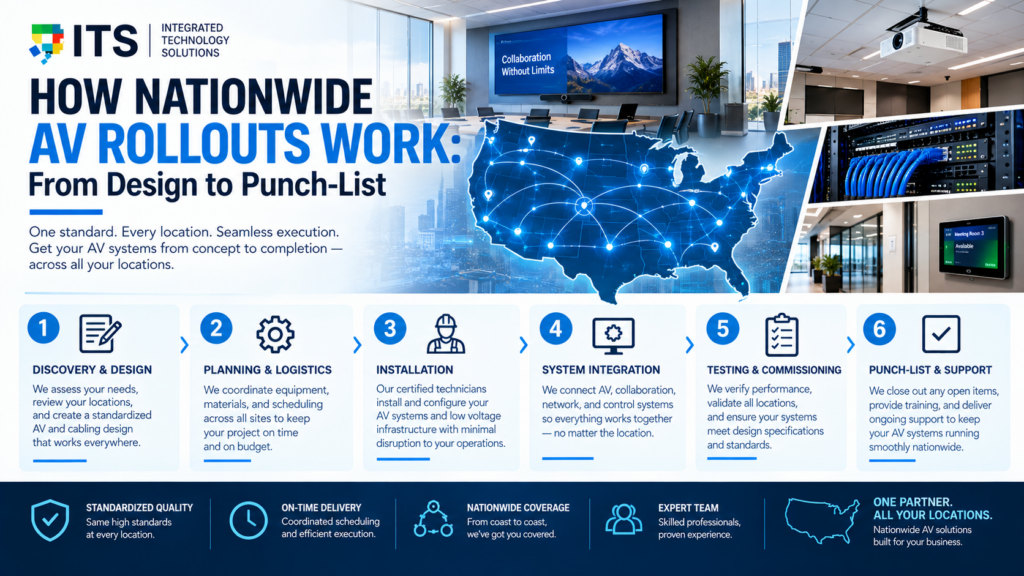
Deploying AV systems across dozens or hundreds of locations is one of the most complex technology programs an enterprise organization can take on. A nationwide AV rollout process touches every part of a business: IT, facilities, operations, procurement, and executive leadership all have a stake in the outcome.
When it works well, a nationwide AV rollout delivers consistent, high-quality technology across every location, on schedule, within budget, with documentation that allows ongoing management long after the integrator has left. When it fails, the organization ends up with inconsistent systems, missed timelines, budget overruns, and locations that need expensive remediation.
The difference between success and failure almost always comes down to process. This guide walks through the nationwide AV rollout process from the first design conversation to the final punch-list sign-off. It explains how multi-site AV project management works at every stage, what the common failure points are, and what questions to ask any integrator before signing a nationwide contract.
Why a Nationwide AV Rollout Is Different From a Single-Site Project
Scaling from one site to fifty or five hundred is not simply a matter of doing the same thing more times. The challenges that are manageable at a single location become serious program risks when multiplied across a national portfolio.
• Consistency: A standard design that works beautifully in one building may encounter site-specific obstacles at others. Every room is different. Every building has different ceiling heights, different HVAC configurations, and different structural constraints.
• Coordination: A nationwide AV rollout process involves dozens of concurrent workstreams. Hardware procurement, local permitting, scheduling, general contractor coordination, and IT network provisioning must all happen in the right sequence at every site.
• Labor: Finding qualified, BICSI certified technicians in every market is not trivial. The quality of field technicians varies significantly by region. The integrator’s ability to staff qualified crews consistently across the country is a major differentiator.
• Hardware supply chain: Procuring identical hardware for hundreds of rooms requires advance planning and warehouse staging. Lead times for AV equipment can extend weeks or months. A delayed shipment to one city can cascade into scheduling disruptions across the program.
• Communication: The client organization must communicate effectively with dozens of local facility managers, landlords, and IT teams across different time zones. Without a structured communication framework, critical information gets lost.
Phase 1: Program Discovery and Standard Design
Every successful nationwide AV rollout process begins with a discovery phase that defines the standard before any site is touched. This phase is the highest-leverage investment in the entire program. Every hour spent here saves multiples during execution.
Portfolio Assessment
The integrator works with the client to understand the full scope of the rollout. How many locations are in scope? What is the mix of room types? How do existing systems vary across the portfolio? What is the target completion timeline? What is the overall program budget?
This assessment also identifies which locations are highest priority and whether phasing is appropriate. A nationwide AV rollout process that tries to deploy everywhere simultaneously is almost always more difficult than a phased approach that builds on early site learnings.
Platform and Technology Selection
Before any room can be designed, the technology platform must be selected. What video conferencing platform will the organization standardize on? What control system approach will be used? What display technology is specified for each room type?
These decisions drive everything that follows. A nationwide AV rollout process built around Microsoft Teams Rooms looks different from one built around Zoom Rooms. The hardware families, configuration approaches, and support requirements differ. Getting these platform decisions right before designing a single room is essential.
Room Type Standardization
Most enterprise multi-site AV project management programs define a small number of standard room types. A typical enterprise might have four to six: a small huddle room, a medium conference room, a large conference room, a boardroom, a training room, and a lobby display configuration.
Each room type gets a standard AV design: specific hardware models, specific mounting positions, specific cable types and quantities, specific configuration settings. Standardization is what makes a nationwide AV rollout process executable. Without it, every room becomes a custom project.
Pilot Site Design and Validation
The standard designs are validated at a pilot site before the full rollout begins. The pilot site is where assumptions get tested against reality. Does the standard large conference room design work in a room with a 9-foot ceiling instead of the 10-foot assumed in the design? Does the camera positioning work from all typical seating positions? Does the control system configuration work correctly with the client’s Teams tenant?
A thorough pilot site validation identifies issues that can be corrected in the standard design before they are replicated across hundreds of rooms. Skipping or rushing the pilot is the single most common cause of quality problems in a nationwide AV rollout.
Phase 2: Site Survey and Pre-Installation Assessment
Before any hardware is ordered for a specific location, that location must be surveyed. This is a non-negotiable step in any responsible nationwide AV rollout process. A design that was not validated against the actual site conditions will encounter problems during installation.
What a Site Survey Covers
A qualified survey technician visits the site and documents everything that affects the standard design:
• Room dimensions: Exact measurements of every room in scope, including ceiling height, window placement, and door locations.
• Ceiling type and accessibility: Open plenum, suspended grid, drywall, or specialty ceiling. Each affects how cables are routed and how devices are mounted.
• Existing cabling infrastructure: What is already installed? Is it usable? Does the standard design require new cable runs or can existing infrastructure be leveraged?
• Power availability: Where are existing outlets? Does the standard design require additional power circuits?
• Network connectivity: Is network access available in each room? What VLANs are provisioned? Is PoE switching available nearby?
• Structural constraints: Are there beams, pipes, or other structural elements that affect display mounting or cable routing?
• Site access and scheduling: What are the building access requirements? Are there occupied hours restrictions? Is a landlord escort required for above-ceiling work?
Site-Specific Deviation Management
The site survey frequently identifies locations where the standard design requires modification. A column blocks the standard display mounting position. A room is 15 percent smaller than the smallest standard room type. A ceiling is four inches lower than the design assumed.
Multi-site AV project management requires a clear deviation process. Deviations are documented, reviewed by the design team, and resolved with a site-specific modification to the standard design. The modification is approved before hardware is ordered and before the installation team arrives. This prevents improvised decisions on site that create inconsistent results.
Phase 3: Hardware Procurement and Logistics
Hardware procurement is one of the highest-risk phases of a nationwide AV rollout process. Lead times for AV equipment can extend four to twelve weeks or longer for some categories. A delayed shipment to one location cascades into schedule disruption that affects every subsequent site in the program.
Bulk Procurement and Warehouse Staging
Experienced nationwide AV rollout teams purchase hardware in bulk rather than site by site. Bulk purchasing locks in pricing, reduces per-unit cost, and ensures that all sites receive identical hardware from the same production runs. Hardware is received at a central warehouse or regional staging facility, inventoried, and staged for shipment to each site on the appropriate installation date.
Pre-staging at a warehouse also allows hardware to be tested before it reaches the site. Control systems can be pre-configured. Hardware can be verified against the bill of materials for each location. Defective units can be identified and replaced before they cause installation delays.
Supply Chain Risk Management
Multi-site AV project management requires proactive supply chain management. This means identifying long-lead items early, placing orders before they are needed, maintaining a buffer stock of high-failure items, and having pre-approved substitute models for hardware that becomes unavailable mid-program. An integrator who does not have established supply chain practices is a risk on any large nationwide AV rollout.
Phase 4: Pre-Installation and Site Readiness
A nationwide AV rollout process that sends installation crews to sites that are not ready wastes time and money. Site readiness verification is a required step before any installation team is scheduled.
Site Readiness Checklist
Before installation begins, each site must confirm:
• Building access approved and escort arrangements confirmed
• Network provisioning complete and VLAN access confirmed for AV devices
• Power circuits installed at locations specified by the site survey
• Any structural work completed (blocking in walls for mounts, conduit installation)
• Hardware confirmed delivered and received at the site or staging facility
• Local facility contact confirmed and available on installation day
• Any permits required have been obtained
Sites that fail readiness verification are held from the installation schedule until all conditions are met. This discipline prevents installation crews from arriving at sites that will not support productive work.
Phase 5: Installation Execution
The installation phase is where the nationwide AV rollout process becomes physically visible. Crews arrive on site, hardware is mounted, cables are run, systems are connected, and software is configured. This is also where the quality of planning either pays off or fails.
Standardized Installation Packages
Each installation crew should arrive with a complete installation package for their specific site. This includes the site survey documentation, the standard design drawings with any approved deviations noted, the bill of materials for that location, configuration parameters for all AV and control hardware, and the testing protocol they will follow after installation.
When crews have everything they need before they arrive, installations are faster, more consistent, and require fewer judgment calls that introduce variability across the program.
Field Technician Quality Standards
One of the most important decisions in a nationwide AV rollout is which technicians will perform the work in each market. Not all contractors have BICSI certified technicians. Not all technicians have experience with the specific platforms being deployed. Variability in field technician quality is one of the leading causes of inconsistent results across a nationwide rollout.
ITS uses BICSI certified technicians on every project and manages quality standards consistently across all markets we serve. Our nationwide deployment capability is built on a vetted network of certified field technicians who follow the same installation standards regardless of location.
Real-Time Program Communication
Multi-site AV project management requires real-time visibility into installation status across the program. The project management team needs to know each day which sites are in progress, which have completed installation, which are awaiting network provisioning, and which have encountered issues requiring escalation. Without real-time status tracking, program managers are flying blind.
Phase 6: Testing and Commissioning
Installation is not complete until every system has been tested end to end. Testing and commissioning is the quality gate of the nationwide AV rollout process. Systems that pass commissioning are delivered to the client. Systems that fail are corrected before handover.
Room Commissioning Protocol
Every room should be commissioned against a standard protocol that tests all system functions:
• Video conferencing: Test call placed from the room to verify camera, microphone, speaker, and display function correctly together
• Content sharing: Laptop connected via room connection point to verify content displays on the room display and is visible to remote participants
• Audio: Full-room intelligibility check to verify all microphone coverage zones are working and echo cancellation is functioning
• Control: Room control panel tested for all functions including display power, volume, input selection, and camera control
• Network: AV devices confirmed on correct VLAN, remote management platform connectivity verified
• Cable certification: All structured cabling runs tested and certified where Cat6A was installed
Remote vs On-Site Commissioning
Many elements of a nationwide AV rollout commissioning process can be performed remotely once the physical installation is complete. Control system configuration, network device management registration, and software platform enrollment can all be done by a centralized configuration team rather than requiring a technician to remain on site. This approach speeds up the program and reduces travel cost without sacrificing commissioning quality.
Phase 7: User Acceptance Testing and Training
The commissioning team has verified that systems work correctly. The next step is confirming that the local users can operate them correctly. User acceptance testing (UAT) and training are distinct phases in multi-site AV project management that are sometimes collapsed but should not be.
User Acceptance Testing
UAT involves local staff using the system in realistic scenarios with AV support standing by. The goal is to identify any usability issues that were not caught during commissioning. Unexpected user behaviors, awkward workflow sequences, and room-specific ergonomic issues often surface during UAT that were invisible during technical commissioning.
Issues identified during UAT are documented, resolved, and re-tested before the room is accepted. In a nationwide AV rollout, UAT findings from early sites should feed back into the standard design to prevent the same issues from appearing at later sites.
User Training
Training for a nationwide AV rollout should be standardized and scalable. In-person training at every location is time-consuming and expensive at scale. Most enterprise programs use a combination of laminated quick reference guides in each room, short video tutorials accessible via QR code, and live or recorded webinar training for local champions who can then support their colleagues.
The goal of training in a nationwide AV rollout process is not to make every employee an AV expert. It is to ensure that any employee can start a meeting in any room without calling IT support. Simple, clear instructions at the point of use are more effective than comprehensive training manuals that are never read.
Phase 8: Punch-List and Project Closeout
The punch-list is the formal list of items that must be resolved before a location is considered complete and accepted. In multi-site AV project management, a disciplined punch-list process is what separates a program that closes cleanly from one that drags on indefinitely with open items at dozens of sites.
What Goes on a Punch-List
Punch-list items are deficiencies identified during commissioning or UAT that were not resolved before site acceptance. Common AV punch-list items include:
• A display that was not mounted at the specified height
• A cable that was not dressed into the wall plate cleanly
• A room label on the control panel that is incorrect
• A microphone that is not enrolled in the room management platform
• A missing cable certification test report for one run in the room
• A software update that was not applied to a specific device
Each punch-list item has an assigned owner, a resolution date, and a verification step to confirm resolution. A room is not officially accepted until all punch-list items are resolved and verified.
Project Documentation Closeout
At site acceptance, the integrator delivers the complete documentation package for that location. This includes as-built drawings for all rooms, cable certification test reports, equipment inventories with serial numbers and warranty details, configuration backups for all AV and control hardware, and training materials.
In a nationwide AV rollout, documentation should be delivered in a consistent, standardized format across all sites. A central documentation repository that the client’s IT and facilities teams can access for any location is one of the highest-value deliverables of a well-managed nationwide program.
Phase 9: Post-Rollout Support and Ongoing Management
A nationwide AV rollout does not end at punch-list sign-off. The organization now has AV systems across dozens or hundreds of locations that need ongoing support. Multi-site AV project management transitions at this point into ongoing AV operations management.
Remote Monitoring and Management
Modern AV management platforms allow centralized remote monitoring of every AV device across every location from a single dashboard. IT teams can see device status, receive alerts for offline devices, push firmware updates, and troubleshoot many issues without dispatching a technician. Remote management is the foundation of scalable AV support for nationwide portfolios.
Managed AV Service Agreements
Many enterprises that have completed a nationwide AV rollout engage their integrator for an ongoing managed AV service agreement. This typically covers remote monitoring, software updates, help desk support, and defined response times for on-site service when remote resolution is not possible. A managed service agreement converts AV from a capital project to a predictable operational expense and ensures the systems remain current as technology evolves.
Common Failure Points in Nationwide AV Rollout Programs
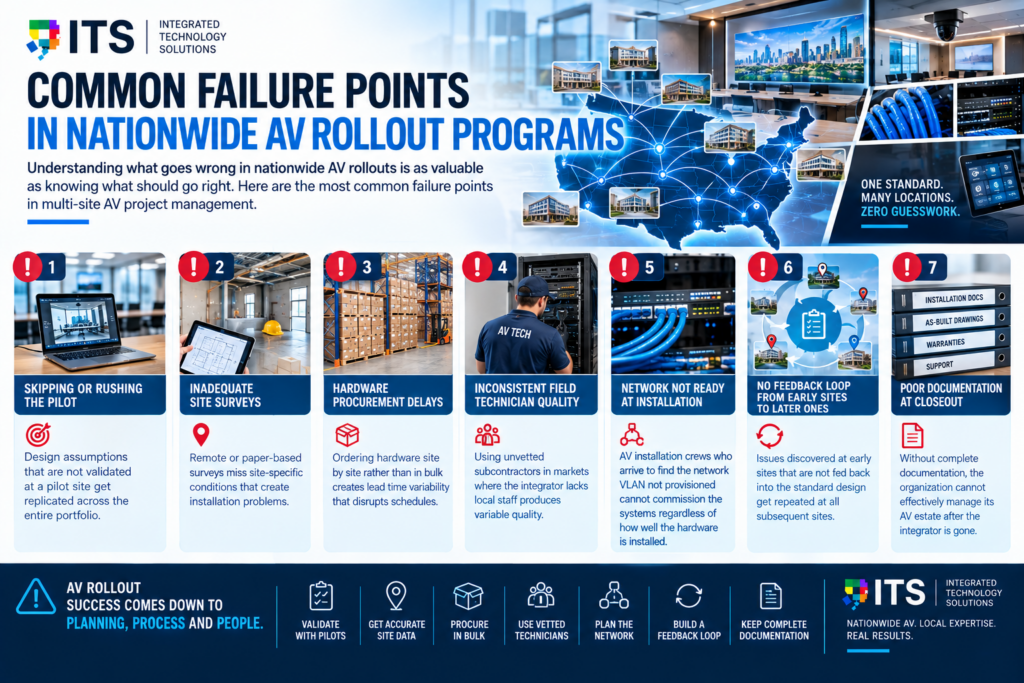
Understanding what goes wrong in nationwide AV rollouts is as valuable as knowing what should go right. Here are the most common failure points in multi-site AV project management.
• Skipping or rushing the pilot: Design assumptions that are not validated at a pilot site get replicated across the entire portfolio.
• Inadequate site surveys: Remote or paper-based surveys miss site-specific conditions that create installation problems.
• Hardware procurement delays: Ordering hardware site by site rather than in bulk creates lead time variability that disrupts schedules.
• Inconsistent field technician quality: Using unvetted subcontractors in markets where the integrator lacks local staff produces variable quality.
• Network not ready at installation: AV installation crews who arrive to find the network VLAN not provisioned cannot commission the systems regardless of how well the hardware is installed.
• No feedback loop from early sites to later ones: Issues discovered at early sites that are not fed back into the standard design get repeated at all subsequent sites.
• Poor documentation at closeout: Without complete documentation, the organization cannot effectively manage its AV estate after the integrator is gone.
What to Look for in a Nationwide AV Rollout Partner
Not every commercial AV integrator has the infrastructure, processes, and nationwide field capability to execute a large multi-site AV project management program. Here is what to look for.
• Proven nationwide deployment experience: Ask for examples of comparable programs. How many sites? What platforms? What was the outcome?
• Certified field technicians in all markets: Understand how the integrator staffs field technicians in markets where they do not have a direct office. BICSI certification and verified platform credentials are non-negotiable.
• Dedicated program management: A nationwide AV rollout needs a dedicated program manager who owns the schedule, the quality, and the client relationship across the entire program.
• Warehouse and staging capability: The ability to receive, stage, and pre-configure hardware before it ships to sites is a meaningful operational advantage.
• Standardized documentation: Every site should produce the same documentation package in the same format. Ask to see an example of a completed site documentation package.
• Infrastructure coverage: An AV integrator who can also handle structured cabling eliminates a coordination gap at every site.
ITS manages nationwide AV rollout programs from our Texas headquarters. We coordinate AV systems, structured cabling, and managed wireless under a single contract across all 50 states. Our program management process follows each of the phases described in this guide. Every site produces the same documentation package in the same format.
Frequently Asked Questions: Nationwide AV Rollout Process
How long does a nationwide AV rollout take?
Timeline depends heavily on site count, room count per site, and hardware availability. A 50-location program with three to five rooms per site and no major supply chain delays typically takes four to nine months from program launch to final punch-list. Programs with hundreds of locations are often managed in waves over 12 to 24 months.
Should sites be done simultaneously or sequentially?
Most well-run nationwide AV rollout programs use a phased approach. An initial pilot phase validates the standard design. A first wave deploys to 10 to 20 percent of sites with the program team in close contact. Subsequent waves accelerate as the process is proven. Full simultaneous deployment across all sites is very high risk because there is no opportunity to catch and correct systemic issues before they are replicated everywhere.
How do you handle AV network integration at each site?
Network integration is one of the most critical coordination points in multi-site AV project management. The integrator must work with the client’s network team to document the network requirements for all AV devices, confirm VLAN provisioning at each site before installation, and test network connectivity as part of commissioning. Centralized IT teams often provision network access remotely, which requires clear communication of device MAC addresses and port assignments well ahead of each installation date.
Can ITS handle a nationwide AV rollout across all 50 states?
Yes. ITS manages nationwide AV rollout programs across all 50 states, coordinated from our Texas headquarters. We handle AV systems, commercial AV installation, structured cabling, and wireless infrastructure under a single contract. Contact our team to discuss your program’s scope, timeline, and requirements.
For industry standards and best practices in commercial AV project management, AVIXA (InfoComm International) publishes project management guidelines and certification programs for AV professionals. The CTS-I (Certified Technology Specialist, Installation) credential is the recognized standard for AV installation professionals and is worth requiring of key technical staff on any nationwide AV rollout.
For structured cabling standards that apply to the infrastructure component of every nationwide AV rollout, the BICSI organization provides credentials and installation guidelines that certified technicians follow on every site.
Ready to Start Your Nationwide AV Rollout?
A well-executed nationwide AV rollout process transforms how an enterprise operates. Consistent, high-quality meeting rooms at every location improve productivity, reduce IT support burden, and create a technology environment that employees and clients notice and appreciate.
Getting there requires the right process, the right partner, and the right commitment to doing each phase correctly before moving to the next. The organizations that rush the pilot, skip site surveys, or accept variable quality from field technicians spend more time and money fixing problems than they saved by cutting corners.
ITS brings a structured, proven nationwide AV rollout process to every multi-site program we manage. From pilot site design through final punch-list at your last location, our team delivers consistent results across all 50 states. Explore our complete technology infrastructure services to see the full scope of what we deliver.
Contact Integrated Technology Solutions today to discuss your nationwide AV rollout. Call us at +1 888-985-5334 or visit our contact page to speak with our program management team.
