
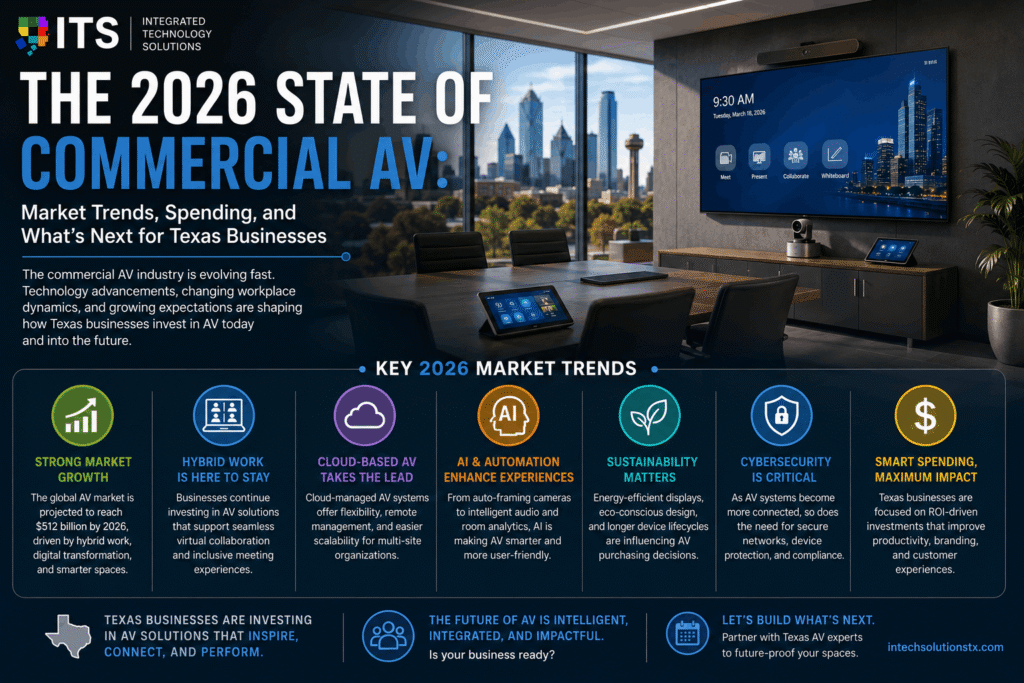
The commercial AV market is growing faster than most businesses realize. Driven by hybrid work, LED display technology, AI integration, and rising expectations for technology in commercial spaces, the commercial AV market 2026 looks meaningfully different from just three years ago.
For business owners, facilities managers, IT directors, and commercial real estate developers, understanding the AV industry trends report picture matters. Technology investment decisions made today will shape how your spaces perform for the next five to ten years. Getting ahead of the curve on commercial AV market 2026 trends helps you make smarter capital allocation decisions and avoid committing to technologies that are already being left behind.
This guide synthesizes the key commercial AV market 2026 trends, looks at where spending is going, identifies the technologies gaining and losing ground, and translates it all into practical guidance for Texas businesses planning AV investments this year.
The Commercial AV Market in 2026: By the Numbers
The global professional AV market was valued at approximately $90 billion in 2024 and is projected to reach $127.31 billion by 2030, growing at a compound annual growth rate of roughly 5.95 percent. That trajectory makes professional AV one of the more resilient segments of the commercial technology market, sustained by demand from enterprise, healthcare, education, hospitality, and government sectors.
The commercial AV market 2026 continues to benefit from several structural forces. Businesses are returning to office environments with higher technology expectations than before. Hybrid work has made meeting room AV a permanent enterprise priority rather than a convenience. Display technology costs have dropped significantly, making LED video walls and high-performance displays accessible to a wider range of businesses than ever before.
The segments driving the most growth in the commercial AV market 2026 are:
• Video conferencing and unified communications: The single largest category of commercial AV spending in most enterprise segments.
• LED display technology: Fine pixel pitch LED and large-format video walls are the fastest-growing hardware category.
• Digital signage: Growing in retail, hospitality, corporate, healthcare, and education as content management platforms mature.
• AV over IP: Replacing dedicated AV matrix switching hardware with software-defined distribution over standard IP networks.
• Managed AV services: Growing demand for ongoing support, remote monitoring, and content management as part of AV contracts.
Top AV Industry Trends Shaping the Commercial AV Market in 2026
This section of the AV industry trends report breaks down the key forces reshaping commercial AV spending and technology decisions in 2026. These are the trends that matter most for businesses making AV investments this year.
Trend 1: Hybrid Work Has Permanently Elevated Meeting Room Standards
The hybrid work model has changed what businesses expect from conference rooms. In the pre-pandemic commercial AV market, a conference room with a projector and a speakerphone was considered acceptable. In 2026, that room fails every standard that employees and clients expect.
Hybrid meetings require that remote participants have an experience that is genuinely equivalent to being in the room. This means high-resolution cameras with intelligent framing, full-room microphone coverage, high-quality displays that show remote participants clearly, and seamless one-touch operation for any conferencing platform.
The commercial AV market 2026 reflects this clearly. Microsoft Teams Rooms and Zoom Rooms certified hardware is now the standard specification for enterprise conference rooms. The pipeline of conference room AV upgrades across American businesses remains very large because so many rooms were not upgraded during the 2020 to 2023 period.
Trend 2: LED Display Technology Has Crossed the Enterprise Threshold
Fine pixel pitch LED displays, which were primarily used in broadcast, command center, and high-end enterprise environments just a few years ago, have crossed a price threshold that makes them practical for a much wider range of commercial AV market 2026 buyers. The combination of falling hardware costs, improving image quality at close viewing distances, and longer product lifespans than LCD alternatives is driving accelerating adoption.
Corporate lobbies, boardrooms, operations centers, healthcare waiting areas, retail environments, and hospitality spaces are all seeing LED video wall installations at volumes that were not possible even three years ago. The commercial AV market 2026 LED opportunity is not a niche. It is a mainstream category in corporate AV spending.
Trend 3: AV over IP Is Displacing Traditional Matrix Switching
Traditional AV distribution relied on dedicated hardware matrix switchers that routed HDMI, SDI, or other video signals between sources and displays. These systems were expensive, inflexible, and difficult to scale. AV over IP replaces dedicated hardware with software-defined routing over standard IP network infrastructure.
In the commercial AV market 2026, AV over IP is now the preferred architecture for any installation that requires flexible signal routing across multiple rooms or buildings. It runs on the same Cat6A and fiber infrastructure that carries data traffic. It scales without additional hardware costs. It is managed through software platforms that can be updated remotely.
The AV industry trends report picture on AV over IP is consistent: installations are growing faster than any other AV distribution category. For integrators and for businesses specifying new AV systems, understanding AV over IP is essential to making future-proof technology decisions in 2026.
Trend 4: AI Is Entering the AV Control Layer
Artificial intelligence is beginning to reshape how commercial AV systems behave. In the commercial AV market 2026, AI is most visibly present in two areas: intelligent camera systems and automated room management.
AI-powered conference room cameras can automatically frame active speakers, switch between participants, and crop and zoom to follow conversation flow. These cameras reduce the manual burden on in-room participants and improve the remote participant experience significantly without requiring a camera operator.
AI room management platforms can automatically adjust lighting, window shading, display brightness, and audio settings based on occupancy and calendar data. As the room fills up before a scheduled meeting, the system prepares itself. When the meeting ends and participants leave, it powers down. These automated behaviors reduce energy waste and improve the user experience simultaneously.
Trend 5: Digital Signage Is Growing Into a Business Intelligence Tool
Digital signage in the commercial AV market 2026 has evolved well beyond displaying static promotional content. Modern digital signage platforms integrate with enterprise data sources to display real-time metrics, occupancy data, safety information, and personalized content automatically.
In corporate environments, digital signage networks display live KPI dashboards on manufacturing floors, team performance metrics in sales offices, and wayfinding and room availability information in office buildings. In healthcare, they display wait time estimates and health education content. In retail, they display dynamic pricing and location-specific promotions. The commercial AV market 2026 is treating digital signage as an operational tool, not just a marketing display.
Trend 6: Managed AV Services Are Becoming the Preferred Delivery Model
Historically, AV projects were one-time capital purchases. The integrator installed the system, handed over the documentation, and the relationship ended unless something broke. The commercial AV market 2026 is shifting toward ongoing managed service relationships.
Managed AV services include remote system monitoring, software updates, content management for digital signage, proactive maintenance, and rapid response support. Businesses that adopt managed AV services reduce downtime, reduce the burden on internal IT staff, and ensure their AV systems continue to perform as the technology evolves. The AV industry trends report data consistently shows managed services growing as a proportion of total AV industry revenue.
Trend 7: Sustainability Is Influencing AV Purchasing Decisions
Corporate sustainability programs are starting to include commercial AV procurement within their scope. Energy consumption of display systems, the carbon footprint of hardware manufacturing, and product end-of-life recyclability are becoming factors in AV purchasing decisions at larger enterprises.
LED display technology wins on sustainability compared to legacy LCD and projection. LED hardware uses significantly less power, lasts longer, and does not contain the hazardous materials present in older fluorescent backlit displays. The commercial AV market 2026 will see sustainability considerations accelerate the transition from legacy display technology to LED.
Trend 8: Cybersecurity for AV Systems Is Becoming Non-Negotiable
As AV systems have become network-connected IP devices, they have also become cybersecurity considerations. Conference room systems, digital signage players, wireless presentation devices, and control systems all represent potential network entry points. The commercial AV market 2026 is seeing enterprise IT teams assert stronger oversight over AV device procurement, firmware management, and network segmentation for AV systems. Integrators who cannot support enterprise cybersecurity requirements are finding themselves excluded from enterprise commercial AV opportunities.
Where Commercial AV Spending Is Going in 2026
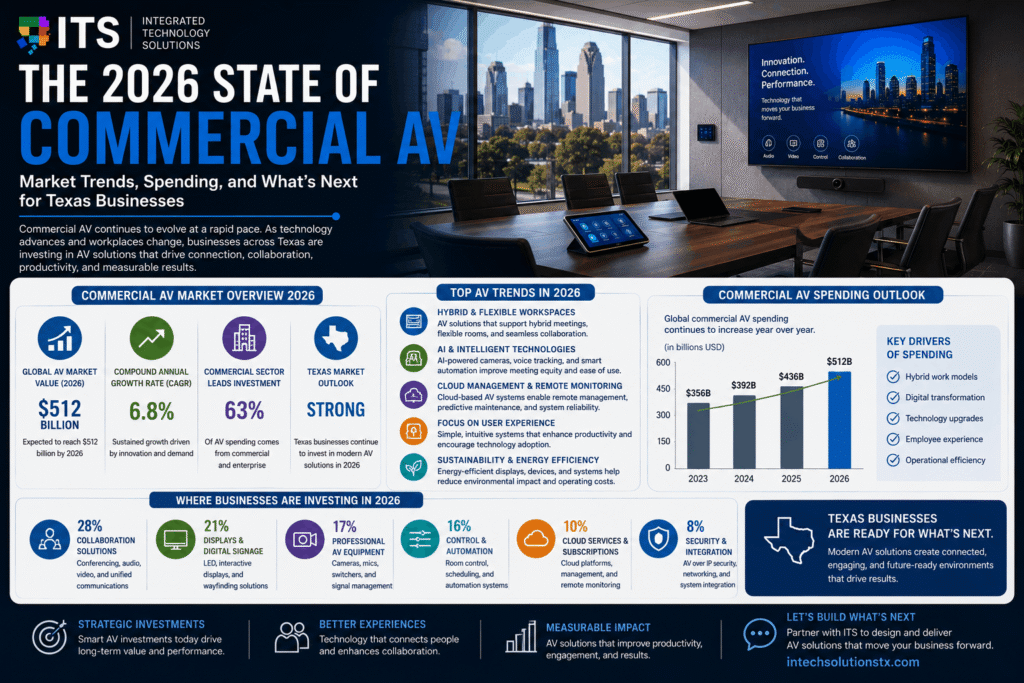
Understanding the AV industry trends report picture at the category level helps businesses make better capital allocation decisions. Here is where the commercial AV market 2026 spending is concentrating across different budget categories.
Conference Room and Meeting Space AV
Meeting room AV remains the largest single category of commercial AV market 2026 spending for enterprise organizations. The combination of post-pandemic room upgrade cycles, hybrid work requirements, and the shift to certified Teams Rooms and Zoom Rooms hardware is sustaining high levels of investment in this category.
The typical enterprise conference room AV budget in 2026 is significantly higher than it was in 2019. The addition of intelligent cameras, ceiling microphone arrays, and certified hardware kits has pushed average room costs up. But the total number of rooms being upgraded each year is also higher than ever, making this the dominant commercial AV market category by total spend.
LED Displays and Video Walls
LED display spending is the fastest-growing hardware category in the commercial AV market 2026. Corporate lobby walls, operations center video walls, boardroom feature displays, and retail signage are all driving demand. The trend toward larger, more impactful displays in commercial spaces is consistent across almost every commercial sector.
ITS installs commercial LED video walls and large-format displays for businesses across Texas through our commercial AV systems services. We handle everything from pixel pitch selection and structural mounting to calibration and content management platform setup.
Digital Signage Networks
Digital signage network investment is growing across nearly every commercial sector. The declining hardware cost of commercial displays, combined with more capable and easier-to-use content management platforms, has expanded the market significantly beyond its traditional retail and hospitality base.
For Texas businesses considering digital signage investment in 2026, the decision is less about whether to invest and more about how to design the content strategy and network that delivers ongoing value. ITS provides digital signage installation and setup services that include both the hardware and the network infrastructure the displays depend on.
Sound Masking and Acoustic Systems
Sound masking is one of the quieter growth areas in the commercial AV market 2026, driven by the open office design that remains dominant in corporate real estate. As more businesses recognize the productivity and speech privacy costs of open-plan environments, professionally installed sound masking systems are moving from a specialty consideration to a standard component of commercial office AV planning.
AV Services and Ongoing Support
The services component of the commercial AV market 2026 is growing faster than the hardware component. Managed services, maintenance contracts, content management services, and professional services for system expansions and upgrades are all growing. This reflects the maturation of the commercial AV market into an ongoing operational discipline rather than a series of one-time capital projects.
Technologies Losing Ground in the Commercial AV Market 2026
An honest AV industry trends report for 2026 also needs to address what is declining. Understanding which technologies are losing ground helps businesses avoid investing in infrastructure that will be difficult to maintain or upgrade in a few years.
Projectors in Corporate Environments
Laser projectors remain appropriate for large auditoriums, theaters, and house-of-worship applications where very large image sizes are required. But in corporate conference rooms and executive spaces, projectors are losing ground rapidly to flat panel displays and LED video walls. The maintenance requirements of projectors, their sensitivity to ambient light, and the complexity of installation compared to flat panels all work against them in the commercial AV market 2026.
New corporate office builds in 2026 are specifying flat panels and LED displays almost exclusively. Projector specifications in corporate conference rooms are becoming increasingly unusual except where screen size requirements genuinely cannot be met with flat panel technology.
Legacy LCD Video Walls
LCD video walls, which use tiled panels with narrow bezels, were the dominant large-format display solution for operations centers, retail, and corporate lobby applications five years ago. In the commercial AV market 2026, they are being displaced by LED video walls on most new projects. The bezel-free, brighter, and longer-lasting LED alternative is more compelling for most commercial applications at current price points.
Proprietary AV Control Systems
Traditional proprietary AV control systems from vendors who require dedicated hardware and proprietary programming are losing share to open and software-defined control alternatives. Enterprise IT teams prefer systems that can be managed through standard software platforms, integrated with existing IT management tools, and updated without vendor-specific expertise. The commercial AV market 2026 is rewarding interoperability and openness.
Legacy 125 kHz RFID and Analog Audio Systems
While not strictly commercial AV, the decline of legacy analog systems is worth noting in any comprehensive AV industry trends report. Analog audio distribution, legacy RFID access control at 125 kHz, and analog CCTV are all in sustained decline. Businesses still operating these systems are doing so on aging infrastructure that is increasingly difficult to support and extend.
The Commercial AV Market in Texas: Regional Dynamics
Texas is one of the strongest commercial AV markets in North America. A combination of factors specific to the state creates above-average demand for professional AV technology across commercial, industrial, healthcare, education, and government sectors.
Corporate Relocation and New Construction
Texas continues to attract major corporate relocations and regional headquarters expansions. Companies relocating from California, New York, and other high-cost states bring high technology standards with them. These relocations generate significant commercial AV market demand in Houston, Dallas, Austin, and San Antonio as new offices are built out to meet the expectations of relocated executive teams.
Energy Sector Technology Investment
Texas energy companies operate extensive operations centers, training facilities, and executive suites that generate consistent commercial AV demand. As energy companies modernize their facilities to attract and retain technical talent, AV systems in conference rooms, training environments, and operations centers are receiving significant investment.
Healthcare Expansion
Texas healthcare is expanding rapidly with new hospital construction and medical office development across the major metro areas and many secondary markets. Healthcare AV, including conference room systems, digital signage, patient entertainment, and communications infrastructure, represents a growing share of the commercial AV market 2026 in Texas.
Education Sector AV Investment
Texas higher education institutions and public school districts continue to invest in classroom AV, collaboration spaces, and event venues. University expansions in Austin, Houston, and Dallas Fort Worth are creating significant demand for large-scale AV deployments that combine classroom technology with campus digital signage, event AV, and administrative conference room systems.
What Texas Businesses Should Prioritize in Commercial AV Investment for 2026
With the commercial AV market 2026 picture clear, what should Texas businesses actually do? Here is practical guidance across the most common investment scenarios.
If You Have Not Upgraded Conference Rooms Since 2020
This is your highest-priority investment. Conference room AV has changed more in the last five years than in the previous decade. Rooms that were not upgraded during the hybrid work transition are failing to meet employee and client expectations daily. Specify certified Teams Rooms or Zoom Rooms hardware, intelligent cameras, and full-room audio. The ROI from improved meeting quality is immediate and measurable.
If You Are Building or Renovating a Commercial Space
Design your AV infrastructure for the commercial AV market 2026 standard, not the standard of three years ago. Specify AV over IP for distribution infrastructure, LED for display technology in lobbies and feature areas, sound masking for open office areas, and a digital signage platform that allows centralized content management. Engage your AV integrator before construction documents are finalized.
If You Manage Multiple Locations
Standardize your commercial AV market technology stack across all locations. Inconsistent AV systems at different sites create support complexity and unequal employee experiences. A standardized design that applies the same platform, the same hardware family, and the same room configurations across all locations is easier to support and delivers consistent results.
If You Are Planning Digital Signage Investment
Start with the content strategy before selecting hardware. The most common mistake in commercial AV market 2026 digital signage projects is buying displays before deciding what content they will show, who will manage that content, and how often it will be updated. Technology without a content plan delivers no value. Build the strategy first, then select the platform and hardware that serves it.
What to Look for in a Commercial AV Partner in 2026
The commercial AV market 2026 is served by a wide range of integrators with very different capabilities. The right partner for your project is not necessarily the largest or the least expensive. Here are the qualities that matter most.
• Certified technicians: BICSI credentials and manufacturer certifications for the platforms you are specifying are non-negotiable standards for any serious commercial AV market 2026 installation.
• Infrastructure capability: An AV integrator who cannot also handle the cabling and network infrastructure that AV systems run on creates coordination complexity. A single contractor who covers both scopes is more efficient.
• Platform knowledge: Deep knowledge of the specific platforms you are deploying, Teams Rooms, Zoom Rooms, Crestron, and others, matters more than broad familiarity with many systems.
• Managed service capability: Given the AV industry trends toward ongoing service relationships, a partner who can support your systems after installation is more valuable than one who only does the initial deployment.
• Multi-site experience: If you have multiple locations, your partner needs proven capability to deliver consistent results across all of them under a single accountable relationship.
ITS brings all of these capabilities to commercial AV market 2026 projects for Texas businesses and nationwide clients. Our commercial AV systems services cover the full scope from design and cabling to hardware installation, commissioning, and ongoing support.
Frequently Asked Questions: Commercial AV Market 2026
Is the commercial AV market growing or contracting in 2026?
Growing. The global professional AV market is on a consistent growth trajectory toward $127 billion by 2030. In Texas specifically, corporate relocation, commercial real estate development, healthcare expansion, and education investment are all sustaining above-average commercial AV market demand.
What is the most important AV investment for a Texas business in 2026?
If you have not upgraded meeting room AV since before 2022, that is your highest priority. Hybrid work has fundamentally changed what a functional conference room requires. The gap between rooms that meet 2026 standards and rooms that do not is clearly visible to employees and clients every day.
How quickly is LED display technology advancing in the commercial AV market?
Rapidly. Pixel pitch options are finer and more affordable than three years ago. All-in-one LED systems have simplified installation. Energy efficiency has improved. For most commercial applications, LED is now the recommended display technology for new installations, and the price premium over LCD has narrowed to a level that can be justified by longevity and performance advantages.
What does AV over IP mean for businesses replacing older AV systems?
If you are replacing AV matrix switching hardware or designing a new AV distribution system, AV over IP is almost certainly the right direction. It provides more flexibility, runs on your existing data network infrastructure, and scales without the hardware limitations of traditional matrix systems. Discuss AV over IP with your integrator before specifying new distribution hardware.
Does ITS keep up with commercial AV market 2026 technology?
Yes. ITS designs and installs current-generation commercial AV systems for clients across Texas and nationwide. We specify LED display technology, AV over IP distribution, certified Teams Rooms and Zoom Rooms hardware, digital signage platforms, and sound masking systems that reflect the commercial AV market 2026 standard, not the standard of several years ago.
For the authoritative industry data underlying this AV industry trends report, AVIXA (InfoComm International) is the global trade association for the professional audiovisual industry. AVIXA publishes the annual Pro AV Industry Outlook report, which provides detailed market sizing, segment analysis, and trend forecasting for the commercial AV market. Their data is the most widely cited source in professional AV industry analysis.
For coverage of specific technology segments within the commercial AV market 2026, the LEDinside research platform tracks LED display market pricing, technology development, and commercial adoption trends across global markets. Their data is useful for businesses evaluating LED display technology investments and trying to understand where pricing is heading.
Plan Your Commercial AV Investment for 2026 With ITS
The commercial AV market 2026 rewards businesses that invest in the right technology at the right time. LED displays, AV over IP, certified collaboration hardware, and managed digital signage are the investments that deliver real returns. Legacy projectors, LCD video walls, and proprietary control systems are the investments that create technical debt.
Understanding the AV industry trends report picture is the first step. The next step is making the right technology decisions for your specific spaces and business requirements. That is where an experienced commercial AV integrator who understands both the technology and your operational context makes a genuine difference.
ITS designs and installs commercial AV systems for Texas businesses and nationwide clients. From conference room AV and LED video walls to digital signage networks and sound masking, we deliver full-scope commercial AV market 2026 solutions under a single contract. Explore our complete technology infrastructure services to see the full range of what we offer.
Contact Integrated Technology Solutions today to discuss your commercial AV investment for 2026. Call us at +1 888-985-5334 or visit our contact page to speak with our commercial AV team.
