
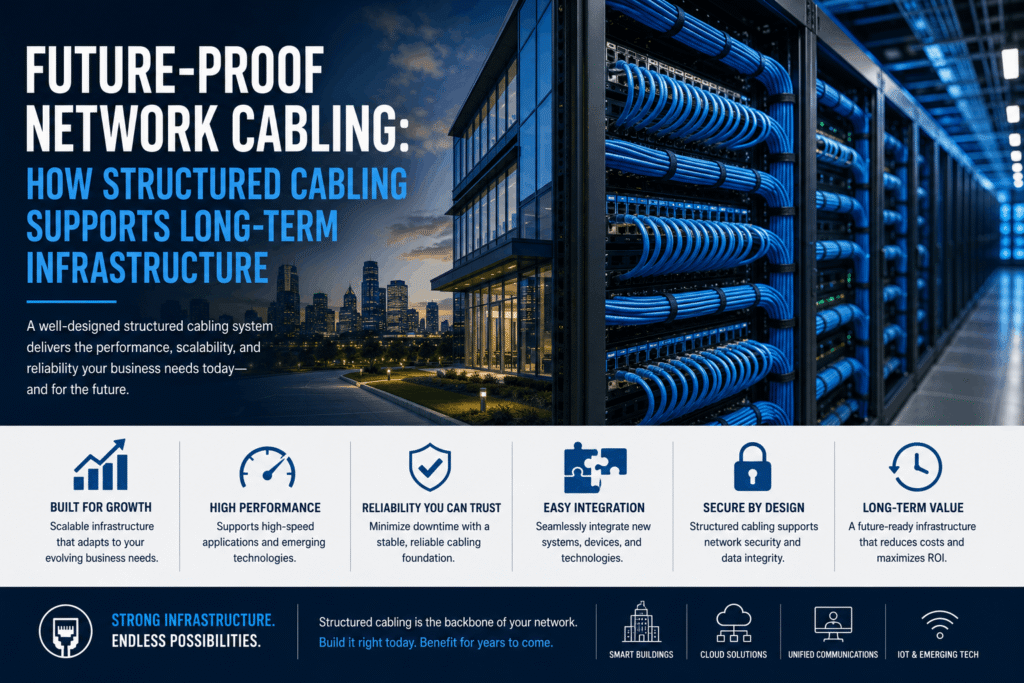
Technology changes fast. The network your business relies on today will need to handle significantly more traffic, more devices, and faster speeds in five years than it does right now. The question is whether your cabling infrastructure will be able to keep up, or whether you will be paying to rebuild it from scratch when the time comes.
Future-proof network cabling is the answer to that question. It is the practice of designing and installing cabling systems that can support not just today’s applications but tomorrow’s technology requirements as well. Done correctly, future-proof network cabling turns your cabling infrastructure from a short-term cost into a long-term strategic asset.
This guide explains what future-proof network cabling actually means in practical terms, what decisions during installation have the biggest long-term impact, and how to calculate the structured cabling ROI that a well-designed system delivers for Texas businesses over its useful life.
Why Future-Proof Network Cabling Matters More Than Ever
Network demands on commercial buildings are increasing faster than most businesses anticipate. A few years ago, a typical office worker used a desktop computer and a desk phone. Today, that same worker may use a laptop, a wireless headset, a docking station, a second monitor connected via USB-C, a video conferencing camera, and a smart badge reader, all simultaneously drawing data from the same network.
Add wireless access points, security cameras, building automation sensors, VoIP phones, and cloud-connected equipment to the mix and the bandwidth demand in a modern commercial building is many times what it was a decade ago. That trend is not slowing down.
Future-proof network cabling addresses this reality directly. Instead of designing for current demand and rebuilding when the system runs out of capacity, a future-proof approach builds in headroom from the start. The result is a cabling system that handles current needs comfortably and has room to grow without requiring a full replacement.
The Cost of Not Future-Proofing
Businesses that install the minimum cabling needed for today often find themselves replacing it much sooner than expected. Recabling a commercial building is disruptive and expensive. It means pulling existing cables, rerunning pathways, retesting every run, and updating all documentation. In an occupied building, this work frequently requires after-hours scheduling, moving furniture, and temporarily relocating staff.
The total cost of a cabling replacement project almost always exceeds what it would have cost to install higher-capacity cabling in the first place. Future-proof network cabling prevents that outcome by making the right choices during the initial installation.
What Makes Network Cabling Future-Proof
Future-proof network cabling is not a single product or a simple upgrade. It is the result of several specific design and installation decisions that work together. Here are the key factors that determine whether a cabling system is truly built for the long term.
Cable Category Selection
The type of cable used is the most fundamental decision in any future-proof network cabling project. Cable categories define the bandwidth and speed performance a cable can support.
Here is a quick comparison of the most relevant copper cable categories for commercial installations in 2026:
• Cat5e: Supports 1 Gbps over 100 meters. Still widely installed but increasingly considered end-of-life for new commercial builds. Provides no meaningful headroom for future speed increases.
• Cat6: Supports 10 Gbps over short runs up to 55 meters, 1 Gbps over full 100-meter runs. A reasonable choice for low-density environments with stable requirements.
• Cat6A: Supports 10 Gbps over full 100-meter runs. The recommended standard for future-proof network cabling in any new commercial installation in 2026. Supports PoE++ for high-power devices and provides meaningful headroom for emerging applications.
• Cat8: Supports 25 and 40 Gbps over short runs up to 30 meters. Used in data center top-of-rack connections. Not appropriate for horizontal cabling in office environments.
For most commercial office buildings, Cat6A is the right choice for future-proof network cabling in 2026. It costs modestly more than Cat6 during installation but delivers significantly more long-term value by eliminating the need to recable when 10 Gbps to the desktop becomes standard, which is already happening in high-performance environments.
Fiber Optic Backbone
The fiber backbone connecting your main distribution frame to each floor or zone is the highest-bandwidth portion of your cabling system. Single-mode fiber is the recommended choice for future-proof network cabling because it supports speeds that far exceed anything currently available on commercial switches, giving the backbone decades of relevant capacity.
Strand count is also an important future-proofing decision. Installing more fiber strands than you currently need costs very little at the time of installation because labor is the dominant cost in fiber backbone work. Adding strands later requires either pulling new cable, which is expensive, or accepting reduced capacity.
ITS provides complete fiber optic installation services for commercial and data center backbone projects across Texas. We design strand counts with growth margin built in from the start so clients never face a capacity-constrained backbone before the rest of their infrastructure needs updating.
Conduit and Pathway Sizing
Conduit and cable trays are the physical channels through which cables run. Oversizing conduit at installation adds almost nothing to the project cost but makes future cable additions dramatically cheaper and easier. A conduit that is 40 percent full today can accept additional cables without any pathway work. A conduit that is 80 percent full today cannot.
Future-proof network cabling design always includes pathway capacity that exceeds current needs. Industry best practice recommends leaving at least 40 percent spare capacity in all conduit and cable tray systems at the time of initial installation.
PoE Capability
Power over Ethernet delivers both data and electrical power through a single cable. It is how modern IP cameras, wireless access points, access control readers, VoIP phones, and desk lighting systems receive power. The demand for PoE capacity in commercial buildings has grown steadily and shows no sign of slowing.
Cat6A supports the full power delivery of PoE++ at 90 watts per port. Older cable categories either cannot support high-power PoE at all or experience heat buildup in dense bundles that degrades performance. Future-proof network cabling with Cat6A eliminates PoE limitations for the life of the installation.
BICSI Certified Installation
A cable that is physically capable of future-proof performance only delivers that performance if it is installed correctly. Exceeding bend radius limits, over-tightening cable ties, improperly untwisting pairs at termination points, and using incorrect termination techniques all degrade cable performance below its rated specification.
BICSI certified technicians are trained to avoid these mistakes. They understand the installation tolerances that preserve long-term performance and apply them consistently on every cable run. Future-proof network cabling without certified installation is not truly future-proof because the physical degradation built in at installation time compounds over the years.
Testing and Certification
Every cable run in a future-proof network cabling installation should be tested with certified field testing equipment immediately after installation. Testing verifies that each run performs at its rated category specification and identifies any that do not before they are hidden behind walls and above ceilings.
Cable certification reports are a documented record of performance at the time of installation. They are also a requirement for most extended application assurance warranties from cable manufacturers, which can cover your cabling system for up to 25 years.
Complete Documentation
Future-proof network cabling requires complete documentation that remains accurate and accessible throughout the life of the system. Every cable run should be labeled at both ends. Patch panel port assignments should be documented. As-built drawings should show the final routing of every cable. Without this documentation, the cost of troubleshooting and making changes grows significantly over time.
Structured Cabling ROI: Understanding the Full Value
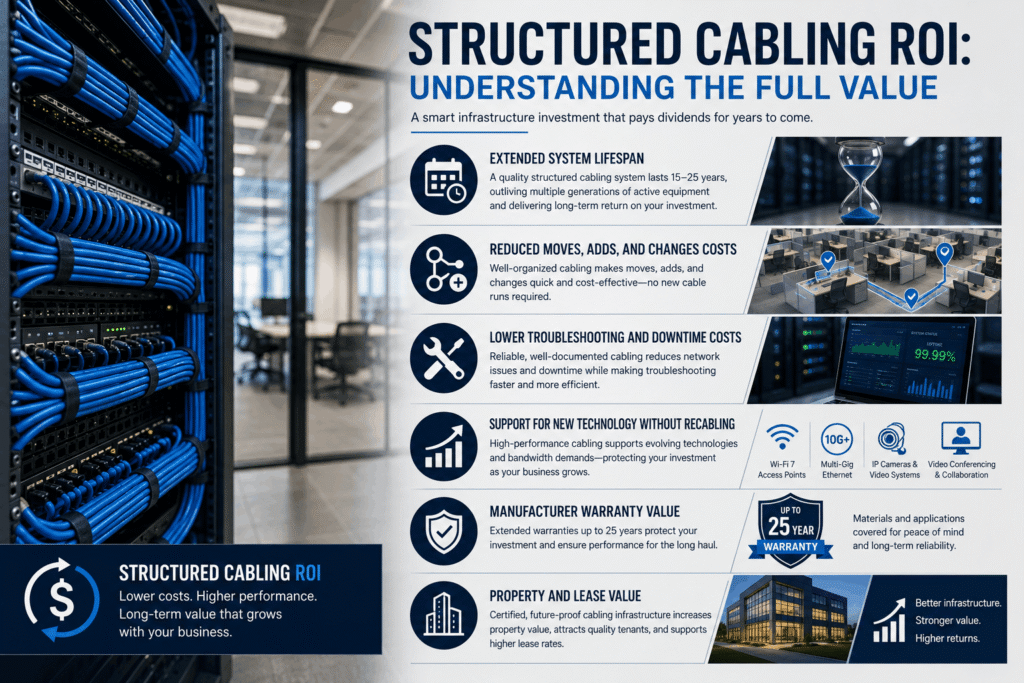
Structured cabling ROI is broader than most businesses realize when they first start thinking about cabling as an investment. The return on a well-designed structured cabling system shows up in multiple ways over the life of the installation.
Extended System Lifespan
Cabling is the longest-lived component of a network infrastructure. A quality structured cabling system, properly installed and certified, has a useful life of 15 to 25 years. Active network equipment like switches, routers, and wireless access points typically need replacement every three to five years. The cabling stays while everything on top of it changes multiple times.
This means the structured cabling ROI calculation spans a very long period. Every year the cabling system supports your network without requiring replacement is a year of return on the initial investment. A future-proof cabling system that lasts 20 years rather than 10 delivers twice the ROI from the same initial spend.
Reduced Moves, Adds, and Changes Costs
Every time a business moves a workstation, adds a new employee, or reconfigures a floor layout, the cabling system is affected. In a well-organized structured cabling system, these moves, adds, and changes happen at the patch panel level with short patch cords. No new cable runs are needed.
In a disorganized or under-designed cabling system, every move requires a technician to pull new cable, terminate it, and test it. Over the life of a building, the difference in MAC costs between a well-designed structured cabling system and a poorly designed one can easily exceed the initial cost difference between the two installations.
Lower Troubleshooting and Downtime Costs
Network problems are expensive. The average cost of network downtime for a mid-size business runs into thousands of dollars per hour when you account for lost productivity, missed transactions, and IT response time. Structured cabling ROI includes the downtime that does not happen because the infrastructure is reliable and organized.
Troubleshooting is also dramatically faster in a well-documented, properly labeled structured cabling system. A technician who can trace a problem to a specific patch panel port and cable run in minutes rather than hours saves labor cost and gets the business back online sooner.
Support for New Technology Without Recabling
Future-proof network cabling delivers structured cabling ROI every time a new technology is adopted without requiring a cabling upgrade. A Cat6A installation that was specified for 10 Gbps ethernet in 2026 will also support multi-gig switching at 2.5 and 5 Gbps for PoE-heavy environments. It will support future wireless access points that demand higher backhaul speeds. It will support video conferencing endpoints that require reliable, high-bandwidth wired connections.
Each of these technology adoptions that happen without a cabling replacement represents direct structured cabling ROI. The cabling investment made years earlier continues to pay dividends as the network evolves around it.
Manufacturer Warranty Value
Major cabling manufacturers offer extended application assurance warranties when their products are installed by certified partners and tested to specification. These warranties cover the cabling system for 15 to 25 years and include both the materials and the network applications running over them.
The structured cabling ROI from a 25-year warranty includes the replacement costs that are covered if the system fails to perform as specified. It also includes the confidence value of knowing your infrastructure is backed by the manufacturer for the majority of its useful life.
Property and Lease Value
For commercial real estate owners and developers, future-proof network cabling adds measurable value to a property. Buildings with documented, certified structured cabling infrastructure attract technology-forward tenants faster. Tenants pay more for spaces where the network infrastructure is already in place and documented. This is one of the less obvious forms of structured cabling ROI but one of the most meaningful for property owners and investors.
Future-Proof Network Cabling for Different Business Types
The specific approach to future-proof network cabling varies by business type and industry. Here is how the priorities shift across common commercial environments.
Corporate Offices
Office environments face constant change. Headcount grows. Floor plans are reconfigured. Technology evolves. Future-proof network cabling for a corporate office prioritizes Cat6A horizontal cabling to every workstation location, spare cable runs to allow future workstation additions without pulling new cable, and a fiber backbone with enough strand count to support multiple generations of active equipment upgrades.
Conduit sizing is particularly important in office environments because architectural constraints often make adding new conduit pathways after construction very expensive. An office that needs to add 20 new workstations two years after moving in will have a far easier and cheaper time if the conduit was sized to accommodate that growth during the original build.
Data Centers
Data centers require the most rigorous approach to future-proof network cabling of any facility type. The stakes are higher, the speeds required are greater, and the cost of a cabling limitation showing up mid-project is severe.
Future-proof network cabling in a data center means single-mode fiber backbone with aggressive strand count, pre-terminated MPO trunk cables for high-density connections, Cat6A copper for horizontal runs where copper is used, and documentation systems that track every connection in real time. ITS delivers all of this through our data center installation services for Texas and nationwide clients.
Healthcare Facilities
Healthcare networks carry an expanding range of traffic types, from electronic health records and medical imaging to patient monitoring, IP-based nurse call systems, and IoT medical devices. Future-proof network cabling in healthcare must accommodate this diversity while meeting the reliability standards that patient safety demands.
Cat6A is the right choice for healthcare horizontal cabling because it supports the high-power PoE that medical devices increasingly require and provides the bandwidth headroom for bandwidth-intensive applications like PACS imaging systems. Redundant fiber backbone paths between MDF and IDF locations support the uptime requirements of clinical environments.
Multi-Tenant Commercial Buildings
For property owners and developers, future-proof network cabling at the building infrastructure level is one of the best investments in tenant attractiveness and lease value available. A building with a documented Cat6A horizontal infrastructure, a high-strand-count fiber backbone, and clean IDF rooms with growth capacity available attracts technology-forward tenants who will pay premium rents for infrastructure that meets their requirements from day one.
Industrial and Logistics Facilities
Warehouses, manufacturing plants, and distribution centers have unique future-proof cabling challenges. Large floor areas, harsh environments, and the increasing adoption of IoT devices, automated equipment, and real-time inventory systems all drive growing network demands. Future-proof network cabling in industrial environments emphasizes ruggedized fiber for long backbone runs, high-density wireless infrastructure supported by Cat6A PoE cabling, and security camera cabling that can handle 4K and higher resolution upgrades without recabling.
How to Calculate Your Structured Cabling ROI
Putting a number on structured cabling ROI helps businesses make a confident investment decision and justify the cost of future-proof cabling over a cheaper minimum-viable installation. Here is a practical framework.
Calculate the Upgrade Cost Premium
Compare the cost of future-proof network cabling with the cost of a minimum-spec installation. The difference is typically in cable category, fiber strand count, and conduit sizing. In most commercial installations, the premium for Cat6A over Cat6 is modest because labor dominates cabling project costs and labor costs are the same regardless of which cable is being installed.
Estimate the Cost of Replacement
If a minimum-spec installation would need to be replaced in 8 to 10 years while a future-proof installation would last 15 to 20 years, calculate what a full recabling project would cost at that point. In a commercial building of any meaningful size, this replacement cost is substantial. Discounting it to present value and comparing it to the upfront upgrade premium makes the structured cabling ROI argument straightforward.
Add the Ongoing Savings
Include annual MAC cost savings from patch-panel-level moves rather than pulled cable, reduced downtime cost from a more reliable and organized system, and the warranty value of manufacturer coverage over the extended system life. Add the revenue impact of faster technology adoption enabled by infrastructure that can support new equipment without upgrades.
Total Structured Cabling ROI
When the full picture is assembled, the structured cabling ROI of future-proof network cabling almost always justifies the modest premium over minimum-spec installation. The businesses that resist investing in future-proof cabling because of upfront cost concerns almost always spend more over time as they deal with the limitations and eventual replacement of cabling that was not designed to last.
Common Mistakes That Undermine Future-Proof Network Cabling
Even well-intentioned future-proof cabling projects can fall short if these common mistakes are made during planning or installation.
• Choosing Cat6 instead of Cat6A to save money: The performance gap between Cat6 and Cat6A over full 100-meter runs is significant. In 2026, Cat6A is the minimum for genuinely future-proof network cabling in any commercial installation.
• Undersizing conduit to reduce installation cost: Conduit that is full today cannot accommodate future cable additions. The cost of undersizing conduit is paid many times over during the facility’s lifetime.
• Skipping cable certification testing: Uncertified cabling has unknown performance characteristics. Problems that would be caught and corrected during testing are instead discovered during operation, often at the worst possible time.
• Installing inadequate fiber strand counts: Adding fiber strands after the fact requires either running new cable or accepting reduced capacity. Specify generous strand counts upfront.
• Using uncertified installers: Cable category ratings assume correct installation technique. Poorly installed Cat6A performs worse than well-installed Cat6 in some cases. Certification matters.
• Skipping documentation: A cabling system without complete documentation becomes harder and more expensive to manage every year. As-built drawings and cable schedules are not optional.
Frequently Asked Questions About Future-Proof Network Cabling
How long should a future-proof cabling system last?
A properly designed and installed Cat6A structured cabling system, certified and documented at installation, should deliver useful service life of 15 to 25 years. With manufacturer application assurance warranties, the system may be covered for the full duration of that period.
Is Cat6A worth the extra cost over Cat6 for future-proofing?
Yes. Cat6A supports 10 Gbps over full 100-meter runs, supports high-power PoE without heat buildup concerns in bundled cable runs, and provides meaningful headroom for future network speed increases. The incremental cost over Cat6 during installation is small relative to the long-term value delivered.
What is the structured cabling ROI for a typical commercial office?
It varies by building size and usage, but businesses consistently find that the combination of extended system lifespan, reduced MAC costs, lower downtime costs, and avoided recabling expense produces strong positive returns over a 10-year period. A site-specific ROI analysis with your actual cost data provides the most accurate picture.
Does future-proof cabling require more maintenance?
No. A well-installed, well-documented future-proof network cabling system typically requires less ongoing maintenance than a poorly designed or aging system. Proper labeling reduces troubleshooting time. Quality installation reduces failure rates. Certified performance means fewer unexpected issues over time.
Does ITS design and install future-proof network cabling in Texas?
Yes. ITS designs and installs future-proof network cabling for commercial clients across Texas and nationwide. Our BICSI certified technicians specify Cat6A for all new horizontal cabling installations and plan fiber backbone strand counts with meaningful growth margin. All cable runs are tested and certified. Complete as-built documentation is a standard project deliverable. Learn more about our approach on our structured network cabling services page.
For detailed technical specifications on cable category performance requirements, the Telecommunications Industry Association (TIA) publishes ANSI/TIA-568, the North American standard for commercial building telecommunications cabling. This document defines performance requirements for each cable category and is the reference standard used by certified installers across the country.
The BICSI organization also publishes installation guidelines that define the correct techniques for installing future-proof network cabling systems. Their Telecommunications Distribution Methods Manual (TDMM) is the most comprehensive reference available for structured cabling design and installation best practices.
Build a Network Infrastructure That Lasts With ITS
Future-proof network cabling is one of the smartest infrastructure investments a business can make. The right cabling choices today eliminate the need for expensive recabling projects tomorrow, support new technologies as they emerge, and deliver structured cabling ROI that compounds year after year over the life of the system.
ITS designs and installs future-proof network cabling systems for commercial clients across Texas and nationwide. We specify Cat6A for all new horizontal installations, plan generous fiber backbone strand counts, size conduit for growth, certify every cable run, and deliver complete as-built documentation on every project.
Our BICSI certified technicians bring the installation quality that makes the difference between a cable that performs at rated specification and one that falls short. We also offer ongoing network infrastructure support to keep your system performing at its best long after installation is complete.
Contact Integrated Technology Solutions today to discuss future-proof network cabling for your commercial project. Call us at +1 888-985-5334 or visit our contact page to schedule a free site assessment and cabling consultation.
