
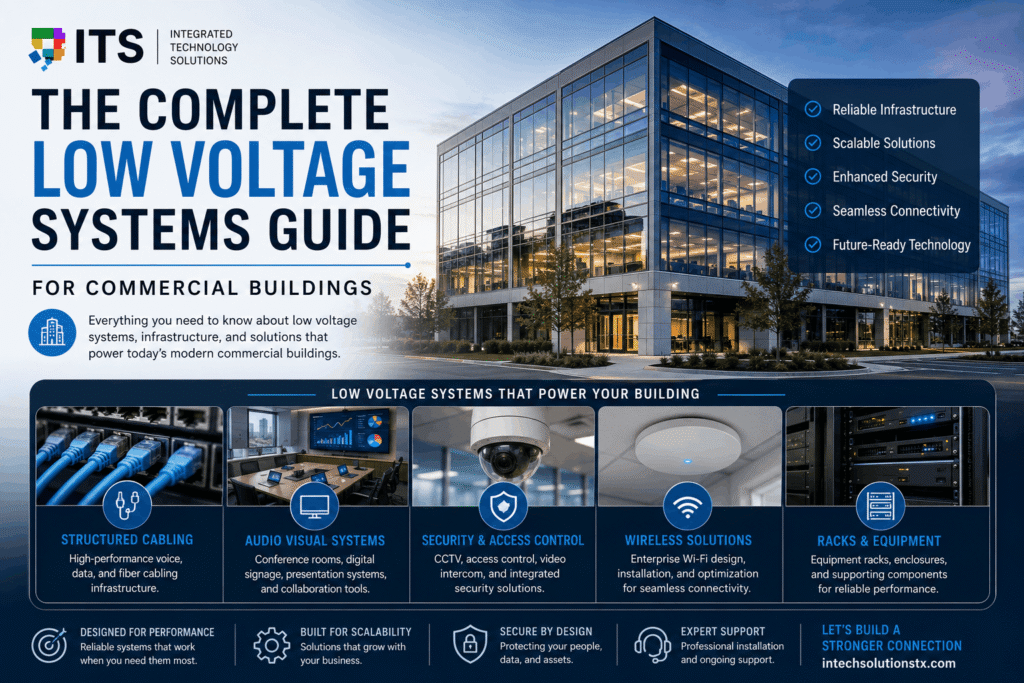
Every commercial building runs on two types of electrical systems. The first is the high-voltage electrical system that powers lights, HVAC equipment, elevators, and outlets. The second is the low voltage systems that carry data, voice, video, and control signals throughout the building.
Most building owners and facilities managers are familiar with the first category. The second is less well understood, even though low voltage systems touch nearly every technology function in a modern commercial building. Your internet connection, phone system, security cameras, access control, fire alarm, wireless network, building automation, AV systems, and intercom all fall under the low voltage systems umbrella.
This low voltage systems guide explains what low voltage means, which systems fall into this category, how they relate to each other, what the installation standards are, and what to look for when choosing a commercial low voltage contractor for your project. Whether you are planning a new build, a renovation, or a technology upgrade, this guide gives you the foundation you need.
What Are Low Voltage Systems?
Low voltage systems are defined by the electrical power they carry. In commercial buildings, low voltage generally refers to systems operating at 50 volts or less. These systems carry signals rather than power. They transmit data, audio, video, and control information across the building without the high power requirements of electrical distribution systems.
The National Electrical Code (NEC) classifies low voltage systems into specific articles based on the type of signal they carry. This classification system affects how cables are installed, how they are separated from power wiring, and what safety standards apply to each system type.
The main NEC articles relevant to commercial low voltage systems include:
• Article 725: Remote control, signaling, and power-limited circuits. Covers building automation, access control signaling, and similar low power applications.
• Article 760: Fire alarm systems. Governs the cabling and installation standards for fire detection and notification wiring.
• Article 770: Optical fiber cables. Covers fiber optic cabling used for data networks and telecommunications.
• Article 800: Communications circuits. Covers structured data cabling, telephone systems, and similar communications wiring.
• Article 820: Community antenna television and radio distribution systems. Covers coaxial cable for cable TV, satellite, and similar distribution systems.
Understanding these classifications matters because they affect how a commercial low voltage contractor must plan and execute an installation. Cables from different NEC articles often cannot share the same conduit or cable tray. Separation requirements between low voltage cabling and high voltage power wiring must be maintained throughout the installation.
The Complete Low Voltage Systems Guide: Every System Explained
This section of the low voltage systems guide covers each major system category you are likely to encounter in a commercial building project. Each system is defined, its purpose is explained, and its relationship to other systems is described.
1. Structured Data Cabling
Structured data cabling is the backbone of every other technology system in a commercial building. It carries network traffic for computers, wireless access points, IP phones, security cameras, building automation controllers, and virtually every other networked device.
Modern commercial buildings use Cat6A copper cable for horizontal runs from the network equipment room to each workstation and device location. Fiber optic cable is used for the backbone connecting equipment rooms on different floors or in different buildings. Both must be installed and tested to ANSI/TIA-568 standards.
Structured cabling is the system that every other low voltage system depends on most directly. A poorly designed or installed cabling system creates performance problems and reliability issues across every other technology deployed in the building. ITS provides full structured network cabling services that serve as the foundation for all other low voltage systems.
2. Fiber Optic Cabling
Fiber optic cable transmits data using pulses of light rather than electrical signals. It supports far higher speeds over much longer distances than copper cable and is immune to electromagnetic interference. In commercial buildings, fiber is used for the backbone cabling between floors and between buildings on a campus.
Single-mode fiber is the standard for new commercial installations in 2026. It supports the highest speeds over the longest distances and provides a fiber plant that will remain relevant for decades. ITS installs and certifies fiber optic cabling systems for buildings and campuses across Texas and nationwide.
3. Wireless Network Infrastructure
Managed wireless is a low voltage system that delivers Wi-Fi connectivity throughout a commercial building via a network of ceiling-mounted access points. Each access point is a low voltage device powered by Power over Ethernet through a Cat6A cable.
A professionally designed wireless system provides seamless coverage across all areas of a building, supports high device density, and maintains consistent performance as users move between areas. ITS designs and installs managed wireless and Wi-Fi systems for commercial buildings of all sizes.
4. Access Control Systems
Access control is the low voltage system that manages who can enter which areas of a building and when. Card readers, biometric scanners, mobile credential readers, and video intercoms all communicate over low voltage cabling to a central access control panel that makes the grant or deny decision.
In this low voltage systems guide, access control is one of the systems that most directly affects daily operations. Every employee interaction at a secure door involves the access control system. The quality of the cabling, the reliability of the hardware, and the configurability of the software platform all affect how well the system performs over its useful life.
5. Video Surveillance and CCTV
IP-based security camera systems are low voltage devices that transmit video over the data network. Each camera connects via Cat6A or fiber cabling to a network video recorder (NVR) or to the main network switch. Modern IP cameras are powered by Power over Ethernet, eliminating the need for separate power runs to each camera location.
Camera placement, resolution selection, storage capacity, and retention period are all decisions that a commercial low voltage contractor helps clients navigate during the design phase. Getting these decisions right during initial installation is far cheaper than correcting them after the system is live.
6. Fire Alarm and Detection Systems
Fire alarm systems are low voltage systems that monitor for smoke, heat, and other fire conditions and activate notification devices when a threat is detected. In commercial buildings, fire alarm systems are governed by NFPA 72 and must be designed, installed, and tested by licensed fire alarm contractors.
Fire alarm wiring is classified separately from other low voltage cabling under NEC Article 760. It has specific installation requirements including fire-rated cable in certain applications and dedicated conduit in others. A commercial low voltage contractor working on a project that includes fire alarm systems must coordinate carefully with the fire alarm contractor to ensure proper integration and code compliance.
7. Audiovisual Systems
Commercial AV systems are a broad category of low voltage systems that includes conference room displays, video conferencing equipment, digital signage, LED video walls, sound masking systems, public address systems, and background music. All of these systems carry audio and video signals over low voltage cabling.
AV cabling includes HDMI, DisplayPort, HDBaseT, and twisted pair solutions for video distribution, as well as balanced audio cabling for professional sound systems. ITS installs complete commercial AV systems including all associated low voltage cabling for every AV component.
8. Building Automation and Control Systems
Building automation systems (BAS) use low voltage cabling to connect sensors, thermostats, variable air volume controllers, lighting controls, and other devices to a central building management platform. These systems control HVAC, lighting, and other mechanical systems to optimize energy use and occupant comfort.
BAS low voltage cabling typically uses RS-485, BACnet MS/TP, or IP-based communications over Cat6 or Cat6A cable. The integration between BAS and the IP data network has increased significantly in recent years as smart building platforms converge IT and OT systems onto common network infrastructure.
9. Paging and Public Address Systems
Paging and public address systems allow building operators to broadcast announcements to specific zones or throughout an entire building. These systems use low voltage speaker cabling distributed from a central amplifier and controller. Modern IP-based paging systems can be managed over the data network, allowing zone control from any authorized device.
In this low voltage systems guide, paging is often underestimated in planning. Buildings that do not install adequate paging infrastructure during construction frequently retrofit it later at significantly higher cost. Planning for paging during the initial build is always the more efficient approach.
10. Intercom and Video Intercom Systems
Intercom systems allow two-way audio and video communication between building entry points and reception or security staff. Video intercoms at main entrances allow staff to verify visitor identity before granting access. These systems connect via low voltage cabling to a central intercom controller and can integrate with access control systems to allow remote door release.
Modern IP video intercom systems communicate over the data network, which simplifies installation and allows flexible placement of internal stations without dedicated intercom cabling runs.
11. Distributed Antenna Systems
A Distributed Antenna System (DAS) extends cellular network coverage inside a building. Many large commercial buildings, particularly those with reinforced concrete or metal construction, have poor cellular signal indoors. A DAS captures cellular signal from an external antenna, amplifies it, and distributes it throughout the building via coaxial cable and indoor antennas.
DAS is increasingly relevant in commercial buildings as employees rely on cell phones for both personal and business communications. Buildings without adequate indoor cellular coverage create a negative experience for occupants and can affect tenant satisfaction and lease renewals.
12. Digital Signage and Display Systems
Digital signage uses low voltage cabling to connect displays, media players, and content management systems throughout a commercial building. Lobby displays, wayfinding screens, conference room signs, and LED video walls all require power and data connections installed by a commercial low voltage contractor. ITS provides full digital signage installation services for commercial buildings across Texas.
How Low Voltage Systems Work Together
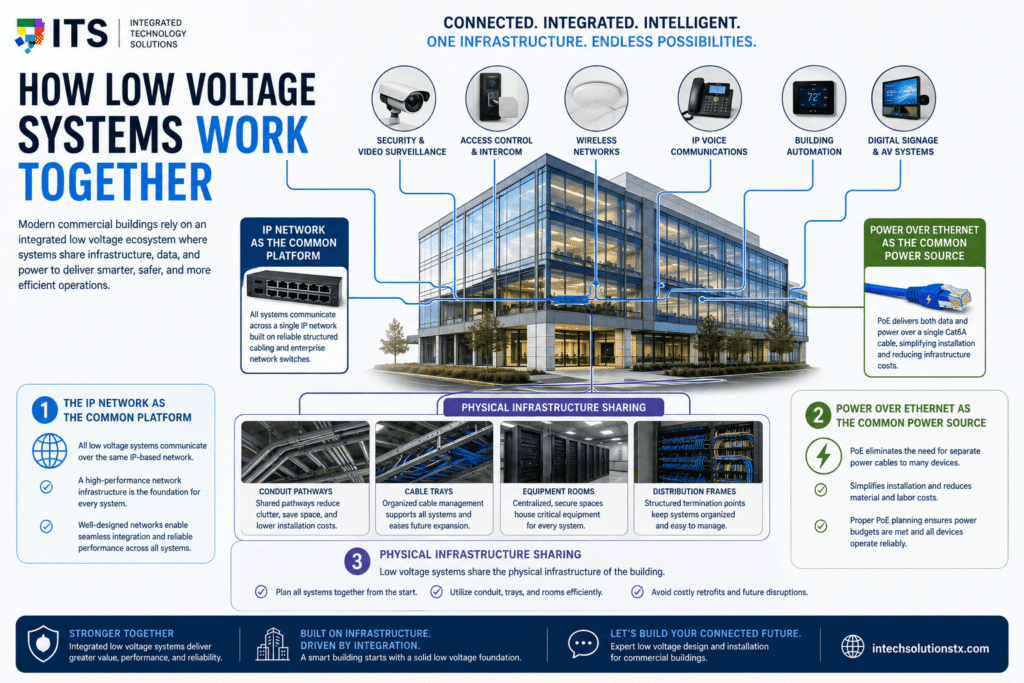
One of the most important concepts in any low voltage systems guide is integration. Modern commercial buildings do not have a collection of independent low voltage systems. They have an interconnected technology ecosystem where each system shares infrastructure, data, and in many cases physical space with the others.
The IP Network as the Common Platform
The shift from proprietary protocols to IP-based communication has been the defining trend in low voltage systems over the past decade. IP cameras, IP phones, IP access control panels, IP building automation controllers, and IP AV systems all communicate over the same data network infrastructure.
This convergence means that the structured cabling and network switching infrastructure is now the shared foundation for every other low voltage system in the building. The quality and design of the data network directly affects the performance of every system that depends on it. A well-designed network supports seamless integration between systems. A poorly designed network creates bottlenecks and failures that affect multiple systems simultaneously.
Power over Ethernet as the Common Power Source
Power over Ethernet (PoE) has eliminated the need for separate power runs to a wide range of low voltage devices. Wireless access points, IP cameras, access control readers, IP phones, building automation sensors, digital signage screens, and intercom stations can all be powered directly from the network switch via the same Cat6A cable that carries their data.
For a commercial low voltage contractor, PoE planning is a critical part of any project. Each PoE port on a switch delivers a limited amount of power. The switch itself has a total PoE budget. Exceeding these limits causes devices to lose power. Calculating PoE requirements for all devices early in the design process prevents power budget problems after installation.
Physical Infrastructure Sharing
Low voltage systems share physical infrastructure including conduit pathways, cable trays, equipment rooms, and distribution frames. Planning the physical infrastructure to accommodate all low voltage systems from the start eliminates the need for additional conduit, additional rooms, or costly retrofits when new systems are added later. This is a core principle of any good low voltage systems guide: plan for all systems together, not one at a time.
Low Voltage Systems Standards and Codes
This low voltage systems guide would be incomplete without addressing the standards and codes that govern commercial low voltage installations. Understanding the applicable standards helps building owners and project managers evaluate whether their commercial low voltage contractor is performing work to the required level.
National Electrical Code (NEC)
The NEC is published by the National Fire Protection Association and is adopted by most jurisdictions in the United States as the governing standard for all electrical and low voltage installations. NEC compliance is a legal requirement for commercial construction, not an optional best practice.
ANSI/TIA-568
TIA-568 is the primary standard for commercial building telecommunications cabling in North America. It defines performance requirements for copper cable categories, fiber optic cable types, connector specifications, and testing methods. Any installation claiming to be Cat6A must comply with TIA-568 performance specifications to earn that rating.
ANSI/TIA-942
TIA-942 is the specific standard for data center cabling infrastructure. It covers physical layout, cable pathways, equipment rooms, grounding, and tier requirements. Any data center cabling installation should reference TIA-942 as the governing design standard.
BICSI Standards
BICSI publishes the Telecommunications Distribution Methods Manual (TDMM), the most comprehensive installation reference for low voltage cabling professionals. BICSI credentials validate that individual technicians have demonstrated knowledge of these standards through rigorous examination.
NFPA 72
NFPA 72 is the National Fire Alarm and Signaling Code. It governs the design, installation, inspection, and testing of fire alarm systems. Compliance with NFPA 72 is mandatory for commercial fire alarm installations and is verified by the local authority having jurisdiction (AHJ).
Texas-Specific Requirements
In Texas, commercial low voltage contractors are required to hold a low voltage license issued by the Texas Department of Licensing and Regulation (TDLR). This license verifies that the contractor meets the legal requirements to perform low voltage work commercially. TDLR licensing is the legal floor. BICSI certification represents the professional standard above that floor.
For detailed information on Texas licensing requirements for low voltage contractors, the Texas Department of Licensing and Regulation website provides current licensing categories, continuing education requirements, and contractor lookup tools.
Planning Low Voltage Systems for a Commercial Building
Effective low voltage systems planning begins well before construction starts. This section of the low voltage systems guide outlines the planning process that produces the best outcomes.
Start With a Systems Inventory
Begin by listing every low voltage system the building will need. Do not limit this to what is needed at move-in. Think about what might be added in three to five years. A building that is wired for AV but does not install equipment at day one can add AV systems later with minimal effort. A building that has no pathway or conduit for AV cabling will face much higher costs when the time comes.
Engage a Commercial Low Voltage Contractor Early
Bring a commercial low voltage contractor into the design process alongside the architect and general contractor. Low voltage pathways, equipment room locations, and conduit routing all need to be coordinated with the building’s structural elements, MEP systems, and architectural finishes before construction begins. Changes made during design cost a fraction of changes made during construction.
Design the Infrastructure, Then the Systems
The most common mistake in commercial low voltage planning is specifying the technology before designing the infrastructure. The right order is to design the physical infrastructure first: equipment rooms, conduit pathways, cable trays, and pull boxes. Once the infrastructure is defined, the specific technology systems are layered in.
Plan for Integration From Day One
Every low voltage system you specify should be evaluated against the others for integration potential. Can access control badge events feed the building automation system to trigger HVAC adjustments? Can fire alarm events trigger AV system muting? Can the IP camera system integrate with the access control platform? Planning for integration during design is far simpler than retrofitting it later.
Specify Testing and Documentation Requirements
Every low voltage system installed in your building should be tested and documented before it is accepted. For structured cabling, this means cable certification test reports for every run. For fiber, OTDR traces for every strand. For AV systems, end-to-end functionality testing of every room. For access control, access event logging verification at every reader. These deliverables protect your investment and give your team the information they need to manage the systems over time.
How to Choose a Commercial Low Voltage Contractor
Choosing the right commercial low voltage contractor is the single most important decision in any low voltage systems project. The contractor’s technical quality, project management capability, and documentation practices determine how well your systems perform for years after installation.
Verify TDLR Licensing in Texas
Any commercial low voltage contractor working in Texas must hold a current TDLR low voltage license. This is not optional. Verify the license number before signing any contract. The TDLR website allows public lookup of licensed contractors. An unlicensed contractor working on your building creates legal liability for both the contractor and potentially for you.
Require BICSI Certification
A TDLR license is the legal minimum. BICSI certification from the Building Industry Consulting Service International is the professional standard above that minimum. Ask which BICSI credentials the contractor’s technicians hold, request the credential ID numbers for verification, and confirm that the certified technicians will actually be on site for your project.
Evaluate Scope Capability
A commercial low voltage contractor who can handle all of your low voltage systems under one contract delivers better coordination, clearer accountability, and typically lower total cost than multiple specialty contractors working independently. Evaluate whether the contractor has proven capability across the full scope of systems your project requires.
Check Documentation Practices
Ask what documentation the contractor provides as a standard project deliverable. At minimum, you should expect as-built drawings for all systems, cable certification test reports for all cabling, equipment inventories with serial numbers and warranty information, and system configuration backups for all software-configured devices.
Ask for Relevant References
Request references from similar commercial projects. A contractor with experience in your building type, your industry, and your system mix is more valuable than one with a long history in different environments. Verify the references and ask specifically about project completion on time, documentation quality, and post-installation support responsiveness.
Low Voltage Systems in Different Commercial Building Types
While this low voltage systems guide applies broadly to commercial buildings, the specific mix of systems and the priorities within each project vary significantly by building type.
Office Buildings
Office buildings require the full range of low voltage systems. Structured cabling and wireless for employee connectivity. Access control at secure entries. AV systems in conference rooms. Digital signage in lobbies. Sound masking for open office acoustic privacy. Fire alarm throughout. Building automation for HVAC and lighting efficiency. The priority is a well-integrated technology environment that supports employee productivity and impresses clients.
Data Centers
Data centers have the most demanding low voltage systems requirements of any commercial building type. Structured cabling and fiber optic backbone must be designed to the highest performance standards. Access control must provide multi-factor authentication with full audit logging. Environmental monitoring must be comprehensive and real time. ITS provides complete data center installation services covering all low voltage systems requirements for mission-critical facilities.
Healthcare Facilities
Healthcare facilities have unique low voltage systems requirements driven by patient safety, clinical workflow, and HIPAA compliance. Nurse call systems, medical device connectivity, patient entertainment systems, and HIPAA-compliant speech privacy solutions all fall within the healthcare low voltage systems scope. Access control must manage staff, visitor, and patient movement differently across different areas of the facility.
Retail and Hospitality
Retail and hospitality low voltage systems prioritize guest experience and operational efficiency. Point-of-sale connectivity, guest wireless, digital menu boards and signage, security cameras, access control for back-of-house areas, and background music and AV systems are all standard in this sector. Multi-location consistency is a key requirement for retail chains and hospitality brands.
Industrial and Logistics
Industrial and logistics facilities prioritize rugged, reliable low voltage systems that perform in demanding environments. High-coverage wireless for inventory management and mobile device support. Security cameras at perimeter and interior points. Access control at vehicle gates and personnel entries. Safety notification systems. Industrial-rated cable and hardware that withstand temperature extremes, dust, and vibration.
Frequently Asked Questions About Low Voltage Systems
What is the difference between low voltage and high voltage in a building?
High voltage systems in commercial buildings include the electrical distribution system that powers outlets, lighting circuits, HVAC equipment, and elevators, typically operating at 120V, 208V, or 480V. Low voltage systems operate at 50V or less and carry signals rather than power. They include data cabling, AV systems, security cameras, access control, fire alarm signaling, and building automation.
Do low voltage systems require permits in Texas?
Permit requirements vary by jurisdiction and system type. Fire alarm systems almost always require permits from the local AHJ. Structured cabling and AV systems may or may not require permits depending on the city or county. A qualified commercial low voltage contractor will identify the applicable permit requirements for your project and obtain the necessary approvals.
How long do low voltage systems last?
Lifespan varies by system type and installation quality. A well-installed Cat6A structured cabling system has a useful life of 15 to 25 years. Access control hardware typically lasts 7 to 12 years. AV display hardware often needs replacement every 7 to 10 years. The cabling infrastructure tends to outlast the active devices mounted on it by many years.
Can one contractor handle all of my low voltage systems?
Yes, with the right contractor. A full-service commercial low voltage contractor who handles structured cabling, fiber, wireless, AV, access control, security cameras, and digital signage under one contract delivers better integration, simpler accountability, and lower total project cost than multiple separate specialty contractors. ITS handles this full scope on commercial projects of all sizes.
Does ITS handle complete low voltage systems projects in Texas?
Yes. ITS is a full-service commercial low voltage contractor serving Texas and nationwide clients. We design and install structured cabling, fiber optic systems, managed wireless, commercial AV, digital signage, access control, and security camera systems under a single contract. Our BICSI certified technicians deliver complete documentation on every project. Explore our full technology infrastructure services to see everything we offer.
For the authoritative technical standards that govern commercial low voltage systems installations, the Telecommunications Industry Association (TIA) publishes ANSI/TIA-568 for structured cabling and ANSI/TIA-942 for data centers. These are the primary standards your commercial low voltage contractor should be designing and installing to on every project.
The BICSI organization also publishes the Telecommunications Distribution Methods Manual (TDMM), the most comprehensive installation reference for low voltage systems professionals. Their credential programs verify that individual technicians have demonstrated knowledge of these standards through independent examination.
Work With ITS for Your Complete Low Voltage Systems Project
Low voltage systems are the technology infrastructure that makes a modern commercial building function. They carry data, enable communication, protect the facility, support building operations, and create the environment that occupants experience every day. Getting them right from the start sets your building up for years of reliable, efficient operation.
This low voltage systems guide has covered the full scope of what commercial low voltage includes, how the systems relate to each other, what standards apply, and how to choose the right commercial low voltage contractor. The key takeaway is integration. Low voltage systems work best when they are planned together, installed by a single accountable team, and documented completely from the start.
Contact Integrated Technology Solutions today to discuss your commercial low voltage systems project. Call us at +1 888-985-5334 or visit our contact page to request a free consultation and scope review with our team.
