
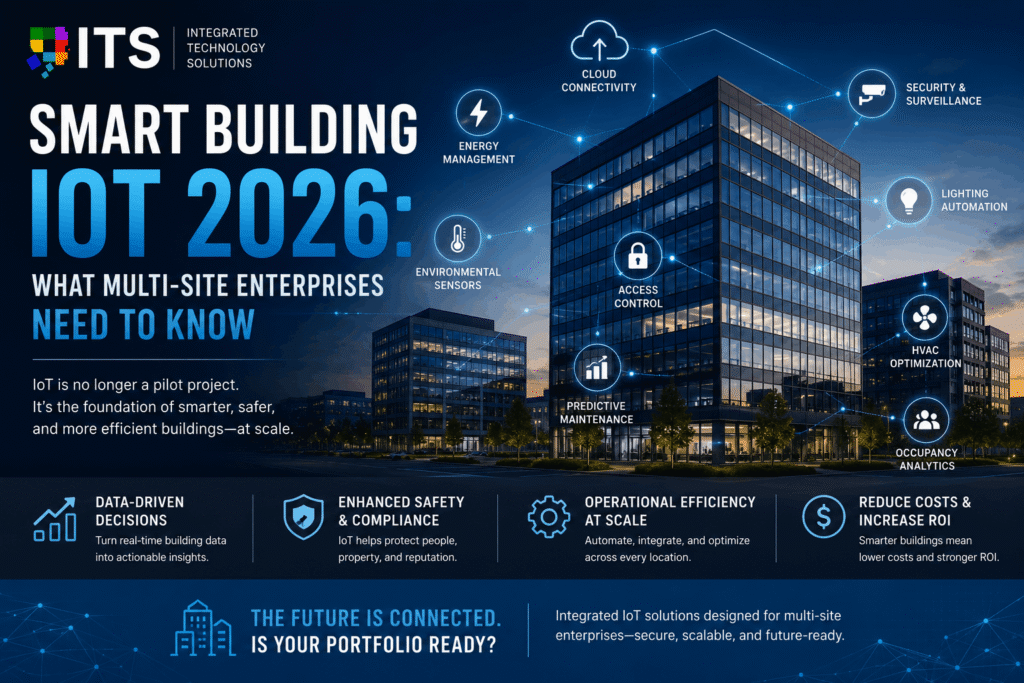
Buildings are no longer just physical spaces. In 2026, smart building IoT technology has transformed commercial facilities into connected systems that generate data, respond to conditions, and communicate with the people who manage them in real time. For multi-site enterprises, this shift represents one of the most significant operational opportunities available today.
Smart building IoT 2026 is not the same technology that was being discussed five years ago. The hardware is more reliable, the software is easier to manage, and the integration between previously separate building systems has reached a level of maturity that makes enterprise-scale deployment genuinely practical.
This guide explains what smart building IoT 2026 looks like in practice, what enterprise building automation actually covers, how multi-site organizations can deploy and manage these systems consistently across locations, and what the infrastructure requirements are for a smart building rollout that delivers real results.
What Is Smart Building IoT in 2026?
Smart building IoT refers to the network of sensors, controllers, and software platforms that collect data from building systems and use that data to automate decisions, trigger alerts, and provide visibility to facility managers and operations teams.
In 2026, a fully enabled smart building IoT deployment covers a broad range of systems. HVAC control, lighting management, access control, occupancy sensing, energy monitoring, water leak detection, air quality tracking, and security surveillance can all be connected to a common data platform that gives facility teams a single place to see and manage everything.
What makes smart building IoT 2026 different from earlier iterations of building automation is integration depth. Previous generations of building automation systems were siloed. The HVAC system ran on its own software. Access control ran on another. Lighting ran on a third. In 2026, open protocols and cloud-based management platforms allow these previously separate systems to share data and coordinate responses in ways that were not practical just a few years ago.
The Difference Between Smart Building IoT and Traditional BMS
A traditional Building Management System (BMS) controls HVAC, lighting, and basic electrical systems through a proprietary, closed platform. It is effective at what it does but is generally limited to the systems it was designed to manage, difficult to integrate with other platforms, and inaccessible from anywhere outside the building’s local network.
Smart building IoT 2026 extends beyond traditional BMS in three important ways. First, it is cloud-connected, allowing remote monitoring and management from any location. Second, it uses open protocols such as BACnet, MQTT, and REST APIs that allow different systems from different vendors to communicate. Third, it generates structured data that can be analyzed for patterns, anomalies, and optimization opportunities that a traditional BMS simply does not provide.
For multi-site enterprises, this distinction matters enormously. A traditional BMS requires a local technician to manage each building independently. Smart building IoT 2026 allows a centralized operations team to monitor and control all locations from a single platform.
Why Multi-Site Enterprises Are Prioritizing Smart Building IoT in 2026
Multi-site enterprises face specific operational challenges that smart building IoT 2026 is uniquely positioned to address. Managing dozens, hundreds, or thousands of locations consistently is one of the hardest problems in commercial real estate operations. Every location has its own building systems, its own maintenance history, and its own set of problems that may or may not be visible to the corporate team.
Here are the core reasons multi-site organizations are accelerating their smart building IoT investments in 2026:
• Energy cost pressure: Energy is one of the largest operating costs for commercial facilities. Smart building IoT systems that optimize HVAC and lighting based on actual occupancy can reduce energy consumption by 20 to 35 percent in well-implemented deployments.
• Labor cost reduction: Automated monitoring reduces the need for manual facility checks. Predictive maintenance alerts allow maintenance teams to respond to developing issues before they become failures, reducing emergency repair costs.
• ESG and sustainability reporting: Corporations with sustainability commitments need granular energy and resource consumption data across all locations. Smart building IoT 2026 platforms generate this data automatically.
• Occupant experience: Smart building systems that maintain consistent temperature, air quality, and lighting across all locations improve the experience for employees and customers regardless of which site they are in.
• Portfolio visibility: Corporate real estate and facilities teams can see the operational status of every building in their portfolio in real time, enabling faster response to incidents and data-driven decisions about lease renewals and capital expenditure.
• Security standardization: Deploying consistent access control, surveillance, and alarm monitoring across all sites through a unified platform makes security management far more efficient and reduces the risk of gaps in coverage.
Core Systems in Enterprise Building Automation
Enterprise building automation in 2026 covers a wider range of systems than most facility managers expect when they first start planning a smart building program. Here is a breakdown of the core systems and what each contributes to an integrated smart building IoT deployment.
HVAC and Energy Management
HVAC is typically the highest-energy system in any commercial building and the most impactful area for smart building IoT 2026 optimization. Connected thermostats, variable speed drives, and occupancy sensors allow HVAC systems to modulate output based on real-time conditions rather than fixed schedules.
Enterprise building automation platforms aggregate HVAC energy consumption data across all locations and identify outliers. A building that is consuming 30 percent more energy than similar sites in the portfolio is immediately visible in a smart building IoT dashboard. The cause, a stuck damper, a misconfigured setpoint, a failing compressor, can be investigated remotely before it becomes a major failure.
Lighting Control and Daylight Harvesting
Smart lighting systems in a smart building IoT 2026 deployment adjust based on occupancy, time of day, and available natural light. Occupancy sensors dim or switch off lights in unoccupied zones automatically. Daylight sensors near windows reduce artificial lighting output when sunlight is sufficient.
For multi-site enterprises, centralized lighting management allows energy policies to be set and enforced consistently across all locations. A corporate policy requiring all lights to be off by 10 PM unless the space is occupied can be deployed to every building in the portfolio from a single configuration update.
Access Control and Physical Security
Modern enterprise building automation integrates access control with smart building IoT platforms so that building access data contributes to occupancy information. When employees badge in and out, the building automation system knows which spaces are occupied and can adjust HVAC and lighting accordingly.
For multi-site enterprises, centralized access control management allows credentialing to be managed at the corporate level. An employee who changes roles or leaves the company has their access updated or revoked across all locations simultaneously. ITS installs enterprise-grade access control systems that integrate with smart building IoT platforms through our commercial security and electrical services.
Indoor Air Quality Monitoring
Indoor air quality (IAQ) monitoring has become a standard component of smart building IoT 2026 deployments, accelerated by heightened awareness of ventilation and air quality in commercial spaces. Sensors track carbon dioxide levels, particulate matter, volatile organic compounds, humidity, and temperature continuously.
For enterprise building automation, IAQ data is valuable in two ways. First, it supports occupant health and productivity. Research consistently shows that better air quality improves cognitive performance and reduces absenteeism. Second, it supports compliance documentation. Organizations with health and safety reporting requirements can use IAQ data as evidence of their building management standards.
Occupancy Sensing and Space Utilization
Understanding how spaces are actually used is one of the most valuable insights smart building IoT 2026 can provide to multi-site enterprises. Occupancy sensors in conference rooms, open office areas, and shared spaces generate data on utilization rates throughout the day.
This data has immediate operational value. HVAC and lighting adjust to actual occupancy. It also has strategic value. A portfolio analysis showing that certain locations consistently have conference rooms at 90 percent utilization while others average 30 percent informs real estate decisions about expansion, consolidation, and lease renewal priorities.
Water and Environmental Leak Detection
Smart building IoT 2026 deployments increasingly include water monitoring as a standard component. Leak detection sensors in mechanical rooms, under raised floors, and near plumbing fixtures alert facility teams to water intrusion before it causes structural damage or equipment failure. Flow sensors on main water lines can detect unusual consumption patterns that indicate a leak even in areas where physical sensors have not been placed.
Elevator and Vertical Transportation Monitoring
For multi-story facilities, elevator monitoring through smart building IoT platforms tracks performance, flags maintenance needs, and integrates elevator availability with occupancy data. Knowing that a building’s primary elevator is operating at reduced speed can affect how meeting rooms on upper floors are scheduled and whether maintenance is dispatched proactively or reactively.
The Infrastructure Behind Smart Building IoT 2026
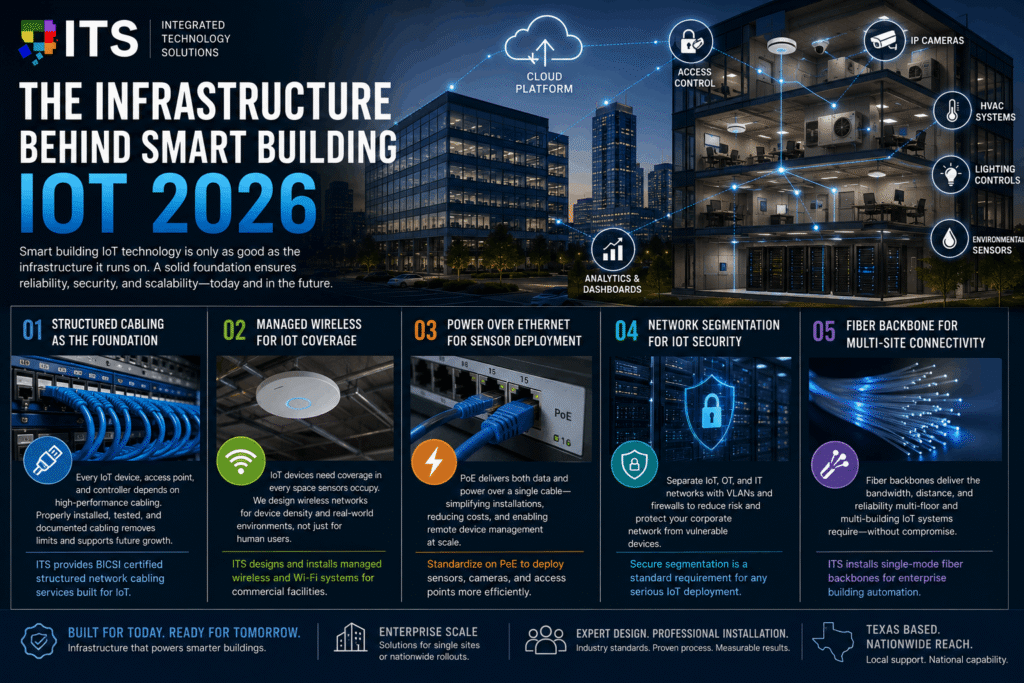
Smart building IoT technology is only as good as the infrastructure it runs on. This is where many enterprise building automation projects underdeliver. Organizations invest in sensors and software but underinvest in the network, cabling, and power infrastructure that sensors and controllers depend on.
Structured Cabling as the Foundation
Every IoT sensor that communicates over a wired network needs a cable. Every wireless access point that carries IoT device traffic needs a Cat6A cable back to the nearest network switch. Every access control reader needs a low voltage cable to its controller.
The cabling infrastructure behind a smart building IoT 2026 deployment needs to be installed correctly, tested, and documented. Under-designed cabling creates a permanent ceiling on what smart building systems can do. ITS provides BICSI certified structured network cabling services that support smart building IoT deployments at any scale.
Managed Wireless for IoT Device Coverage
Many smart building IoT devices communicate over Wi-Fi, Zigbee, Z-Wave, or cellular. Wi-Fi coverage in particular must be designed for the device density and distribution pattern of IoT sensors, not just for human users. An access point deployment designed for laptops and phones may not provide adequate coverage in mechanical rooms, stairwells, and storage areas where sensors are installed.
Enterprise building automation Wi-Fi design requires a wireless survey that accounts for IoT device locations specifically. ITS designs and installs managed wireless and Wi-Fi systems for commercial facilities and IoT-dense environments across Texas and nationwide.
Power over Ethernet for Sensor Deployment
Power over Ethernet (PoE) simplifies smart building IoT deployment significantly. Instead of running separate power cables to every access control reader, occupancy sensor, IP camera, and wireless access point, PoE delivers both data and power through a single Cat6A cable from the nearest network switch.
For multi-site enterprise building automation, standardizing on PoE for IoT device deployment reduces installation cost, simplifies troubleshooting, and allows remote power cycling of devices through the network switch without a physical site visit.
Network Segmentation for IoT Security
Smart building IoT devices represent a cybersecurity consideration that enterprise IT teams must address. IoT devices often have limited security capabilities and run firmware that is not updated as frequently as enterprise IT equipment. Placing IoT devices on a dedicated, segmented network VLAN prevents a compromised sensor from providing a path into the corporate network.
Enterprise building automation security architecture should include separate network segments for IoT devices, operational technology systems, and corporate IT, connected through a firewall with strict access control policies between segments. This is a standard design requirement for any serious smart building IoT 2026 deployment.
Fiber Backbone for Multi-Floor and Multi-Building Connectivity
In larger facilities and campus environments, a fiber optic backbone connects smart building IoT infrastructure across floors and between buildings. Fiber provides the bandwidth and distance performance that smart building data aggregation requires without the signal degradation that would occur with copper over longer runs. ITS installs single-mode fiber backbones for enterprise building automation projects through our fiber optic installation services.
Deploying Smart Building IoT Across Multiple Sites
Single-site smart building IoT is manageable. Multi-site enterprise building automation is a different challenge. Deploying and maintaining consistent smart building systems across dozens or hundreds of locations requires a structured approach that most organizations learn the hard way.
Standardize the Technology Stack First
The most important decision in a multi-site smart building IoT 2026 program is choosing a standardized technology stack before deploying. If each location uses a different sensor vendor, a different IoT gateway, or a different management platform, the result is a collection of independent smart building deployments that cannot be managed centrally.
Standardization across sensor types, communication protocols, gateway hardware, and management platforms is what makes enterprise building automation genuinely enterprise-scale. It allows a single team to support all locations, enables consistent reporting across the portfolio, and dramatically reduces the cost and complexity of adding new sites.
Pilot Before Scaling
Successful multi-site smart building IoT programs almost always begin with a single pilot location. The pilot site allows the technology team to work through integration challenges, identify network infrastructure gaps, refine the management platform configuration, and build the internal expertise needed to manage the system before scaling to the full portfolio.
A well-run pilot also generates the ROI data that justifies the broader enterprise building automation investment. Real energy savings and maintenance cost reductions from one location, measured and documented, are far more persuasive to finance and leadership than projected numbers from a vendor pitch.
Assess Infrastructure at Each Site
Smart building IoT 2026 technology cannot be deployed on inadequate infrastructure. Before each site is added to the program, a physical assessment should determine whether the existing cabling, wireless coverage, power distribution, and network equipment can support the planned IoT deployment.
Sites that need infrastructure upgrades should have those upgrades scoped and budgeted as part of the smart building rollout plan. Trying to deploy IoT sensors on a cabling infrastructure that was never designed to support them creates reliability problems that undermine confidence in the entire program.
Use a Single Technology Partner Where Possible
Multi-site enterprise building automation projects that use a single technology contractor for infrastructure, cabling, and device installation across all locations achieve better consistency, simpler accountability, and lower total cost than programs that use local contractors at each site. A single partner learns the standard once and applies it everywhere. Documentation is consistent. Troubleshooting is simpler because the team knows exactly what was installed.
Smart Building IoT 2026 Trends Enterprises Need to Watch
The smart building IoT 2026 landscape is evolving faster than most enterprise real estate and facilities teams can track. Here are the trends with the most direct implications for multi-site organizations this year.
AI-Driven Building Optimization
Machine learning models are being integrated into smart building IoT platforms to optimize HVAC, lighting, and energy systems more precisely than rule-based automation alone can achieve. These models learn from historical data at each building to predict occupancy patterns, adjust setpoints proactively, and identify anomalies that rule-based systems would miss.
For multi-site enterprises, AI-driven enterprise building automation is becoming a meaningful differentiator. Buildings using AI optimization consistently outperform those running fixed schedules on energy efficiency metrics, often by an additional 10 to 20 percent over well-configured traditional automation.
Digital Twin Integration
A digital twin is a virtual model of a building that is continuously updated with real data from smart building IoT sensors. In 2026, digital twin platforms are becoming more accessible for enterprise building automation programs and are being used for space planning, energy modeling, and maintenance forecasting.
For multi-site enterprises, digital twins allow facilities teams to model changes at a building before implementing them physically. If a floor layout change is being considered, the digital twin can predict how it will affect HVAC load distribution, wireless coverage, and occupancy sensor coverage before a single piece of furniture is moved.
Unified IT and OT Management
The convergence of Information Technology (IT) and Operational Technology (OT) is one of the defining trends of smart building IoT 2026. Building control systems that were previously managed by facilities teams on proprietary OT networks are increasingly moving to IP-based networks managed by IT teams.
This convergence creates both opportunities and challenges for enterprises. The opportunity is unified visibility and management. The challenge is that IT security practices and OT reliability requirements are different and sometimes in conflict. Enterprises investing in smart building IoT 2026 need a governance model that addresses both.
5G and Private Cellular for IoT Connectivity
Private 5G networks are emerging as an alternative connectivity option for smart building IoT 2026 in large facilities and campuses. Private 5G provides dedicated, high-bandwidth, low-latency wireless connectivity that is separate from public cellular networks and more reliable in dense IoT environments than shared Wi-Fi. While still early in adoption for enterprise building automation, private 5G is a technology worth understanding as it matures through 2026 and beyond.
Cybersecurity as a Core Building Systems Requirement
Smart building IoT 2026 has expanded the attack surface of every enterprise facility. Building automation systems, access control platforms, HVAC controllers, and IP cameras are all potential entry points for malicious actors. High-profile incidents involving building systems as vectors for corporate network breaches have raised cybersecurity awareness at the board level in many organizations. In 2026, cybersecurity for building systems is no longer optional or an afterthought. It is a baseline requirement for any enterprise building automation program.
What Multi-Site Enterprises Should Do Right Now
If your organization manages multiple commercial facilities and has not yet developed a formal smart building IoT strategy, 2026 is the right time to start. The technology is mature, the ROI evidence is well-documented, and the gap between organizations that have invested in enterprise building automation and those that have not is growing.
Here is a practical starting point:
• Audit your current building infrastructure at each location: Understand what cabling, wireless, and network infrastructure you currently have at each site before selecting smart building IoT technology.
• Define your primary use cases: Energy management, security standardization, occupancy analysis, and maintenance optimization are the most common enterprise building automation priorities. Start with the one or two that have the clearest ROI for your organization.
• Select a platform before selecting sensors: The management platform determines what you can see and manage across your portfolio. Choose a platform that supports your priority use cases, then select sensors and devices that are compatible with it.
• Engage IT and facilities together: Smart building IoT 2026 sits at the intersection of IT and facilities management. Successful programs require both teams to be involved from the start.
• Plan a pilot site: Choose a location that represents your typical portfolio and run the full smart building IoT stack there before committing to enterprise-wide deployment.
• Partner with a technology provider who can deliver consistent infrastructure across all sites: The physical infrastructure layer is where enterprise building automation programs succeed or fail. It must be installed consistently, documented completely, and supported reliably across every location.
Frequently Asked Questions About Smart Building IoT 2026
How long does it take to deploy smart building IoT across multiple sites?
A single-site pilot with full infrastructure and IoT deployment typically takes 8 to 16 weeks depending on building size and complexity. Multi-site rollouts following a standardized approach can add sites more quickly, typically 4 to 8 weeks per site once the standard has been established and the team is experienced with the process.
What is the typical ROI for enterprise building automation?
Energy savings from smart HVAC and lighting optimization typically range from 20 to 35 percent of baseline energy costs for well-implemented deployments. Maintenance cost reductions from predictive monitoring add further savings. Most enterprises see positive ROI within 3 to 5 years, with energy savings alone often covering the infrastructure investment within that period.
Does existing building infrastructure need to be replaced for smart building IoT?
Not necessarily. Many smart building IoT sensors use wireless communication and battery power, which reduces infrastructure requirements. However, access points, network switches, and IoT gateways need wired connections. Buildings with aging or inadequate cabling infrastructure will need targeted upgrades to support reliable IoT connectivity.
How is enterprise building automation different for Texas facilities?
Texas facilities face specific energy challenges including extreme summer heat that drives high HVAC loads, and increasingly unpredictable grid conditions that make energy monitoring and demand response more valuable than in many other markets. Smart building IoT 2026 platforms with strong energy management capabilities are particularly relevant for Texas multi-site enterprises.
Does ITS support smart building IoT infrastructure deployments?
Yes. ITS provides the complete physical infrastructure layer for smart building IoT 2026 deployments, including structured cabling, fiber optic backbone, managed wireless, PoE switching infrastructure, and security system integration. We support multi-site enterprise building automation rollouts across Texas and nationwide from our Houston headquarters. Contact our team to discuss your portfolio’s infrastructure requirements.
For in-depth research on smart building IoT trends and enterprise building automation market data, the Building Efficiency Initiative publishes research on energy efficiency and smart building technology adoption across commercial real estate portfolios worldwide.
The American Society of Heating, Refrigerating and Air-Conditioning Engineers (ASHRAE) also publishes standards and guidelines that directly govern smart building HVAC automation, indoor air quality targets, and energy performance benchmarks for commercial buildings of all types.
Build the Infrastructure Your Smart Building Program Needs
Smart building IoT 2026 is creating measurable competitive advantages for multi-site enterprises that invest in it correctly. Energy cost reductions, maintenance savings, security standardization, and occupant experience improvements are all real, documented outcomes from well-implemented enterprise building automation programs.
The common thread in every failed smart building program is infrastructure. Sensors without reliable connectivity, systems without adequate cabling, and IoT platforms without the network foundation to support them all lead to the same outcome: technology that underdelivers and erodes confidence in the program.
ITS provides the complete infrastructure layer that smart building IoT 2026 deployments require. Structured cabling, fiber optic backbone, managed wireless, PoE infrastructure, and integrated security systems, all installed by BICSI certified technicians, documented completely, and supported reliably. Explore our full technology infrastructure services to see everything we deliver for enterprise building automation projects.
Contact Integrated Technology Solutions today to discuss smart building IoT infrastructure for your multi-site enterprise. Call us at +1 888-985-5334 or visit our contact page to speak with our team.
