
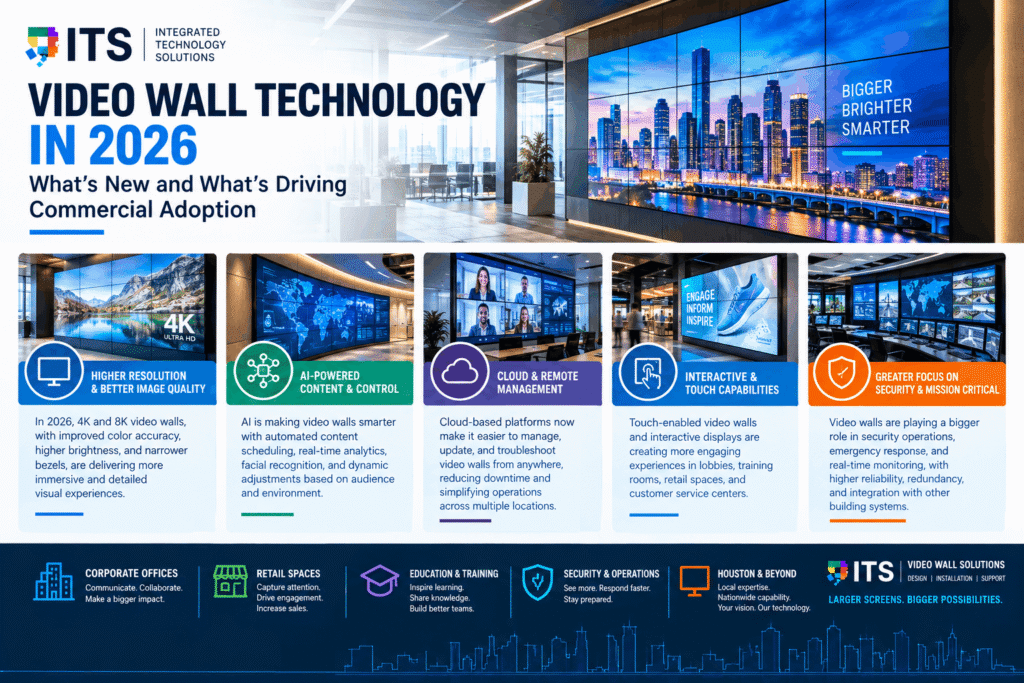
Video wall technology in 2026 looks very different from what it was even three years ago. The hardware has improved dramatically. Prices have come down. The use cases have expanded beyond large enterprise lobbies and broadcast studios to include mid-size businesses, healthcare facilities, retail environments, and government spaces.
If you are evaluating commercial video wall options for your organization, this guide covers what has changed in video wall technology 2026, what the commercial video wall trends look like across different industries, and what the technology actually means for real installation decisions.
This is not a buyer’s guide focused on installation pricing. It is a technology overview for decision-makers who want to understand what is available, what is driving adoption, and how the landscape has shifted before they start the design process.
Why Video Wall Technology 2026 Is a Different Conversation Than It Was in 2022
Four years ago, the commercial video wall conversation was simpler. Fine pixel pitch LED was expensive and reserved for large enterprise budgets. LCD video wall panels were the practical option for most commercial applications. The decision tree was shorter.
That calculus has fundamentally changed. Here is what has driven the shift in video wall technology 2026.
Fine Pixel Pitch LED Has Reached Commercial Price Points
The most significant shift in video wall technology 2026 is the democratization of fine pixel pitch LED. Pixel pitches of 1.2mm to 1.8mm, which were enterprise-only territory in 2021 and 2022, are now accessible to a much broader range of commercial buyers.
This matters because fine pixel pitch LED is objectively superior to LCD video wall panels in almost every measurable way: brightness, contrast ratio, viewing angle, lifespan, and bezel-free image quality. The only real barrier was price. That barrier has lowered significantly.
The price reduction is driven by increased manufacturing scale, improved LED chip efficiency, and greater competition among manufacturers including Absen, Leyard, Unilumin, Samsung, and LG. Commercial integrators now have more high-quality panel options at competitive prices than at any previous point.
LCD Video Walls Are Losing Ground
As fine pixel pitch LED has come down in price, LCD video wall panels have lost their value proposition for most commercial video wall applications. The bezel gaps that create visible lines between panels, lower brightness levels, shorter service life, and more complex maintenance needs make LCD panels increasingly hard to recommend for new commercial video wall installations.
There are still specific use cases where LCD panels make sense, primarily applications where very large screen sizes are needed at the lowest possible cost per square foot and viewing conditions are controlled. But commercial video wall trends in 2026 show LED displacing LCD on most new projects.
MicroLED Is on the Horizon but Not Yet Commercial
MicroLED is the technology the industry is watching most closely for the next generation of video wall technology. MicroLED offers even better performance than current fine pixel pitch LED, with improved efficiency, higher brightness, and longer lifespan. The challenge is manufacturing cost, which remains extremely high.
MicroLED is commercially available in limited configurations and at very high price points as of 2026. It is not a practical option for most commercial video wall installations today, but it is the technology direction the industry is heading. Organizations planning long-term technology infrastructure should be aware of where the roadmap is going.
Software-Defined Display Management Has Matured
The hardware story is only part of the shift in video wall technology 2026. The software layer has matured significantly. Display management platforms from companies like Userful, Datapath, and Christie Brio now offer browser-based content management, remote monitoring, and flexible layout control that did not exist at this level of capability or affordability even a few years ago.
For commercial video wall applications, this means that content management no longer requires dedicated on-premise hardware at every location. A centrally managed digital signage or display network can push content to video walls across multiple sites from a single platform. This is one of the commercial video wall trends with the most operational impact for multi-location organizations.
The Main Types of Video Wall Technology in 2026
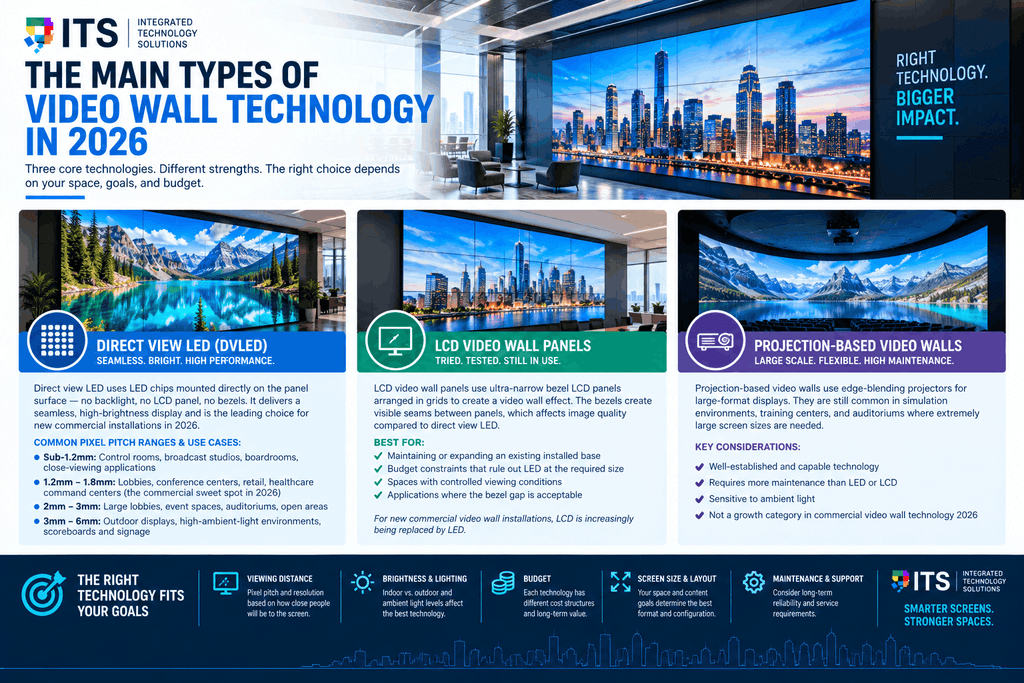
Understanding the technology options is the foundation of any commercial video wall planning process. Here is a clear overview of the main technologies and where each one fits.
Direct View LED (DVLED)
Direct view LED is the technology category that includes fine pixel pitch LED video walls. In a direct view LED display, the LED chips are mounted directly on the panel surface. There is no backlight layer and no LCD panel in between. The result is a seamless, high-brightness display with no bezels.
Direct view LED is the dominant commercial video wall technology for new installations in 2026. It covers a wide range of pixel pitches from sub-1mm for very close-viewing applications to 3mm to 6mm for large outdoor or high-ambient-light environments.
Pixel pitch determines image resolution at a given viewing distance. A smaller pixel pitch means higher resolution at closer distances. Selecting the right pixel pitch for the viewing distance in your space is one of the most important technical decisions in a commercial LED video wall project.
• Sub-1.2mm pixel pitch: Control rooms, broadcast studios, high-end boardrooms, close-viewing applications
• 1.2mm to 1.8mm pixel pitch: Corporate lobbies, conference centers, premium retail, healthcare command centers — the commercial sweet spot in 2026
• 2mm to 3mm pixel pitch: Large format lobby displays, event spaces, auditoriums, open floor applications
• 3mm to 6mm pixel pitch: Outdoor displays, high-ambient-light environments, large venue scoreboards and signage
LCD Video Wall Panels
LCD video wall panels remain installed and operational in many commercial environments. They use ultra-narrow bezel LCD panels arranged in grids to create a video wall effect. The bezels create visible seams between panels, which affects image quality compared to direct view LED.
LCD panels make sense for applications where the installed base is being maintained or expanded, where budget constraints rule out LED at the required screen size, or where the viewing conditions are controlled and the bezel gap is acceptable. For new commercial video wall installations, they are increasingly replaced by LED.
Projection-Based Video Walls
Projection-based video walls using edge-blending projectors are still found in large-venue applications like simulation environments, training centers, and auditoriums where extremely large screen sizes are needed. The technology is well-established and capable, but it requires more maintenance than LED or LCD and is sensitive to ambient light. It is not a growth category in commercial video wall technology 2026.
Commercial Video Wall Trends by Industry in 2026
The commercial video wall trends in 2026 vary by industry. Understanding where adoption is growing and what is driving it in specific sectors helps frame the right questions for your own project.
Corporate Offices and Conference Centers
Corporate environments are the largest single category for commercial video wall technology 2026 adoption. The trend is driven by several converging factors: the return to office has increased investment in premium in-office experience, hybrid meeting technology has driven the need for larger and better displays in conference rooms and collaboration spaces, and falling LED prices have made lobby and common area video walls accessible to mid-market companies.
The most common commercial video wall applications in corporate environments are executive boardrooms, large conference rooms and collaboration hubs, lobby and reception displays, and technology experience showrooms. Fine pixel pitch LED at 1.2mm to 1.8mm is the dominant technology choice for these applications.
Healthcare Facilities
Healthcare is one of the fastest-growing sectors for commercial video wall technology adoption. Hospitals and health systems are deploying video walls in patient-facing environments including waiting areas, wayfinding systems, and patient education spaces. Clinical operations centers use video wall technology for patient monitoring dashboards and situational awareness displays.
Healthcare video wall installations have specific requirements around sanitation, patient privacy, and continuous operation that influence hardware selection and installation approach. LED technology’s lower maintenance profile and longer service life make it particularly well-suited for healthcare environments where display downtime is disruptive.
Retail and Hospitality
Commercial video wall trends in retail and hospitality are being driven by the need for experiential environments that differentiate physical locations from online alternatives. High-end retail flagships use large-format LED video walls as brand storytelling canvases. Hotels and entertainment venues deploy them in lobbies, bars, and event spaces to create signature visual experiences.
The commercial video wall technology 2026 landscape for retail includes outdoor-rated LED panels for storefront and window applications, flexible form-factor displays for curved and non-rectangular installations, and integration with real-time data and content management platforms for dynamic pricing and promotional displays.
Government and Public Safety
Government agencies, emergency management centers, and public safety operations have been steady adopters of video wall technology for operations center and command center applications. The commercial video wall trends in this sector favor reliability, redundancy, and long operational life over cutting-edge pixel pitch specs.
Fine pixel pitch LED at 1.5mm to 2mm is well-suited for these applications, offering the brightness and contrast needed for 24/7 operations in mixed lighting conditions with a service life that justifies the infrastructure investment. ITS has experience with government AV and technology integration for public sector clients across Texas.
Education and Houses of Worship
Higher education institutions and houses of worship represent a growing segment of commercial video wall adoption. Large lecture halls and auditoriums benefit from high-brightness LED displays that outperform projectors in ambient light. Sanctuaries and worship spaces use video walls for lyrics, sermon content, and live camera feeds without the maintenance requirements of projection systems.
The pixel pitch range for these applications typically falls in the 1.8mm to 2.5mm range, where resolution is adequate for viewing distances of 15 feet and beyond and the cost-per-square-foot is reasonable for the budget constraints typical of institutional buyers.
What Is Actually Different About Video Wall Technology 2026 vs. 2023
For organizations that evaluated commercial video wall technology a few years ago and set it aside because the cost or technology was not right, here is a specific summary of what has changed.
Brightness and Efficiency
LED efficiency improvements since 2022 have delivered significant brightness improvements at equivalent or lower power consumption. Today’s commercial LED video wall panels deliver higher nit output with lower heat generation, which reduces cooling requirements and lowers total cost of ownership. For high-ambient-light environments like retail and lobbies, this matters a lot.
Refresh Rate and Motion Handling
High refresh rate LED panels, which reduce flicker and improve motion handling, have become standard in commercial-grade products rather than a premium option. This is particularly relevant for video content and live camera feeds, where lower refresh rates create visible artifacts. Most commercial video wall panels in 2026 ship with refresh rates of 3840Hz or higher.
Front-Service Panel Design
A significant practical improvement in commercial video wall technology 2026 is the broad availability of front-service panel designs. In earlier LED panel generations, maintenance required rear access, which made wall-mounted and recessed installations difficult to service without dismantling them. Front-service panels allow module replacement from the face of the display without rear access. This is now a standard feature at most commercial pixel pitches.
Controller and Processing Improvements
The processing hardware that drives commercial video wall systems has also improved substantially. Modern video wall controllers offer 4K and 8K source support, flexible input routing, and lower-latency video processing than systems from three or four years ago. Cloud-managed and software-defined processing options have expanded, reducing the cost and complexity of the control layer.
Key Planning Considerations for a Commercial Video Wall in 2026
If you are moving from technology research to active project planning, these are the key considerations that will shape your design decisions.
Viewing Distance Drives Pixel Pitch
The single most important technical decision in a commercial video wall project is pixel pitch selection. The rule of thumb is that the viewing distance in feet should be roughly equal to the pixel pitch in millimeters multiplied by 10 — so a 1.5mm pitch display starts to deliver clear images from about 15 feet away. Your integrator should perform a viewing distance analysis for your specific space before recommending pixel pitch.
Ambient Light Affects Everything
Display brightness requirements are determined by the ambient light in the installation environment. A lobby with floor-to-ceiling windows requires a much higher-brightness panel than a conference room with controlled lighting. Make sure your integrator specifies panel brightness in nits and does a site assessment that accounts for worst-case lighting conditions.
Power and Cooling Infrastructure
Commercial LED video walls require dedicated power circuits and generate heat that must be managed. Larger installations require coordination with the electrical contractor for circuit capacity and with the mechanical engineer for HVAC load. These infrastructure requirements should be planned before the installation design is finalized.
Content and Control System Integration
A commercial video wall is only as useful as the content that runs on it and the control system that manages it. Plan the content management platform, the input sources, and the control system interface as part of the design process, not as afterthoughts. Integration with your existing AV control system, digital signage platform, or meeting room technology should be specified before hardware procurement.
For organizations deploying video walls across multiple locations, our nationwide AV rollout process guide covers how multi-site AV programs are coordinated from design through final punch-list.
How ITS Approaches Commercial Video Wall Technology Projects
ITS designs and installs commercial video wall systems as part of our full commercial AV systems capability. We work with direct view LED technology across the full range of commercial pixel pitches, and we handle the complete scope: display design and layout, structural mounting, power and cabling infrastructure, control system integration, content management platform setup, and commissioning.
We do not recommend a product before we understand the space. Viewing distance, ambient light, content type, structural conditions, and integration requirements all shape the design. The right commercial video wall for a 10,000-square-foot corporate lobby is a different product than the right solution for a 20-person conference room, even if the hardware brand is the same.
Our structured cabling and low voltage infrastructure services are included in the scope of every video wall project, so the data and power infrastructure is designed and installed to the same standard as the display hardware.
For clients evaluating commercial video wall options in Texas and nationwide, we offer site assessments and design consultations as part of the project development process. Reach us at +1 888-985-5334 or visit our contact page to start the conversation.
For in-depth technical standards around commercial display installations, the AVIXA (InfoComm International) publishes regularly updated research on display technology performance, installation standards, and commercial AV market trends. For LED-specific technology research and market data, the LED Professional publication covers LED technology development and commercial adoption across global markets.
Frequently Asked Questions: Video Wall Technology 2026
Is direct view LED the right technology for most commercial video wall applications in 2026?
For most new commercial video wall installations in 2026, yes. Direct view LED offers better image quality, longer service life, lower maintenance requirements, and a bezel-free image compared to LCD panels. The price gap between LED and LCD has narrowed significantly. For most corporate, healthcare, retail, and institutional applications, LED is the better long-term investment.
What pixel pitch should I specify for a corporate conference room?
For a typical corporate conference room with a primary viewing distance of 10 to 20 feet, a pixel pitch in the 1.2mm to 1.8mm range is appropriate. The exact spec depends on room dimensions, ceiling height, and how the display will be used. A site assessment from your AV integrator is the right starting point.
How long does a commercial LED video wall last?
Commercial-grade LED panels from major manufacturers are rated for 100,000 hours of service life at 50 percent brightness. At typical usage levels, this equates to approximately 10 to 15 years of operational life. This is significantly longer than LCD video wall panels, which typically require backlight replacement or panel replacement at 5 to 7 years.
Can ITS install a commercial video wall outside Texas?
Yes. ITS installs commercial video wall systems as part of nationwide AV programs for multi-location clients across all 50 states. Our local technician model coordinates vetted, certified field installers in each market under centralized ITS project management.
What should I look for in a commercial video wall installer?
AVIXA CTS credentials, documented experience with the specific panel technology you are deploying, a complete installation scope that includes cabling and control system integration, and a project process that includes site assessment before design. An installer who specifies a product before understanding your space is not approaching the project correctly.
Video Wall Technology in 2026: The Bottom Line
Commercial video wall technology in 2026 is more capable, more accessible, and more varied than at any previous point. Fine pixel pitch LED has reached commercial price points. LCD is losing ground. MicroLED is on the horizon. Software-defined content management has matured. Commercial video wall trends show adoption expanding across corporate, healthcare, retail, government, and institutional sectors.
The technology research question — what is available and how does it work — is what this guide has covered. The design question — what is right for your specific space and use case — is where your AV integrator comes in.
Contact Integrated Technology Solutions to discuss commercial video wall technology options for your project. Call +1 888-985-5334 or reach out through our contact page.
