
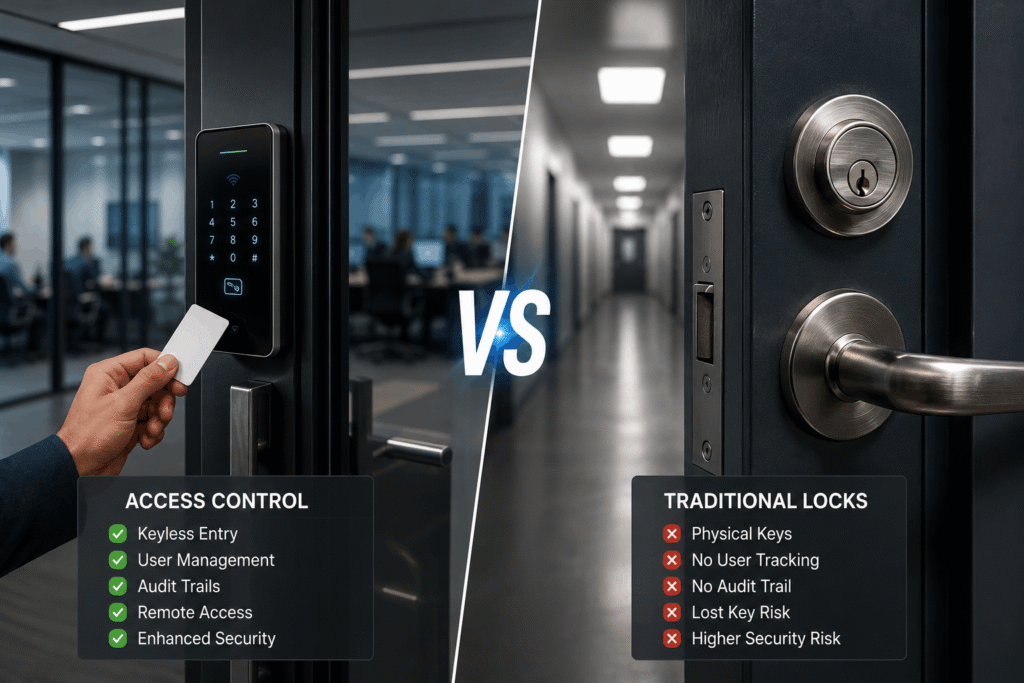
If you manage a commercial building, an office complex, or a multi-tenant facility, you have probably asked yourself this question: is it time to move beyond traditional locks? The debate around access control vs traditional locks is one of the most common conversations in building security today.
Traditional locks have protected buildings for centuries. They are simple, familiar, and affordable. But they have real limits. Lost keys, unauthorized copies, and no way to track who entered where are just a few of the problems building managers deal with every day.
Modern access control systems offer a smarter way to manage building security. They give you control, visibility, and flexibility that a traditional lock simply cannot match. But they also come with a higher upfront cost and a learning curve.
This guide breaks down access control vs traditional locks in plain language. It covers how each system works, where each one falls short, and how Texas building managers can decide which approach is right for their property. By the end, you will have a clear picture of what your building actually needs.
How Traditional Locks Work
Traditional locks are mechanical devices. A physical key turns a cylinder inside the lock, which moves a bolt and opens the door. That is the basic principle behind every traditional lock, from a simple door knob to a heavy-duty deadbolt.
Traditional locks have been the default security choice for buildings of all sizes for generations. They require no electricity, no software, and no ongoing subscription. A locksmith can service them. Any hardware store carries replacement parts.
Common types of traditional locks used in commercial buildings include:
- Deadbolts: Strong single-cylinder or double-cylinder locks used on exterior doors.
- Mortise locks: Recessed into the door for a clean finish. Common in commercial office buildings.
- Padlocks: Portable and versatile. Used on gates, storage units, and secondary access points.
- Master key systems: A hierarchy of keys where one master key opens all locks. Common in multi-tenant office buildings and apartment complexes.
Traditional locks are proven and durable. But the moment we compare access control vs traditional locks side by side, the limitations of mechanical systems become clear.
The Limitations of Traditional Locks for Commercial Buildings
Traditional locks work well in simple environments. But commercial buildings are not simple. They have multiple entry points, high staff turnover, vendor access requirements, and round-the-clock use. Traditional locks struggle to keep up.
No Audit Trail
When someone uses a traditional key, there is no record of it. You cannot see who entered a room, when they entered, or how long they stayed. If something goes wrong, a theft, a security incident, or an unauthorized access, you have no way to trace it back through the lock system.
Key Control Is a Constant Problem
Keys get lost. Employees leave without returning them. Contractors borrow keys and make unauthorized copies. Over time, you lose track of how many copies exist and who has them. Re-keying the entire building every time this happens is expensive and disruptive.
No Remote Control
A traditional lock does what it does. You cannot lock or unlock a door remotely. If an employee is locked out after hours, someone needs to physically go to the building. If you need to restrict access to a specific area quickly, you cannot do it without changing the physical lock.
Limited to One Permission Level
A traditional key either opens a lock or it does not. You cannot set time-based restrictions, limit access to specific hours, or give someone temporary access that expires automatically. Managing different permission levels for different staff members is not possible with traditional locks.
How Access Control Systems Work
Access control systems replace the physical key with an electronic credential. Instead of inserting a key, a person presents a card, enters a PIN, scans a fingerprint, or uses a smartphone app. The system checks that credential against a database and either grants or denies access.
Every interaction is logged. Every door event is recorded. Building managers can view activity in real time or review history at any time.
The main types of access control credentials used in commercial buildings today include:
- Key cards and fobs: The most common credential in offices and commercial buildings. Easy to issue and deactivate instantly.
- PIN codes: Simple and cost-effective. Can be used alone or combined with a card for two-factor access.
- Mobile credentials: Employees use their smartphones as access cards. Increasingly common in modern workplaces.
- Biometrics: Fingerprint or facial recognition. Used for high-security areas where shared credentials are not acceptable.
- Video intercoms: Visitors identify themselves via camera before access is granted. Common in multi-tenant buildings.
ITS installs all of these credential types as part of our access control systems services across Texas and nationwide.
Access Control vs Traditional Locks: A Direct Comparison
Now that we understand how both systems work, let us compare access control vs traditional locks across the factors that matter most to building managers.
Security Level
Traditional locks provide a basic level of physical security. A quality deadbolt is hard to break through, but it can still be defeated by a copied key or a lock pick. There is no way to verify who is using a key.
Access control systems are far harder to compromise. Credentials can be tied to a specific person and deactivated instantly. Biometric systems add another layer because credentials cannot be shared or copied. When comparing access control vs traditional locks on pure security, access control wins clearly.
Audit and Accountability
Traditional locks: zero audit trail. There is no record of who used which key and when.
Access control systems: full audit trail. Every access event is logged with a timestamp and user identity. This is invaluable for investigating incidents, managing compliance, and holding people accountable.
Ease of Management
With traditional locks, managing access means managing physical keys. Adding a new employee means cutting a new key. Removing access means collecting the key, hoping it has not been copied. For buildings with dozens or hundreds of staff, this becomes unmanageable quickly.
With access control systems, adding or removing access takes seconds. A manager logs into the software and makes the change instantly. This is one of the most practical advantages when evaluating access control vs traditional locks for commercial properties.
Flexibility and Permissions
Traditional locks offer no flexibility. A key opens a lock or it does not. There are no time restrictions, no temporary access options, and no way to limit which doors a specific key can open without using a complex master key system.
Access control systems offer complete flexibility. You can give a contractor access to one door from 8 AM to 5 PM on a specific date. You can restrict certain employees to specific floors. You can grant visitors temporary credentials that expire automatically. This level of control is simply not possible with traditional locks.
Cost
Traditional locks have a low upfront cost. A quality commercial deadbolt is inexpensive to purchase and install. The ongoing cost is minimal unless you need to re-key regularly.
Access control systems have a higher upfront investment. Hardware, installation, and software licensing all factor into the cost. However, when you account for the cost of re-keying, lost productivity from lockouts, and the price of a security incident, access control systems often pay for themselves quickly.
Reliability
Traditional locks are highly reliable. They work without power, software, or network connectivity. A mechanical lock will function in a power outage.
Access control systems depend on power and, in many cases, network connectivity. A well-designed system includes battery backup and fail-safe configurations so doors remain accessible during power outages. However, this requires proper planning during installation.
When Traditional Locks Are Still the Right Choice
It would be easy to say access control systems are always better. But that is not always true. There are situations where traditional locks remain the most practical option.
- Low-traffic secondary access points: A rarely used storage room or utility closet may not need electronic access control.
- Budget-constrained small businesses: A sole proprietor operating from a single-room office may not need the features access control offers.
- Backup locking mechanisms: Many access control installations include a traditional key override as a backup. Both systems can coexist.
- Areas without power infrastructure: Remote locations without reliable power may not support electronic access control without significant additional investment.
The right answer in the access control vs traditional locks debate is rarely all-or-nothing. Most commercial buildings benefit from a hybrid approach where electronic access control covers primary entry points and high-security zones, while traditional locks handle secondary or low-risk areas.
When Access Control Systems Are the Clear Choice
For most commercial properties in Texas, access control systems provide significant advantages that traditional locks simply cannot offer. Here are the scenarios where the choice is clear.
Multi-Tenant Office Buildings
Managing keys for dozens of tenants, each with multiple staff members, is a logistical nightmare. Access control systems give each tenant their own credential set that can be managed independently. Adding or removing tenants is simple. Auditing who accessed common areas is straightforward.
Healthcare Facilities
Hospitals and clinics handle sensitive patient information and medications. Controlling who can enter specific areas is not just a security preference, it is a compliance requirement. Access control systems provide the documentation and restriction capabilities these environments need.
Data Centers and Server Rooms
Physical access to servers is one of the biggest security risks for any organization. A data center or server room should always use access control. Every entry should be logged, and access should be limited to only those who absolutely need it.
Warehouses and Industrial Facilities
Large facilities with shift workers, contractors, and deliveries happening around the clock need a system that can manage high volumes of access events. Traditional locks and master key systems break down quickly in these environments. Access control scales to meet the demand.
Any Building With High Staff Turnover
If your building regularly onboards and offboards employees, access control is a must. Deactivating a credential the moment an employee leaves takes seconds. With traditional locks, you have no reliable way to prevent a former employee from using a key they never returned.
Commercial Security Systems Texas: What the Best Setups Look Like
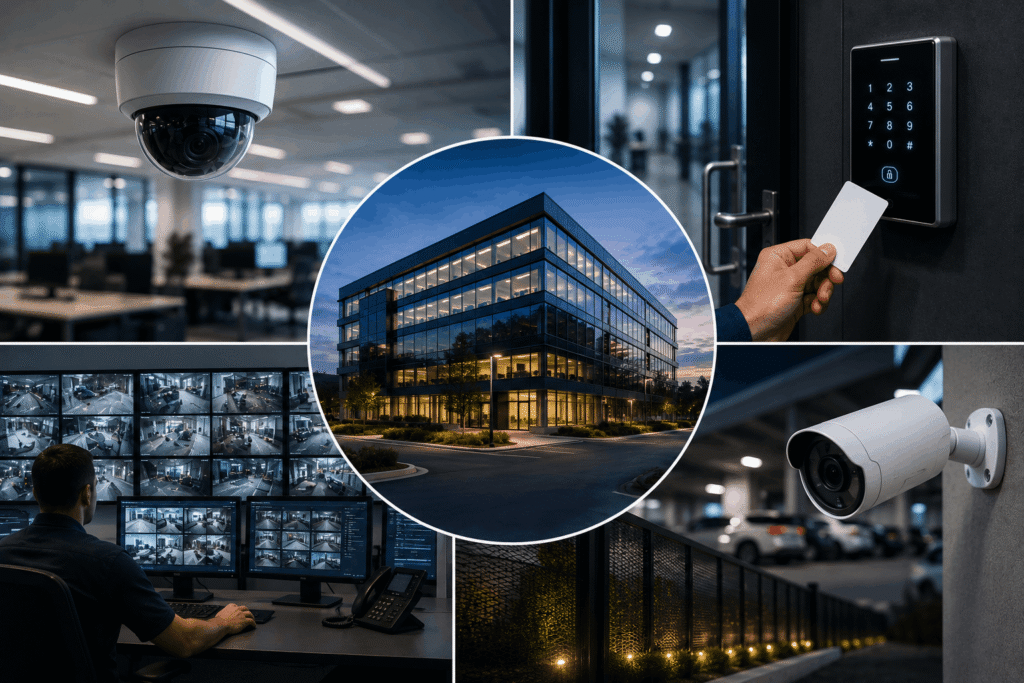
Access control is just one part of a complete security setup. The strongest commercial security systems Texas buildings use combine access control with surveillance, environmental monitoring, and integrated alarm systems.
Here is what a well-designed commercial security system for a Texas office building or facility typically includes:
- Access control at all primary entry points: Key card, mobile credential, or biometric readers at every main entrance and restricted area.
- Video surveillance throughout the facility: Cameras covering all entrances, exits, parking areas, and high-value zones.
- Integrated alarm systems: Intrusion detection that ties into the access control system and triggers alerts on unauthorized entry attempts.
- Remote monitoring capabilities: Managers can view live camera feeds, check access logs, and respond to alerts from any device.
- Visitor management integration: A front desk intercom or kiosk system that logs all visitors and ties their access to the control platform.
ITS designs and installs complete commercial security systems Texas businesses rely on for daily protection. Our commercial security and electrical services cover the full scope of what a professional security installation requires, from planning and cabling to installation and ongoing support.
The Role of Cabling in Access Control Installation
One aspect of access control that building managers often overlook is the cabling infrastructure behind the system. Every access control reader, door controller, and intercom needs power and data connectivity.
Power over Ethernet (PoE) cabling is the most common approach for modern access control installations. A single cable carries both data and power to each reader. This simplifies installation and reduces the number of separate power supplies needed.
Proper structured cabling is essential for a reliable access control system. Poorly installed or unorganized cabling leads to connection failures, intermittent faults, and difficult troubleshooting. ITS handles all cabling as part of every security installation through our structured network cabling services, ensuring your access control infrastructure is built on a solid foundation.
Texas Compliance Considerations for Access Control
Building managers in Texas need to be aware of a few code and compliance requirements when installing access control systems. These rules exist to keep buildings safe, especially during emergencies.
Fire Code and Egress Requirements
Any electronic lock on a fire egress door must fail in the unlocked position during a fire alarm. Magnetic locks and electric strikes used on egress doors must be integrated with the building’s fire alarm system so they release automatically when an alarm activates. This is a code requirement across Texas.
ADA Accessibility
Access control hardware must comply with ADA requirements. This affects the height at which card readers are mounted, the force required to operate doors, and the availability of accessible entry paths. A professional installer ensures all hardware placement meets these requirements.
Permitting
Some access control installations require permits from local authorities, particularly in Houston and other major Texas cities. ITS handles permit coordination as part of our installation process, so building managers do not need to navigate that process alone.
For a detailed look at how Texas commercial security regulations apply to your building, the Texas Department of Insurance provides guidance on alarm systems and security licensing requirements for commercial properties across the state.
How to Transition From Traditional Locks to Access Control
If you have decided that access control is right for your building, the good news is that the transition does not need to happen all at once. Most buildings move to access control in phases.
Step 1: Assess Your Current Entry Points
Start by identifying which doors and access points carry the highest security risk. Main entrances, server rooms, executive areas, and storage rooms with valuable equipment are typically the highest priority.
Step 2: Define Your Access Zones and Permission Levels
Decide which staff members need access to which areas. Map out your access zones before selecting hardware. This shapes what kind of system you need and how many readers and controllers are required.
Step 3: Select the Right Credential Technology
Choose the credential type that fits your workforce and culture. Key cards are the easiest starting point for most offices. Mobile credentials work well for tech-forward environments. Biometrics are best for high-security zones where shared access is unacceptable.
Step 4: Work With a Professional Installer
Access control installation involves electrical work, cabling, software configuration, and compliance checks. This is not a DIY project. Working with a certified installer ensures the system works correctly from day one and meets all local code requirements.
Step 5: Train Your Staff
Even the best access control system fails if staff do not know how to use it. Make sure your team understands how to issue and revoke credentials, review access logs, and respond to system alerts. A short training session at go-live makes a big difference.
Frequently Asked Questions: Access Control vs Traditional Locks
Can I keep traditional locks alongside an access control system?
Yes. Most professional installations include a traditional key override as a backup. This ensures you can always access the building even if the electronic system experiences a power failure or technical issue.
How long does access control installation take for a commercial building?
A small office with a handful of access points can be completed in one to two days. Larger facilities with dozens of doors and integrated surveillance may take one to several weeks depending on complexity and cabling requirements.
What happens to the access control system during a power outage?
A properly designed system includes battery backup for door controllers and readers. Depending on your configuration, doors can be set to fail-safe (unlock during power loss) or fail-secure (remain locked during power loss). The right setting depends on the door’s function and fire code requirements.
Is access control worth the investment for a small business?
For businesses with sensitive data, valuable equipment, or regular staff changes, yes. The cost of a single security incident, a theft, a data breach, or an unauthorized access event often far exceeds the cost of a professional access control installation.
Does ITS install access control systems across Texas?
Yes. ITS installs commercial access control systems across Houston, Dallas, Austin, San Antonio, and statewide. We also support multi-site deployments nationwide. Visit our access control systems Houston page for more details on our local services.
For further reading on commercial access control standards and best practices, the Security Industry Association (SIA) is the leading trade organization for the security technology industry. Their resources cover access control standards, emerging credentials, and compliance guidance for commercial installations.
Make the Right Security Choice for Your Building
The access control vs traditional locks debate comes down to one core question: how much control and visibility does your building actually need? For most commercial properties in Texas, the answer points clearly toward access control.
Traditional locks served buildings well for generations. But they were not designed for the complexity of modern commercial facilities. High staff turnover, multi-tenant environments, compliance requirements, and the need for audit trails have pushed building managers toward smarter solutions.
Access control systems give you real-time visibility, instant credential management, flexible permissions, and a full audit trail. When combined with video surveillance and integrated commercial security systems, they provide a level of protection that traditional locks simply cannot match.
ITS designs and installs access control and commercial security systems for buildings of all sizes across Texas and nationwide. Our team handles everything from the initial site assessment to cabling, installation, compliance checks, and staff training. Explore our full range of technology and security services to see how we can help protect your property.
Contact Integrated Technology Solutions today to discuss access control and commercial security for your building. Call us at +1 888-985-5334 or visit our contact page to schedule a free site consultation.
