
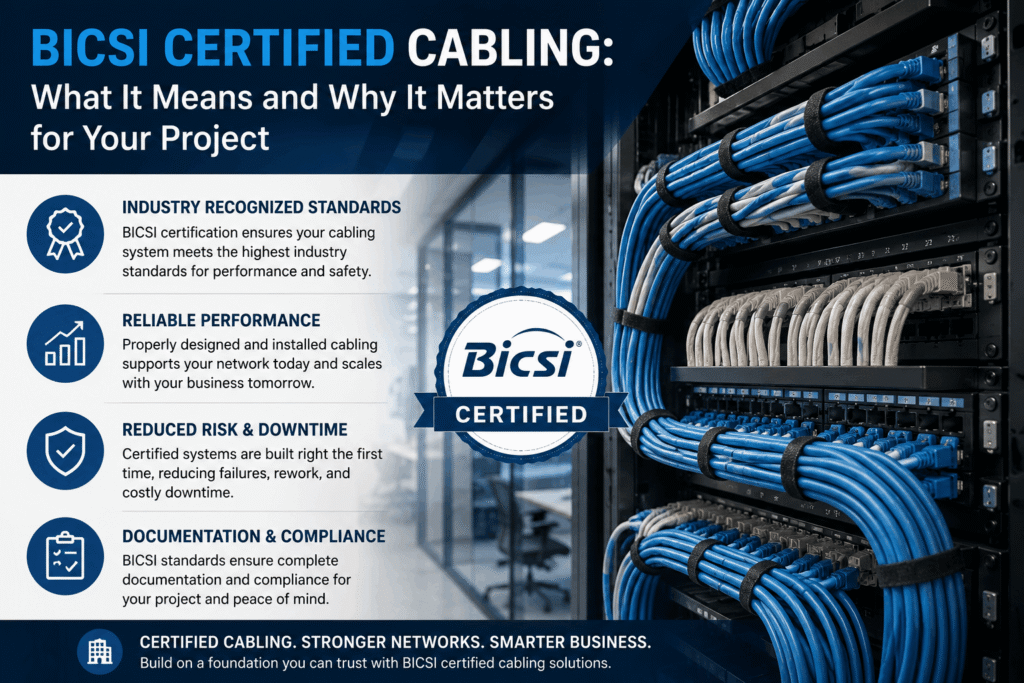
When you hire a cabling contractor, you are trusting them with the foundation of your entire network. Every device your business relies on, from servers and phones to security cameras and wireless access points, depends on that cabling infrastructure performing correctly day after day. So how do you know your installer is qualified to do it right?
That is exactly what BICSI certified cabling professionals are designed to answer. BICSI certification is the gold standard for low voltage cabling in commercial and institutional projects. It tells you that the technicians working on your building have been trained, tested, and approved to meet the highest standards in the industry.
This guide explains what BICSI certified cabling means, how the certification process works, and why it should be one of your top requirements when choosing a cabling contractor for any commercial project in Texas. By the end, you will have a clear understanding of what to look for and why it matters for your business.
What Is BICSI?
BICSI stands for Building Industry Consulting Service International. It is a nonprofit professional association that supports the information and communications technology (ICT) industry. Founded in 1974, BICSI has grown into a globally recognized authority on low voltage cabling, network design, and building infrastructure.
BICSI develops and publishes the technical standards, installation guidelines, and best practices that the cabling industry follows. Their manuals, including the BICSI Telecommunications Distribution Methods Manual (TDMM), are used by engineers, architects, and installers around the world as the definitive reference for low voltage infrastructure design.
Beyond publishing standards, BICSI offers a rigorous professional certification program. Earning a BICSI credential requires passing technical exams, demonstrating hands-on experience, and completing ongoing continuing education. It is not a certificate you get from a weekend course. It represents a serious professional commitment to the craft.
What Does BICSI Certified Cabling Mean?
When a contractor offers BICSI certified cabling, it means the technicians performing the work hold one or more active BICSI credentials. These credentials verify that the individual has demonstrated a specific level of knowledge and skill in low voltage cabling systems.
BICSI certified cabling is not just about pulling wire. It covers the entire lifecycle of a cabling system, from design and pathway planning to installation technique, testing methodology, and documentation. A BICSI certified cabling professional understands how every decision during installation affects long-term performance.
The phrase ‘BICSI certified cabling’ typically refers to installations where:
• One or more technicians hold active BICSI credentials
• The installation follows BICSI-published installation guidelines and standards
• The project is documented and tested in line with BICSI-recognized methods
• The contractor can produce certification documentation to back up the claim
For building owners, facility managers, and IT directors, asking for BICSI certified cabling is one of the most effective ways to protect your infrastructure investment before a single cable is run.
The Main BICSI Credentials Explained
BICSI offers several credentials, each targeting a different role in the low voltage industry. Understanding which credentials are most relevant to your project helps you ask the right questions when evaluating contractors.
BICSI Registered Communications Distribution Designer (RCDD)
The RCDD is BICSI’s flagship credential. It is held by designers, engineers, and senior project managers who plan and oversee low voltage cabling systems. Earning an RCDD requires passing a rigorous exam covering network design, cable plant planning, standards compliance, and project management.
An RCDD on your project means the person designing your cabling system has been independently verified as competent in low voltage infrastructure planning. For large commercial projects, data centers, or complex multi-building campuses, an RCDD-level designer is a strong indicator of a high-quality installation.
BICSI Installer Credentials (Installer 1 and Installer 2)
BICSI Installer credentials are the hands-on technician certifications. They are split into two levels.
BICSI Installer 1 covers the fundamentals of low voltage cabling installation. It validates that a technician understands basic copper and fiber installation techniques, safety practices, and cable management standards.
BICSI Installer 2 is a more advanced credential. It is split into copper and optical fiber pathways. Technicians who hold Installer 2 credentials have demonstrated advanced knowledge of installation methods, testing procedures, and troubleshooting for their specific cabling type. This is the credential you want to see on a team installing your network backbone or data center cabling.
BICSI Outside Plant (OSP) Specialist
The OSP credential covers cabling infrastructure outside buildings, including underground conduit, aerial cable, and campus-wide fiber networks. This credential is relevant for multi-building campuses, university networks, industrial facilities, and any project where cabling runs between structures across a site.
BICSI Data Center Design Consultant (DCDC)
The DCDC credential focuses specifically on data center design. It covers power, cooling, cabling, and physical infrastructure in mission-critical environments. Contractors offering BICSI certified cabling for data center projects should ideally have team members with this credential in addition to standard installer qualifications.
What Is Low Voltage Certification and Why Does It Matter?
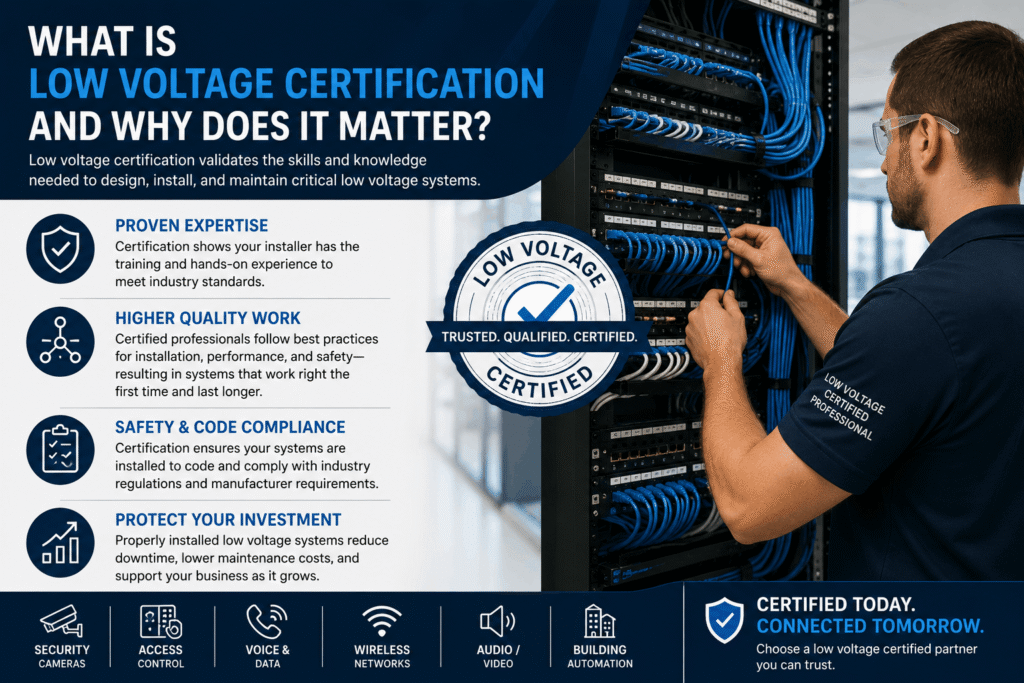
Low voltage certification covers a broader category than BICSI alone. Low voltage systems include any building systems that operate at 50 volts or less. This includes structured network cabling, fiber optic systems, security cameras, access control, fire alarm systems, AV systems, and wireless infrastructure.
Low voltage certification matters for several key reasons. First, it addresses safety. While low voltage systems carry less power than electrical systems, improper installation can still create fire hazards, signal interference, and equipment damage. Certified technicians understand how to route cables safely, maintain proper separation from power lines, and avoid common installation errors.
Second, low voltage certification affects your warranty coverage. Many cabling manufacturers only honor their product warranties when the installation is performed by certified technicians and tested to their specifications. If an uncertified installer puts in your cabling and you experience a failure, the manufacturer may deny your warranty claim.
Third, low voltage certification may be required by your building code or project specifications. Many commercial construction projects, particularly in Texas government, healthcare, and education sectors, require documentation that low voltage systems were installed by certified professionals.
How BICSI Certification Protects Your Business
Choosing BICSI certified cabling is not just about following best practices. It is a practical decision that protects your business in several concrete ways.
It Protects Your Investment
Cabling infrastructure is a long-term investment. A commercial cabling system is expected to support your operations for 10 to 15 years or more. Poor installation shortens that lifespan dramatically. Improperly terminated cables, excessive bend radius, and poor cable management all degrade performance over time.
BICSI certified cabling technicians are trained to avoid these mistakes. They understand the installation tolerances that affect long-term performance. They know how to properly dress, terminate, and test every cable run so your system performs at rated speeds throughout its useful life.
It Keeps Your Warranties Valid
Extended system warranties, often called application assurance warranties, are offered by major cabling manufacturers when their products are installed by certified partners and tested to specification. These warranties can cover your cabling infrastructure for 15 to 25 years and include both the cable and the connected applications.
BICSI certified cabling from an authorized installer is typically a prerequisite for these programs. Without certified installation, you get the standard product warranty, which is far shorter and covers only the materials, not the performance.
It Reduces Troubleshooting Costs
Problems with cabling are notoriously difficult and expensive to diagnose. A single bad termination buried in a wall can cause intermittent network issues that take hours to track down. BICSI certified cabling includes rigorous testing and documentation, so every cable run is verified before it goes live.
This upfront investment in quality pays off consistently over time. Buildings with well-documented, properly tested BICSI certified cabling systems have fewer network incidents, faster troubleshooting times, and lower ongoing IT support costs.
It Supports Future Upgrades
Technology changes. The network your business needs today will not be identical to the one you need in five years. BICSI certified cabling is installed with headroom for growth. Certified installers choose cable categories and installation methods that support higher speeds and emerging applications, not just current ones.
A properly installed Cat6A system certified by BICSI trained technicians can support 10 Gbps speeds and is considered ready for 25 and 40 Gbps applications at shorter distances. Cutting corners on installation method eliminates that future-readiness, even with the same cable.
It Meets Compliance and Code Requirements
Many regulated industries and public sector projects require proof that low voltage systems were installed by certified professionals. Healthcare facilities seeking HIPAA compliance, government buildings following GSA standards, and educational facilities often specify BICSI certified cabling in their project requirements. Having that documentation protects you during inspections and audits.
BICSI Certification vs. General Electrical Licensing in Texas
In Texas, low voltage cabling contractors are required to hold a state-issued low voltage license from the Texas Department of Licensing and Regulation (TDLR). This license is a legal requirement for anyone installing low voltage systems commercially. It covers basic competency and general safety requirements.
BICSI certification goes significantly further. A TDLR low voltage license proves that a contractor is legally permitted to work. BICSI certification proves that the technicians performing the work have met a higher professional standard through independent examination and demonstrated experience.
Think of it this way. A low voltage license is the legal minimum to operate. BICSI certified cabling is the professional standard that separates average installers from the best ones in the business. For any commercial project where performance and longevity matter, you want both.
What to Ask a Cabling Contractor About BICSI Certification
Not every contractor who claims to do BICSI certified cabling actually has current certified staff. Before hiring any low voltage contractor for a commercial project, ask these specific questions.
Which specific BICSI credentials does your team hold?
Ask for the specific credential names, not just a general yes or no. A contractor should be able to tell you whether they have RCDDs, Installer 2 copper or fiber technicians, or other relevant certifications. If they cannot be specific, that is a warning sign.
Can you provide credential ID numbers or verification?
BICSI credentials are individually registered. A contractor should be able to provide credential ID numbers that you can verify directly on the BICSI website. Legitimate BICSI certified cabling companies have no hesitation providing this information.
Are your certifications current?
BICSI credentials require ongoing continuing education to maintain. A credential that expired three years ago does not represent current knowledge. Ask about renewal status and confirm the certifications are active, not lapsed.
Will certified technicians be on-site for my project?
Some contractors hold certifications at the company level but assign uncertified workers to individual projects. Make sure the technicians who will physically work on your installation hold the relevant BICSI credentials, not just someone in the corporate office.
Will you provide test reports and as-built documentation?
BICSI certified cabling includes proper testing and documentation as a standard deliverable. Every cable run should be tested with certified equipment and results recorded. As-built drawings should reflect the final installed system. A contractor who hesitates on this question is not following BICSI-level standards regardless of what certifications they claim.
Projects That Benefit Most From BICSI Certified Cabling
While BICSI certified cabling is a smart choice for any commercial project, some environments benefit more than others. Here are the project types where certification makes the biggest difference.
Data Centers
Data centers are mission-critical environments where cabling errors have immediate and severe consequences. BICSI certified cabling is essentially the standard for serious data center construction. ITS performs full data center installation services with BICSI certified technicians on every project, from backbone fiber to rack integration and grounding.
Healthcare Facilities
Hospitals, clinics, and medical offices run life-critical systems over their networks. Imaging equipment, patient monitoring systems, electronic health records, and communication platforms all depend on reliable, properly installed cabling. BICSI certified cabling gives healthcare facility managers confidence that the underlying infrastructure will not let them down.
Government and Education
Federal, state, and local government facilities often specify BICSI certified cabling in project requirements. Schools and universities operate complex networks covering multiple buildings and supporting thousands of simultaneous users. Low voltage certification is frequently a contract requirement in both sectors.
Commercial Office Buildings and Corporate Campuses
Large office buildings and corporate campuses with structured cabling needs, fiber backbone, and complex network designs benefit greatly from BICSI certified installers. Our structured network cabling services cover everything from small office buildouts to multi-floor enterprise installations, all performed by BICSI certified cabling technicians.
Multi-Site National Deployments
Businesses with multiple locations across Texas or nationwide need consistent cabling quality at every site. BICSI certified cabling from a single provider with certified staff in each region ensures that the network infrastructure at your San Antonio office performs the same as the one at your Dallas headquarters.
Low Voltage Certification and the Broader Technology Infrastructure
Low voltage certification covers more than just network cabling. Every low voltage system in your building benefits from properly certified installation. Here is how BICSI standards and low voltage certification apply across the systems ITS installs.
• Fiber optic cabling: Fiber optic installation requires specific BICSI certified techniques for splicing, termination, and OTDR testing to ensure performance at rated speeds.
• Security systems: Access control and surveillance cabling follows low voltage certification standards for safe routing, EMI separation, and power distribution.
• Wireless infrastructure: Managed wireless systems depend on properly installed PoE cabling infrastructure, which must be installed to the same BICSI certified standards as the rest of the network.
• Commercial AV systems: Display systems, sound masking, and video conferencing infrastructure all run on low voltage cabling that benefits from BICSI certified installation practices.
Frequently Asked Questions About BICSI Certified Cabling
Is BICSI certification required by law in Texas?
BICSI certification is not legally required in Texas. However, a TDLR low voltage license is required for commercial low voltage work. BICSI certification goes beyond the legal minimum to demonstrate professional competency. Many project specifications and manufacturer warranty programs require it.
How do I verify that a contractor is BICSI certified?
You can verify BICSI credentials directly through the BICSI website at www.bicsi.org. Ask the contractor for the credential holder’s name and ID number, then confirm the credential is active. Any reputable BICSI certified cabling company will provide this willingly.
Does BICSI certification guarantee a perfect installation?
No certification eliminates human error entirely. But BICSI certified cabling does set a measurably higher standard for how work is planned, executed, tested, and documented. It significantly reduces the likelihood of installation errors and ensures any problems are caught through testing before they become network issues.
Does BICSI certified cabling cost more?
Certified installation may carry a modest premium over uncertified work. However, the cost of rework, downtime, and warranty disputes caused by poor installation consistently exceeds any savings from choosing a cheaper, uncertified contractor. The long-term cost of BICSI certified cabling is almost always lower.
Does ITS employ BICSI certified technicians?
Yes. ITS has BICSI certified technicians on our team and applies BICSI standards to every commercial project we handle. Our BICSI certified cabling approach covers structured network cabling, fiber optic systems, data center installations, and low voltage infrastructure across Texas and nationwide.
To learn more about BICSI credentials, continuing education requirements, and how to verify a technician’s certification status, visit www.bicsi.org. BICSI’s website includes a searchable directory of certified professionals and detailed information about every credential program they offer.
For a broader look at low voltage cabling standards that BICSI certified professionals follow, the Telecommunications Industry Association (TIA) publishes the ANSI/TIA-568 and ANSI/TIA-942 standards that govern commercial and data center cabling design and installation across North America.
Choose BICSI Certified Cabling for Your Next Project
Your cabling infrastructure is the foundation everything else in your network depends on. It deserves to be installed by professionals who have proven their knowledge, tested their skills, and committed to the highest standards in the industry. That is exactly what BICSI certified cabling delivers.
From design and pathway planning to installation, testing, and documentation, BICSI certified cabling professionals approach every project with a level of precision that uncertified contractors simply cannot match. The result is infrastructure that performs reliably, lasts longer, and costs less to maintain over time.
Integrated Technology Solutions employs BICSI certified technicians and applies BICSI standards to every commercial cabling project we take on. Whether you need structured network cabling for a new office, fiber optic backbone for a data center, or low voltage infrastructure for a multi-site national deployment, our certified team delivers the quality your business deserves.
Contact Integrated Technology Solutions today to discuss your cabling project with a BICSI certified team. Call us at +1 888-985-5334 or visit our contact page to request a free site consultation and project quote.
