
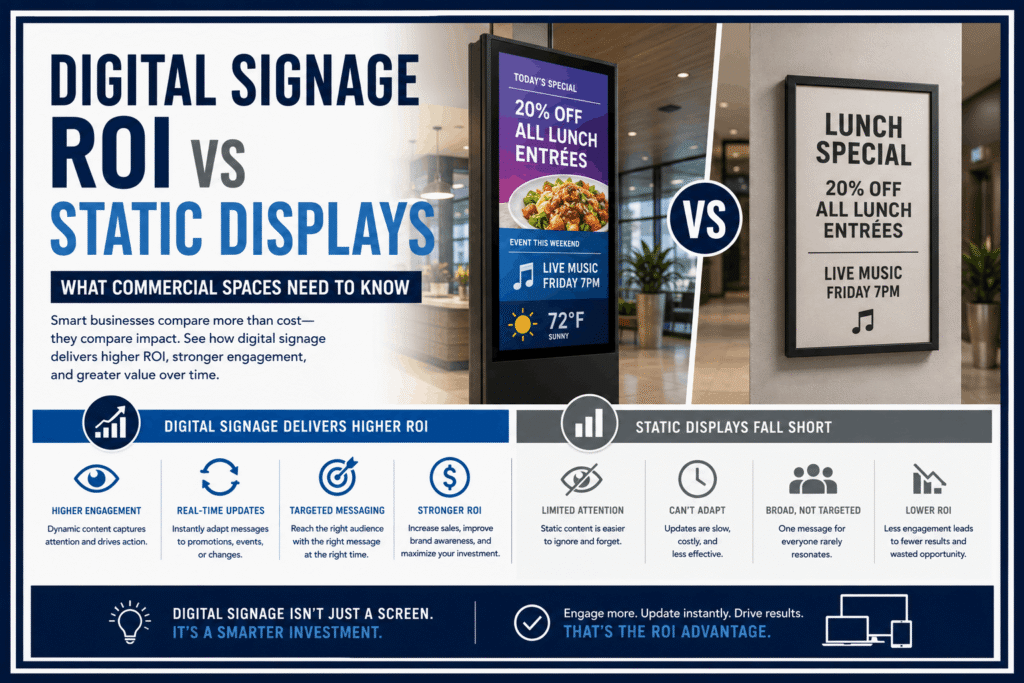
Static displays have been the default choice for commercial spaces for decades. Printed posters, framed banners, and vinyl graphics are familiar, affordable, and simple. But they are also fixed. Once a static display is printed and installed, the message is locked in until someone replaces it. In a world where business moves fast and audiences expect dynamic, relevant content, that limitation adds up quickly.
Digital signage ROI is the question more and more business owners, property managers, and marketing teams are asking. Is switching from static to digital worth the investment? How long before the costs pay off? What does digital signage actually deliver that a printed sign cannot?
This guide answers all of those questions directly. It compares digital signage and static displays across the factors that matter most to commercial decision-makers, breaks down the real components of digital signage ROI, and helps businesses in Texas and beyond determine when digital is the right move and when it is not.
What Is Digital Signage ROI?
Digital signage ROI refers to the measurable return a business gets from investing in digital display technology compared to what it would spend on static alternatives. It accounts for both the direct financial return and the broader business value that digital signage delivers over its useful life.
Calculating digital signage ROI is not always straightforward. Some returns are easy to quantify, such as reduced printing costs and increased sales from promotional displays. Others are harder to put an exact number on, such as improved brand perception, better customer experience, and reduced staff time spent swapping printed materials.
A complete picture of digital signage ROI looks at both sides of the equation: the full cost of ownership and the full value generated. Businesses that only look at upfront hardware cost consistently underestimate the return because they miss everything that happens over the life of the system.
Static Displays: Strengths and Real Costs
Before making the case for digital signage ROI, it is worth being honest about why static displays are still widely used. They have genuine advantages that deserve acknowledgment.
Strengths of Static Displays
• Low upfront cost: A printed banner or framed poster costs a fraction of what a digital display does to purchase and install.
• No power required: Static displays need no electricity and no network connection. They work anywhere.
• No technical maintenance: There is nothing to malfunction, update, or reboot.
• High brightness outdoors: Well-produced vinyl and print graphics in direct sunlight can outperform lower-brightness digital displays in visibility.
The Hidden Costs of Static Displays
The low upfront cost of static displays is real, but the long-term cost picture is more complicated. Most businesses underestimate what they spend on static signage over time.
• Recurring print and production costs: Every time a message changes, a new sign must be designed, printed, and delivered. For businesses that update messaging frequently, this adds up to thousands of dollars per year.
• Installation and labor costs: Replacing static displays requires staff time or outside contractors. Multiply this by every location and every update cycle.
• Waste: Printed materials that are outdated or unused become waste. Businesses running promotions, events, or seasonal campaigns produce significant quantities of printed material that goes directly in the recycling bin.
• Missed revenue opportunities: A static display cannot be updated in real time. A promotion that ended yesterday is still being advertised today. A product that sold out is still being promoted. These gaps cost money.
• Brand inconsistency: Static displays at multiple locations go out of date at different rates. Without a coordinated replacement process, messaging becomes inconsistent across a brand’s footprint.
What Digital Signage Delivers That Static Cannot
The fundamental advantage of digital signage over static displays is content flexibility. A digital display can show anything, at any time, in any sequence, from anywhere. That flexibility creates value in ways that static simply cannot replicate.
Real-Time Content Updates
With a digital signage content management system, any authorized user can update a display in seconds from a laptop or phone. A price change, a new promotion, a change in business hours, or an emergency message can be pushed to every screen across every location simultaneously.
This speed and flexibility is a core driver of digital signage ROI in retail, healthcare, hospitality, and corporate environments. The ability to respond to conditions in real time is simply not possible with static displays.
Scheduled Content and Dayparting
Digital signage allows businesses to schedule different content for different times of day automatically. A hotel lobby can show breakfast specials in the morning, local attractions at noon, and dinner promotions in the evening. A corporate office can show meeting schedules during business hours and security reminders overnight.
This kind of contextual content delivery increases relevance and engagement. A message that matches the moment the viewer is in performs better than a static message that is always the same regardless of context.
Multi-Location Consistency
Businesses with multiple locations can manage all screens from a single platform. A brand update, a campaign launch, or a corporate announcement can be deployed to every screen in every location at exactly the same time. This consistency is extremely difficult and expensive to achieve with static displays.
For Texas businesses with offices or retail locations across Houston, Dallas, Austin, and San Antonio, this kind of centralized control over messaging is a significant operational advantage.
Dynamic Data Integration
Modern digital signage platforms can pull live data from external sources and display it automatically. Weather feeds, stock tickers, sports scores, social media walls, queue management data, and real-time KPI dashboards are all examples of dynamic content that digital signage can display and update continuously.
In healthcare waiting rooms, manufacturing floors, corporate operations centers, and financial services offices, this kind of live data display has genuine business value that no static display can come close to matching.
Audience Attention and Engagement
Motion captures attention. Digital displays with animated content, video, and changing messages attract and hold viewer attention longer than static displays. Research on digital signage ROI consistently finds that digital displays generate significantly higher recall rates than static equivalents. People remember what they saw on a digital screen more than what they saw on a printed sign.
How to Calculate Digital Signage ROI
Understanding digital signage ROI in real numbers requires looking at both sides of the ledger carefully. Here is a practical framework for calculating it.
Step 1: Calculate the Full Cost of Digital Signage
The true cost of a digital signage system includes more than the screens. A complete cost calculation covers:
• Hardware: Display screens, media players, mounts, and enclosures.
• Installation: Professional mounting, cabling, and network connection. This is where working with a qualified installer matters.
• Content management software: Most platforms charge an annual subscription. This is an ongoing cost but is typically modest relative to the value delivered.
• Content creation: Someone needs to design and manage the content. This may be handled internally or outsourced.
• Network infrastructure: Displays need reliable network connectivity. If existing wireless coverage is inadequate, this may require an upgrade.
• Maintenance and support: Ongoing support costs over the system’s useful life, typically 7 to 10 years for commercial-grade hardware.
Step 2: Calculate the Full Cost of Static Alternatives
Now do the same honest accounting for static displays over the same period:
• Annual printing and production costs multiplied by the number of years in the comparison period
• Installation and swap-out labor costs for each update cycle
• Design costs for each new static piece produced
• Waste disposal and recycling costs for outdated materials
Most businesses that run this calculation find that the total cost of static signage over five to seven years is significantly higher than they expected. In high-update-frequency environments like retail, hospitality, and foodservice, the static cost often exceeds the digital investment within three years.
Step 3: Quantify the Revenue Impact
This is where digital signage ROI gets interesting. Beyond cost savings, digital signage can directly drive revenue. Retail environments using digital signage for promotional displays consistently report increases in impulse purchase rates. Restaurants using digital menu boards report higher average order values. Corporate lobbies with digital displays report better client impressions that support business development.
Quantifying this impact precisely requires tracking sales data before and after installation. But the direction of the effect is consistent across industry research. Digital signage drives more engagement, and more engagement drives more revenue.
Even a conservative estimate of incremental revenue impact, combined with measurable cost savings on printing and labor, typically produces a compelling digital signage ROI calculation for any commercial space with moderate to high foot traffic.
LED Signage for Commercial Buildings: Why LED Is the Dominant Technology
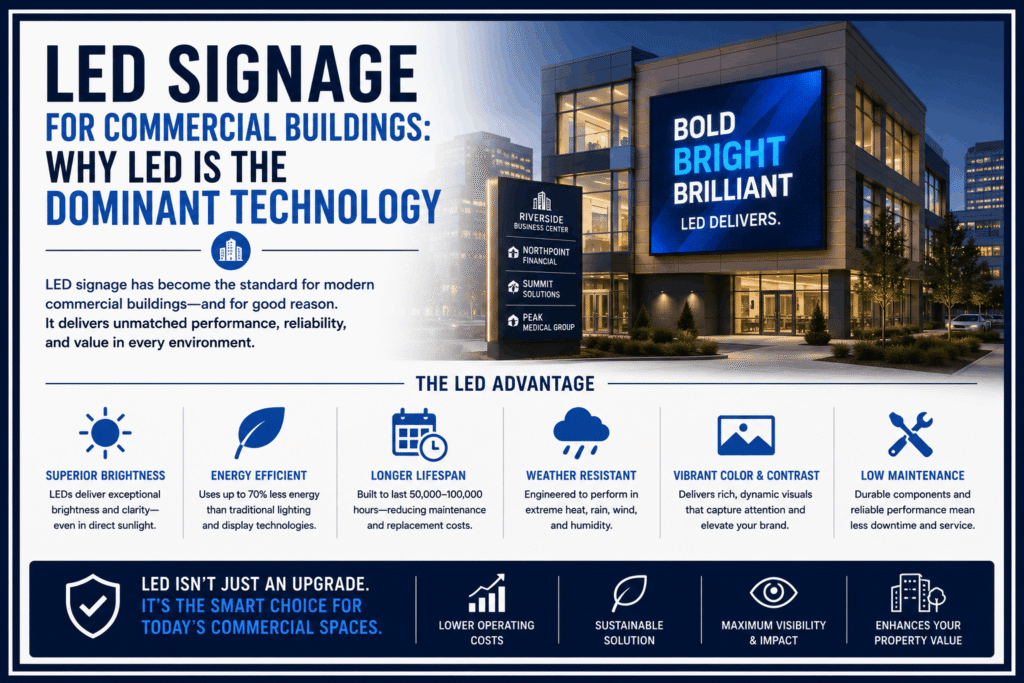
When businesses move to digital signage, the technology choice matters. LED signage for commercial buildings has become the dominant standard for most applications, outperforming older LCD and projector-based solutions on almost every measure.
Brightness and Visibility
LED signage in commercial buildings can achieve brightness levels that remain fully visible in direct sunlight and bright lobby environments. LCD displays often wash out in high-ambient-light conditions. For retail storefronts, building facades, outdoor wayfinding, and sun-filled lobbies, LED is the technology that performs reliably regardless of lighting conditions.
Energy Efficiency
Modern LED signage in commercial buildings uses significantly less power than older display technologies. LED backlighting is far more efficient than fluorescent or CCFL backlighting in legacy LCD systems. For businesses tracking energy consumption as part of sustainability programs, this difference is meaningful both for operating costs and reporting.
Lifespan and Reliability
Commercial-grade LED displays are rated for 50,000 to 100,000 hours of operation. That translates to many years of continuous use. LCD panels with fluorescent backlights degrade much faster and require backlight replacement. LED lifespan directly affects the digital signage ROI calculation because a longer-lasting display spreads its capital cost over more years.
Seamless Large-Format Displays
LED video wall panels join together without visible bezels, allowing very large seamless displays in lobbies, atriums, and feature walls. This creates visual impact that static displays and standard LCD screens simply cannot match. For commercial buildings where first impressions matter, the difference is immediately visible to anyone who walks in.
ITS installs LED signage for commercial buildings as part of our digital signage services and our commercial AV systems work. Whether the application calls for a single lobby display or a large-format LED video wall, our team handles design, installation, and commissioning from start to finish.
Digital Signage ROI by Commercial Space Type
Digital signage ROI varies by environment. Some commercial spaces see a faster and stronger return than others. Here is how the ROI calculation plays out across the most common commercial applications.
Retail Environments
Retail is where digital signage ROI research is most extensive. Studies consistently show that digital point-of-sale displays increase impulse purchase rates, and dynamic promotional content drives higher basket sizes than static price tags or printed posters.
Retail environments also have high update frequency for promotions, seasonal campaigns, and price changes. The printing cost savings alone can be substantial for large retailers. Add revenue lift from better promotional content and digital signage ROI in retail is typically strong and relatively quick to materialize.
Corporate Offices and Commercial Buildings
In corporate offices, digital signage ROI comes from multiple sources. Lobby displays impress clients and signal organizational quality. Employee communication screens in break rooms and corridors improve internal communication and reduce email load. Meeting room displays showing schedules reduce booking conflicts and wasted space.
LED signage in commercial buildings also supports wayfinding, especially in larger multi-floor or multi-wing facilities where visitors and new employees need guidance. Digital wayfinding is significantly cheaper to update than printed directory systems and provides a much better visitor experience.
Healthcare Facilities
Hospitals, clinics, and medical offices benefit from digital signage ROI in waiting room environments. Digital displays showing estimated wait times reduce perceived wait times and improve patient satisfaction scores. Health education content on digital screens replaces printed pamphlets that quickly become outdated.
Healthcare facilities with multiple entrances or large campuses also see significant value from digital wayfinding systems. A well-designed digital directory that a patient can interact with reduces staff time spent giving directions and improves the overall patient experience.
Hospitality and Food Service
Hotels and restaurants are among the highest-ROI environments for digital signage. Digital menu boards in restaurants consistently produce higher average order values than printed menus. The ability to change menu items, prices, and featured specials instantly has enormous operational value for food service businesses.
In hotels, digital signage in lobbies, elevator banks, and conference areas keeps guests informed and reduces front desk inquiries. Event boards, dining specials, and local recommendations delivered through digital displays add to the guest experience without adding staff workload.
Industrial and Logistics Facilities
Manufacturing plants and distribution centers use digital signage on production floors for safety messaging, real-time production data, KPI dashboards, and shift announcements. Digital displays in these environments reduce reliance on printed safety notices that become outdated, improve safety awareness through dynamic messaging, and give floor managers a real-time communication channel to the entire workforce.
When Static Displays Are Still the Right Choice
Digital signage ROI is compelling in most commercial environments, but there are situations where static is still the practical choice.
• Permanent wayfinding: Room numbers, floor directories, and building markers that never change do not need digital updates. Engraved or high-quality printed permanent signage is appropriate here.
• Very low traffic areas: A remote utility room or storage area with almost no foot traffic will never generate enough viewer engagement to justify digital hardware.
• No power or network access: Some locations simply cannot support digital hardware without significant infrastructure investment that cannot be justified by the use case.
• Regulatory compliance contexts: Some compliance notices, fire exit signs, and safety labels are required to be permanently posted in specific formats. These are not candidates for digital replacement.
A smart approach to digital signage ROI does not mean replacing every static display in a building. It means identifying the locations and use cases where digital delivers the most value and investing there first.
What Makes a Digital Signage Installation Deliver Strong ROI
The technology is only part of what drives digital signage ROI. The content strategy and the quality of the installation both play a significant role in how much value the system actually delivers.
Content Strategy Matters
A digital display showing the same static image it showed on day one delivers almost no advantage over a printed sign. Digital signage ROI comes from using the platform’s flexibility. Content needs to be updated regularly, scheduled intelligently, and designed to engage the specific audience in that location.
Businesses that invest in a content plan alongside their hardware investment see dramatically better returns than those that treat digital signage as a one-time install and forget it.
Display Placement and Viewing Angles
A display that faces the wrong direction, hangs too high, or sits in a location where it cannot be seen delivers poor ROI regardless of content quality. Professional installation includes planning display placement based on actual foot traffic patterns and typical viewing distances.
Network Infrastructure
Digital signage that cannot reliably connect to its content management system cannot be updated. Reliable network connectivity is a prerequisite for digital signage ROI. ITS designs and installs the managed wireless and network infrastructure that digital signage systems depend on, ensuring every display maintains a stable connection for remote content management.
Professional Installation and Cabling
A commercial display mounted incorrectly, powered inconsistently, or connected with poorly routed cables creates maintenance problems that erode ROI over time. ITS handles complete installation including display mounting, power connections, and structured cabling for every digital signage project, so the infrastructure behind the display is as professional as the display itself.
Frequently Asked Questions About Digital Signage ROI
How long does it take to see a return on digital signage?
Most commercial environments see digital signage ROI materialize within two to four years when accounting for printing cost savings, labor reduction, and revenue impact. High-frequency update environments like retail and food service often see payback in 18 to 24 months. Corporate and healthcare applications typically take two to four years.
Does digital signage really increase sales?
Industry research consistently shows it does in retail and food service environments. The exact impact varies by content quality, placement, and the specific products or promotions being displayed. Businesses that actively manage their digital signage content see higher returns than those that set content once and leave it unchanged.
What is the lifespan of commercial LED signage?
Commercial-grade LED displays are typically rated for 50,000 to 100,000 hours of use. Running 12 hours per day, a 50,000-hour display would last over 11 years. LED signage in commercial buildings typically outlasts multiple generations of static display materials by a wide margin.
Can I manage digital signage across multiple Texas locations from one place?
Yes. Cloud-based content management systems allow centralized management of displays across unlimited locations. You can push content to every screen in every location simultaneously, schedule location-specific content, and monitor display status from a single dashboard.
Does ITS install digital signage systems in Texas?
Yes. ITS installs commercial digital signage systems for businesses across Houston, Dallas, Austin, San Antonio, and statewide. We also support multi-location national deployments. Visit our digital signage service page for more information on our installation capabilities and the environments we serve.
For further research on digital signage performance and audience engagement data, the AVIXA (InfoComm International) publishes annual AV industry research that covers digital signage adoption trends and ROI metrics across commercial sectors. Their data is widely referenced by AV professionals and business decision-makers evaluating digital signage investments.
The Digital Signage Association (DSA) also provides industry benchmarks and resources on digital signage ROI across retail, corporate, healthcare, and hospitality environments. Their member resources include case studies and ROI frameworks that help businesses build the business case for digital signage investment.
Make the Move to Digital Signage With ITS
The case for digital signage ROI over static displays is clear in most commercial environments. Static displays have low upfront costs, but the long-term cost of printing, labor, and missed opportunities consistently exceeds the investment in a well-planned digital signage system.
Digital signage delivers what static cannot. Real-time updates. Scheduled content. Multi-location control. Dynamic data integration. Higher audience engagement. And in the right environments, measurable revenue lift that shows up directly in business performance.
LED signage in commercial buildings takes this further. Commercial-grade LED hardware is bright, energy-efficient, and built to last for years. The seamless, vibrant visual experience it delivers in lobbies, retail environments, corporate spaces, and healthcare facilities creates immediate impact that static simply cannot replicate.
ITS designs and installs complete digital signage solutions for commercial businesses across Texas and nationwide. We handle everything from display selection and mounting to cabling, network infrastructure, and content management platform setup. Explore our full range of commercial AV systems services to see how digital signage fits into a complete technology strategy for your space.
Contact Integrated Technology Solutions today to discuss digital signage ROI for your commercial space. Call us at +1 888-985-5334 or visit our contact page to request a free consultation and project quote.
