
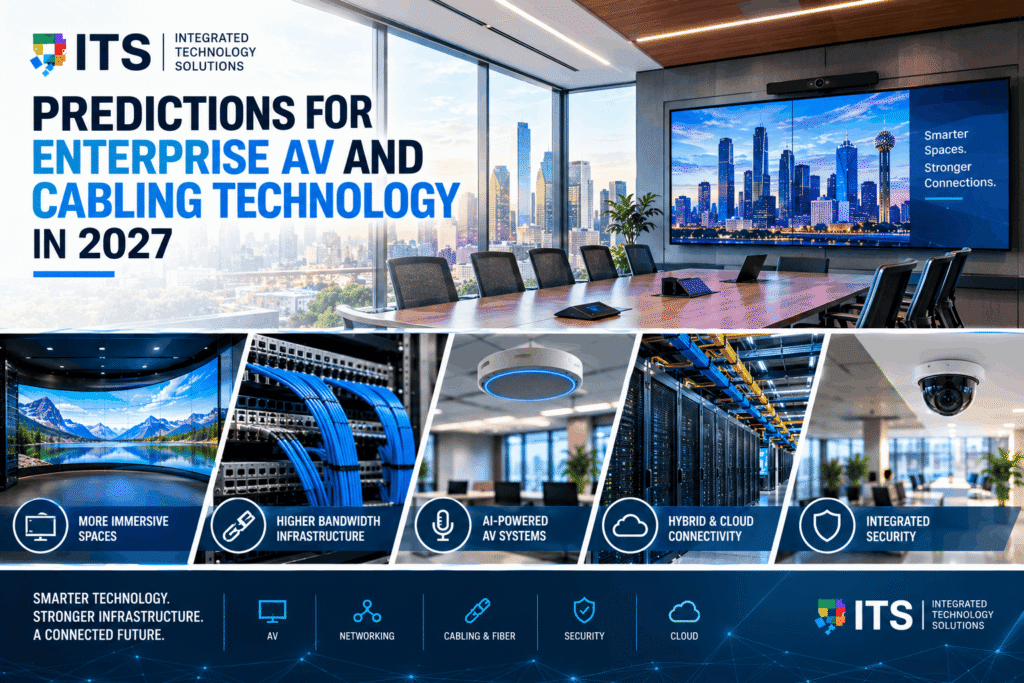
The commercial technology landscape changes fast. What was cutting-edge two years ago is now standard. What is emerging today will be expected by 2027.
For IT directors, facilities managers, and technology decision-makers, staying ahead of those shifts is not just interesting. It is practical. The decisions you make today about cabling infrastructure, AV systems, and network architecture will determine whether your facilities are ready for what comes next, or whether you are paying to retrofit systems that should have been planned better from the start.
These AV technology predictions for 2027 are grounded in what we see happening on commercial job sites every day. We are not predicting science fiction. We are describing the directions that are already underway and explaining where they are headed by the end of next year. Some of these enterprise IT trends will affect your next project. All of them will affect your planning horizon.
1. Cat6A Becomes the Baseline for New Commercial Installations
Cat6A has been the recommended standard for new commercial cabling for several years. In 2027, it will be the baseline expectation. Cat6 will move into the category of legacy infrastructure, acceptable for low-demand applications but no longer the right choice for a new installation designed to last ten or more years.
The driver is bandwidth demand. A modern commercial office runs IP cameras, wireless access points, video conferencing endpoints, digital signage, access control readers, and occupancy sensors all over the same cabling infrastructure. Many of those devices are now Power over Ethernet, meaning the cabling carries both data and power. Cat6A handles those loads with room to grow. Cat6 is running out of headroom.
One of the clearest AV technology predictions for 2027 is that Cat6A will also become the minimum for PoE++ applications. As AV devices, lighting controls, and building automation systems draw more power over Ethernet, the higher-grade cable becomes necessary not just for bandwidth but for thermal management. Cat6A handles power more efficiently because its larger conductors and improved geometry reduce heat buildup in bundled runs.
Enterprise IT trend: If your cabling infrastructure is more than seven years old, your Cat6 plant may not support the next generation of PoE devices or high-bandwidth AV endpoints. Our structured cabling services include infrastructure assessments that evaluate whether existing cabling can support new technology requirements.
2. Fiber to the Desk Gains Real Traction
Fiber to the desk has been discussed for years. In 2027, it will stop being a specialty option and start appearing in mainstream commercial projects.
The case for fiber at the workstation level has always been technically sound. Fiber handles higher bandwidth, does not generate heat from power loads, is immune to electromagnetic interference, and supports much longer runs than copper. The reason it has not taken over is cost and complexity. Fiber endpoints cost more than copper. Technicians need additional training. Active equipment at each end adds to the system cost.
What is changing is the economics. Single-pair Ethernet (SPE) on one side and small-form-factor fiber solutions on the other are both converging on price points that make fiber at the workstation financially reasonable for a wider range of projects. In high-performance environments like trading floors, healthcare facilities, and broadcast studios, the premium is already justified. By 2027, it will be justified for a broader range of office applications.
This is one of the enterprise IT trends that will affect cabling design decisions most directly. Specifying fiber pathways in new construction now preserves the option without committing the full cost upfront. Infrastructure decisions made in 2026 and early 2027 will determine whether buildings can adopt fiber at the desk without expensive retrofits later.
3. Wi-Fi 7 Deployments Accelerate
Wi-Fi 6E was the last major wireless upgrade cycle. Wi-Fi 7, formally IEEE 802.11be, is already in devices and access points available today. By 2027, Wi-Fi 7 will be the standard for new enterprise wireless deployments.
Wi-Fi 7 brings meaningful improvements over Wi-Fi 6 and 6E. Multi-Link Operation (MLO) allows devices to send and receive data across multiple frequency bands simultaneously, dramatically reducing latency and improving reliability. Maximum throughput increases to 46 Gbps in ideal conditions, though real-world enterprise performance benefits are more modest and more important, involving better client density handling and lower latency rather than raw speed numbers most devices will never reach.
The enterprise IT trend here is not just about faster Wi-Fi. It is about wireless infrastructure becoming capable enough to replace wired connections for an expanded range of applications. High-resolution video conferencing, wireless AV distribution, and real-time collaboration tools all benefit from Wi-Fi 7 capabilities in ways that previous generations could not reliably deliver.
One of our clearest AV technology predictions for 2027: wireless AV distribution will move from a specialty solution to a mainstream option for conference rooms and collaboration spaces. The limiting factor has always been the reliability and latency of the wireless network underneath. Wi-Fi 7 removes most of those objections.
Enterprise IT trend: Wi-Fi 7 access points require Cat6A or better for backhaul to reach their rated performance. Wireless infrastructure and cabling infrastructure are more closely linked than ever. Our managed wireless services cover full enterprise Wi-Fi design, installation, and validation including cabling infrastructure assessment.
4. AV over IP Replaces Traditional AV Matrix Switching
Traditional AV distribution uses dedicated hardware matrix switchers to route video signals from sources to displays. A large system might have a single switcher handling dozens of inputs and outputs. That switcher is expensive, proprietary, and a single point of failure.
AV over IP distributes video signals over the standard Ethernet network infrastructure instead. Encoders convert video signals to network packets at the source. Decoders convert them back at the display. The network itself handles the routing. Any encoder can reach any decoder, at any scale, without a proprietary matrix switcher in the middle.
AV over IP has been growing for several years. By 2027, it will be the dominant architecture for new commercial AV installations with more than a handful of displays. The AV technology predictions for 2027 from virtually every industry analyst and trade organization point in the same direction: proprietary matrix switching is end-of-life architecture for new projects.
What this means practically is that the network becomes the AV backbone. Network design and AV design must be coordinated from the beginning of a project. An AV system specification that does not involve the network team is incomplete. The network must support multicast traffic, have sufficient bandwidth headroom, and be configured correctly for AV quality of service.
This is one of the enterprise IT trends with the most direct infrastructure implication. The cabling and switching infrastructure that carries AV over IP traffic needs to be sized for video bandwidth, not just data traffic. Our commercial AV services include AV over IP design and our network cabling scope is designed in coordination with AV requirements.
5. AI-Driven Conference Room Systems Become Standard
Conference room technology has been getting smarter for several years. Cameras that track the active speaker. Microphones that suppress background noise automatically. Room scheduling systems that release unoccupied bookings. In 2027, AI will be embedded in conference room systems at a level that makes manual operation feel like a step backward.
Here is what AI-driven conference room systems will do as a standard by 2027:
• Auto-frame and crop to active speakers, including tracking multiple participants simultaneously
• Separate speech from background noise in real time, not just during post-processing
• Identify meeting participants and adjust camera angles and display layouts automatically
• Transcribe and summarize meetings in real time with speaker identification
• Manage room audio zones based on where people are sitting, not where the microphones are mounted
These capabilities are available today in high-end systems. By 2027, they will be in mid-market systems at price points that make them standard for corporate conference rooms.
The AV technology prediction for 2027 that matters most here is about infrastructure. AI-enabled AV systems require more network bandwidth, more processing power at the room level, and more reliable connectivity than their predecessors. A conference room designed for traditional video conferencing may not have the infrastructure to support next-generation AI-enabled systems without cabling upgrades, access point additions, or power circuit additions for higher-wattage devices.
6. Digital Signage Becomes Dynamic and Data-Connected
Static digital signage has been mainstream for years. A screen in the lobby showing company news or wayfinding information is no longer impressive or even particularly useful.
By 2027, the enterprise IT trend in digital signage is toward dynamic, data-connected displays. Signage that pulls live data from building systems, business applications, and external feeds. Displays that change content based on who is in the room, what time it is, or what is happening in the business. Wayfinding that updates in real time as meeting room bookings change throughout the day.
The AV technology predictions for 2027 from the signage industry are consistent: the content management system becomes as important as the display hardware. A digital signage installation that cannot integrate with real-time data sources is already behind. Our digital signage services include content management system selection and integration as part of the design scope.
The infrastructure implication: data-connected signage needs reliable network connectivity at every display location. Displays that were installed with a single HDMI cable and a local media player are not ready for this shift. New installations should be planned with IP connectivity, sufficient bandwidth, and content management system integration from day one.
7. Security Systems Converge with IT Infrastructure
Physical security systems have historically operated on separate networks from IT infrastructure. IP cameras talked to a dedicated video management system. Access control ran on its own network. The IT team and the facilities team managed their respective systems with minimal coordination.
That separation is ending. One of the clearest enterprise IT trends for 2027 is the full convergence of physical security systems onto the corporate IT network. IP cameras, access control, visitor management, and alarm systems are all becoming IT-managed devices, subject to the same network security policies, firmware update cycles, and monitoring tools as laptops and servers.
This creates real benefits. Unified monitoring. Easier integration between systems. Reduced infrastructure cost from sharing a single network. And it creates real challenges. Security cameras and access control systems have historically had poor cybersecurity practices. Default passwords, unpatched firmware, and no encryption were standard. Putting those devices on a corporate network without addressing those weaknesses creates significant risk.
The AV technology prediction for 2027 that follows from this trend: organizations will increasingly require demonstrated cybersecurity compliance from physical security contractors, not just installation quality. Our commercial security services include IP camera and access control systems designed for IT network integration from the start, not adapted after the fact.
8. Single-Pair Ethernet Expands IoT Connectivity
Single-Pair Ethernet (SPE) is a relatively new cabling standard that uses a single twisted pair of conductors instead of the four pairs in standard Ethernet cables. It carries data at speeds up to 10 Mbps over distances up to 1,000 meters, with Power over Data Line (PoDL) for powering endpoint devices.
SPE is not designed to replace Cat6A for workstations or AV systems. It is designed for the enormous category of IoT devices that need connectivity but not high bandwidth: sensors, actuators, environmental monitors, access readers, lighting controls, and building automation endpoints.
By 2027, SPE will be a recognized part of commercial building infrastructure planning. Buildings that install SPE infrastructure during construction will have a cost-effective pathway to connect hundreds or thousands of IoT devices without running full Cat6A to each one. Buildings that do not plan for it will face the same kind of retrofit problem that early buildings faced when wireless access points became standard.
This is one of the enterprise IT trends that most facilities and IT teams are not yet thinking about. The planning decisions being made today for buildings that will open in 2027 and beyond need to account for SPE infrastructure requirements, particularly in healthcare, education, and smart building environments where IoT device density will be high.
9. Cabling Infrastructure Lifecycle Planning Becomes a Budget Priority
Enterprise organizations have generally treated cabling infrastructure as a one-time capital expense. Install it during construction, forget about it until something breaks, replace it reluctantly when it fails.
By 2027, that approach will be increasingly untenable. The technology demands placed on cabling infrastructure are growing faster than the expected lifespan of installed cable plants. A Cat6 installation from 2015 was specified for the technology of 2015. It was not designed for PoE++ power loads, Wi-Fi 7 backhaul, AV over IP distribution, or the IoT device densities that are now standard.
One of the practical AV technology predictions for 2027 is that enterprise IT and facilities budgets will increasingly include line items for cabling infrastructure assessments and planned upgrades, rather than waiting for failures. Organizations that have a documented picture of their cabling infrastructure, including test results, as-built records, and age and condition information, will be better positioned to plan technology upgrades without emergency rework.
This connects directly to the work ITS does on project closeout. Every project we deliver includes full as-built documentation and test reports. That documentation is the starting point for lifecycle planning. For organizations without that record, an infrastructure assessment is the first step. Our structured cabling services include assessments for existing installations.
10. Sustainability Requirements Affect Technology Specification
Commercial building sustainability requirements are expanding. Energy codes, green building certifications, and corporate sustainability commitments are all driving change in how technology systems are specified and installed.
By 2027, this enterprise IT trend will show up in commercial AV and cabling in several ways:
• PoE lighting and controls. Power over Ethernet lighting reduces the need for dedicated electrical circuits and enables granular, software-controlled energy management. It requires structured cabling infrastructure designed for power, not just data.
• Energy-efficient AV endpoints. Display manufacturers are under increasing pressure to reduce standby power and operating power. By 2027, energy consumption will be a factor in AV product specification alongside performance and cost.
• Longer-lifespan infrastructure. Sustainable building practice includes specifying infrastructure that lasts. Cat6A over Cat6, fiber over copper for backbone, and higher-grade termination hardware all extend the useful life of installed infrastructure and reduce the frequency of replacement.
• Documentation as a sustainability tool. Buildings that cannot provide as-built records for their technology infrastructure cannot optimize energy management or plan upgrades efficiently. Documentation is increasingly being recognized as an element of sustainable building operation, not just a project closeout formality.
What These AV Technology Predictions for 2027 Mean for Your Next Project

Ten trends. Each one has a practical implication for decisions you are making right now.
The common thread across all of these enterprise IT trends is infrastructure. Cabling, pathways, equipment rooms, power, and network architecture are the foundation that every AV and IT system depends on. The technology at the top of the stack changes quickly. The infrastructure underneath changes slowly and expensively.
The organizations that will be best positioned in 2027 are the ones that make infrastructure decisions today with the next five to ten years in mind. That means:
• Specifying Cat6A or better for all new horizontal cabling
• Designing fiber backbone pathways that support future expansion
• Sizing equipment rooms for the equipment density of 2027, not 2024
• Planning wireless infrastructure for Wi-Fi 7 access point density and backhaul requirements
• Designing AV systems with AV over IP architecture as the baseline rather than the specialty option
• Treating cabling documentation as a strategic asset, not a project closeout formality
ITS designs and installs commercial AV, structured cabling, wireless, and security systems with these enterprise IT trends in mind on every project. Whether you are planning a new build-out, upgrading an existing facility, or managing a multi-location technology program, our team brings the technical depth and practical experience to specify infrastructure that is ready for what comes next. Read more about how we approach technology build-out planning for commercial projects of every size.
Frequently Asked Questions: AV Technology and Enterprise IT Trends for 2027
How do I know if my current cabling infrastructure can support 2027 technology requirements?
The starting point is knowing what you have. If you have test reports and as-built documentation for your current cabling, a low voltage contractor can review them against the requirements of the systems you want to add. If you do not have documentation, a cabling assessment is the first step. The assessment tests existing links, documents the infrastructure as it is actually installed, and evaluates it against current and near-future technology requirements.
Should we wait to install Wi-Fi 7 until more devices support it?
No. Wi-Fi 7 access points are backward compatible with Wi-Fi 6, 6E, 5, and 4 devices. Deploying Wi-Fi 7 infrastructure now supports all existing devices while preparing the network for next-generation devices as they arrive. The real question is whether your cabling infrastructure supports Wi-Fi 7 access point backhaul requirements, which typically require Cat6A or better for multi-gigabit uplinks.
What is the biggest mistake organizations make when planning AV systems for 2027?
Designing the AV system in isolation from the network infrastructure. AV over IP, wireless AV distribution, AI-enabled conference room systems, and data-connected signage all depend on the network in ways that older AV systems did not. If the AV design and the network design are developed separately, conflicts appear at installation when it is expensive to resolve them. Engaging a contractor who understands both AV and network infrastructure from the start eliminates that problem.
How should enterprise IT teams think about physical security convergence?
Start by inventorying every physical security device on the network, or that will be on the network after an upgrade. Evaluate each device for firmware currency, default credential risks, and encryption capability. Develop a standard for physical security device cybersecurity that matches the organization’s IT security policy. Then apply that standard to new procurement. Retrofitting cybersecurity onto existing devices is harder than specifying it correctly from the start.
Does ITS help with technology planning beyond just installation?
Yes. ITS engages with clients during the design and planning phase of commercial technology projects, not just at installation. We provide infrastructure assessments, technology roadmap consultations, and design services that help organizations make better infrastructure decisions before construction begins. Reach us at +1 888-985-5334 or through our contact page to start a planning conversation.
For authoritative perspective on enterprise AV technology predictions and industry trends, AVIXA publishes an annual AV industry outlook report covering market size, technology adoption trends, and enterprise IT trends in the commercial AV sector. BICSI’s technology outlook resources cover infrastructure trends for telecommunications and data center environments.
