
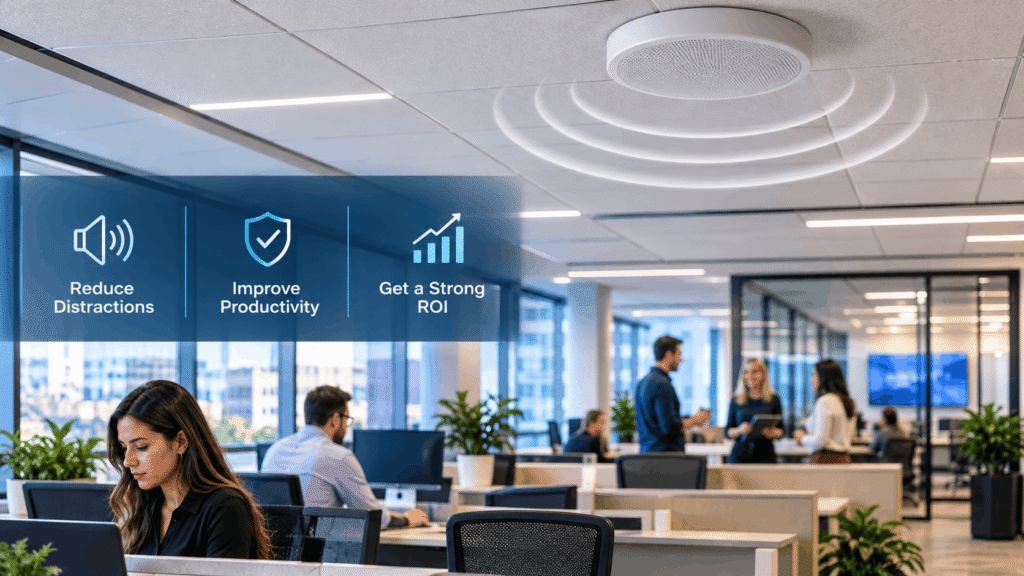
Open offices are loud. Anyone who has worked in one knows the problem. Conversations carry across the room. Phone calls are impossible to ignore. A single loud colleague disrupts everyone around them. Productivity drops. Stress goes up.
The instinct is to add more acoustic panels, more carpet, more soft surfaces. Those help, but they do not solve the core problem. The core problem is not that sound is too loud. It is that speech is too intelligible. When you can clearly hear what someone is saying across the room, your brain processes it even when you are trying to ignore it.
Office sound masking systems solve that problem directly. They add a low-level background sound to the environment that makes speech less intelligible without making the office noticeably louder. When speech privacy improves, concentration improves with it.
This guide covers what sound masking systems actually do, what they cost, how to evaluate ROI, and which systems work best for different office environments.
What Is an Office Sound Masking System?
A sound masking system is not white noise. That is the most common misconception. White noise includes all frequencies equally, which creates a harsh, unpleasant sound at the levels needed to be effective.
Office sound masking systems use a precisely tuned audio signal that is shaped to match the frequency profile of human speech. The signal is typically described as a soft rushing or airflow sound. It is designed to be heard without being noticed, similar to HVAC background noise.
The signal is distributed through a network of small loudspeakers installed in or above the ceiling. The speakers are tuned so the sound level is consistent throughout the covered area, typically within plus or minus one to two decibels. Inconsistent coverage creates “hot spots” and “dead spots” that undermine the system’s effectiveness.
How Sound Masking Works
Speech intelligibility depends on the difference between the level of the speech signal and the level of background sound. When background sound is low, speech stands out clearly even from a distance. When background sound is higher, the same speech becomes harder to understand from the same distance.
Sound masking raises the background sound floor by a controlled amount, typically 6 to 12 decibels, specifically in the frequency range where speech is most intelligible. A person speaking at a normal conversational level becomes difficult to understand beyond a short distance, typically 10 to 15 feet in a well-tuned system, compared to 40 to 50 feet in an untreated open office.
The result is not silence. People can still hear that conversations are happening around them. They just cannot make out the words. That is the difference between a distraction and background noise.
Where Office Sound Masking Systems Are Used
Open offices are the most common application, but office sound masking systems are used across many commercial environments.
• Open plan offices. The primary application. Open floor plans with low or no partitions between workstations create high speech intelligibility across large areas. Sound masking reduces the effective radius of conversational distraction.
• Healthcare facilities. HIPAA requires reasonable steps to protect patient privacy in clinical areas. Sound masking is one of the most practical tools for achieving speech privacy at nurse stations, check-in areas, and adjacent waiting rooms without construction.
• Legal and financial offices. Confidential conversations in law firms, financial advisory offices, and insurance companies benefit directly from improved speech privacy. Sound masking helps protect client confidentiality without private offices for every employee.
• Call centers. Call centers generate constant voice noise. Sound masking reduces the cross-contamination of audio from adjacent workstations, improving agent focus and customer call quality.
• Government and secure facilities. Sound masking is commonly specified in classified and sensitive compartmented information facilities (SCIFs) and government offices where speech privacy is a security requirement.
• Education. Open learning environments, libraries, and academic offices use sound masking to create workable acoustic conditions in spaces that were not designed with speech privacy in mind.
Sound Masking Cost: What to Expect

Sound masking cost varies based on the system type, the coverage area, the installation environment, and the level of tuning and commissioning included. Here is a practical breakdown.
Per-Square-Foot Cost
The most common way to estimate sound masking cost is per square foot of coverage area. For commercial office sound masking systems installed in a standard suspended ceiling environment, typical installed cost runs from $1.50 to $3.50 per square foot. That range covers equipment, installation labor, and basic commissioning.
Higher-end direct field systems, which install emitters directly in the plenum above the ceiling rather than below it, typically run from $2.50 to $5.00 per square foot installed. These systems produce more consistent coverage and allow more precise tuning but cost more to install because the emitters are less accessible once the ceiling is closed.
Total Project Cost by Office Size
To put sound masking cost in practical terms:
• Small office (2,000 to 5,000 sq ft): Typically $3,000 to $17,500 installed. A single-zone system with one amplifier and basic tuning.
• Mid-size office (5,000 to 20,000 sq ft): Typically $7,500 to $70,000 installed. Multiple zones, dedicated amplification per zone, full tuning and commissioning.
• Large office (20,000 to 50,000 sq ft): Typically $30,000 to $175,000 installed. Multi-zone system with centralized control, zone-by-zone tuning, and integration with building automation.
• Enterprise or multi-floor deployment: Priced per floor or per zone. Floor-by-floor pricing is common for large programs, with economies of scale reducing per-square-foot cost on larger total footprints.
These ranges reflect installed cost in a standard suspended ceiling office environment. Unusual ceiling types, existing infrastructure conflicts, or phased installation across occupied spaces can add to the sound masking cost. A site-specific proposal is the only way to get an accurate number for a given project.
What Drives Sound Masking Cost Up or Down
Several factors push sound masking cost above or below the typical range:
• Ceiling type. Standard suspended acoustic tile ceilings are the easiest and least expensive installation environment. Open ceilings, plaster ceilings, or unusual ceiling heights require modified mounting approaches that add labor cost.
• Number of zones. More zones mean more amplifiers and more tuning time. Large offices with multiple acoustic environments, conference rooms, and open areas typically require multi-zone systems.
• System type. Indirect field systems (speakers above the tile, radiating upward through the ceiling) are less expensive to install than direct field systems (speakers mounted below the ceiling, radiating down). Indirect field systems are more common in standard office environments.
• Commissioning quality. A properly commissioned system requires a trained technician with calibrated measurement equipment to tune the sound level and frequency profile zone by zone. Systems that are installed but not properly tuned rarely perform well. Budget for thorough commissioning.
• Paging and music integration. Many office sound masking systems also support paging and background music distribution on the same speaker infrastructure. Adding these capabilities increases equipment cost but reduces the overall cost compared to installing separate paging and music systems.
Sound Masking ROI: The Business Case
Sound masking cost is easy to quantify. The return on that investment is harder to measure precisely, but the research is consistent. Reduced noise distraction produces measurable improvements in employee productivity and satisfaction.
The Productivity Research
Several published studies have examined the relationship between acoustic conditions and office worker productivity. The findings are consistent across different research groups and methodologies.
A study published in the Journal of the Acoustical Society of America found that open office workers experienced a 66 percent reduction in productivity on cognitively demanding tasks when exposed to irrelevant speech. The mechanism is well understood. The human brain cannot fully suppress speech processing even when the listener is actively trying to focus on something else. Intelligible speech near the threshold of consciousness is more disruptive than speech that is clearly audible or clearly inaudible.
Sound masking reduces speech intelligibility below the threshold where the brain actively processes it. When speech stops being understandable, it stops being a distraction in the same way.
Calculating ROI on Sound Masking Cost
The simplest ROI calculation for office sound masking systems treats it as a productivity investment. Here is a conservative model:
• An open office of 10,000 square feet houses approximately 80 to 100 workers at standard density.
• Sound masking cost for that space is approximately $15,000 to $35,000 installed.
• If sound masking improves effective productive hours by 5 percent across the workforce, the gain is roughly 4 hours per worker per week.
• At an average fully-loaded employee cost of $60,000 to $80,000 per year, a 5 percent productivity gain is worth $3,000 to $4,000 per employee per year.
• For 80 employees, that is $240,000 to $320,000 in recovered productivity per year.
• Payback period on a $25,000 sound masking installation: less than six weeks.
Even at a more conservative productivity improvement of 2 percent, the payback period on a well-designed sound masking installation is typically under six months. No other acoustic improvement delivers a comparable return at this cost level.
ROI Beyond Productivity
Productivity is the most quantifiable ROI component, but it is not the only one.
• Reduced absenteeism. Chronic noise stress contributes to fatigue and burnout. Reducing noise distraction in open offices has been correlated with lower stress levels and reduced sick day use in several workplace studies.
• Reduced real estate footprint. Some organizations justify an open office plan in part because of sound masking. The ability to seat more employees per square foot becomes practical when speech privacy is controlled. For organizations paying $50 to $100 per square foot for commercial office space in major markets, the space efficiency argument for sound masking is substantial.
• HIPAA compliance. For healthcare organizations, sound masking cost in clinical areas may be partially justifiable as a compliance investment, not just a productivity one. The cost of a HIPAA violation is substantially higher than the cost of an office sound masking system.
• Talent retention. Office environment quality affects employee satisfaction and retention. Acoustic comfort is consistently among the top-rated workplace concerns in occupant satisfaction surveys. A well-tuned sound masking system improves the employee experience in a tangible, measurable way.
Top Office Sound Masking Systems
The commercial office sound masking systems market is dominated by a small number of established manufacturers. Here are the systems most commonly specified for commercial office projects.
Cambridge Sound Management Qt
Cambridge Sound Management is one of the most recognized names in office sound masking systems. Their Qt product line uses a direct field approach, with small emitters installed above the ceiling tile that radiate sound upward through the tile into the occupied space below.
The Qt system is known for ease of installation and consistent coverage. It uses a distributed architecture with small local controllers rather than a central amplifier, which reduces the impact of a single component failure. Cambridge Sound Management systems are widely specified for corporate offices, healthcare, and legal environments.
Soft dB Modio
Soft dB is a Canadian manufacturer with strong representation in the North American commercial office sound masking systems market. Their Modio system uses an above-ceiling indirect field approach and is known for precise tuning capability and robust system management software.
Soft dB systems are often specified for larger, multi-zone installations where detailed zone-by-zone control and documentation are required. Their tuning methodology is well-regarded among acoustic consultants.
AtlasIED Atmosphere
AtlasIED’s Atmosphere platform integrates sound masking with paging and background music distribution in a single system architecture. For organizations that want a unified audio infrastructure rather than separate systems for masking, paging, and music, the Atmosphere platform reduces overall system cost and simplifies management.
AtlasIED has strong distribution and support presence across North America, which makes service and replacement parts readily available for commercial clients.
Lencore Spectra
Lencore has a long history in the commercial sound masking systems market. Their Spectra system is a centralized architecture with a main signal generator and distributed amplifiers feeding ceiling speakers. Lencore is frequently specified for healthcare, legal, and financial environments where speech privacy requirements are strict.
The Spectra system supports detailed zone control and is designed for large, complex installations. Lencore also offers a paging and music integration path similar to AtlasIED.
Biamp Tesira with Sound Masking
Biamp is a major commercial audio processing platform. Their Tesira DSP architecture supports sound masking as one application alongside conferencing, paging, and distributed audio. For organizations already deploying Biamp for conference room AV or distributed audio, adding sound masking to the Tesira infrastructure is a natural extension.
Biamp’s approach suits integrators who are already working within their ecosystem and want to manage sound masking alongside other audio systems from a single platform.
Choosing the Right System for Your Office
The right system depends on your specific environment and priorities. Here are the key factors that guide system selection.
Office Size and Zoning Requirements
Small offices with a single acoustic environment can use a simple single-zone system from any of the major manufacturers. Large offices with conference rooms, executive areas, open plan floors, and transitional spaces need multi-zone systems with independent control over each zone’s sound level and frequency profile.
Zone boundaries matter. Areas with significantly different acoustic requirements need independent zones. A conference room adjacent to an open office should be a separate zone from the open office. Trying to tune a single zone to serve both spaces produces compromised results in both.
Ceiling Type and Access
Standard suspended acoustic tile ceilings are compatible with all major office sound masking systems and produce the best results with indirect field approaches. Open ceilings require direct field speaker mounting and typically cost more to install. Low ceilings or unusual ceiling geometry may require acoustic modeling before the system is specified.
Integration with Paging and Music
If the organization uses paging for announcements or wants background music in common areas, selecting a sound masking system that integrates those functions reduces total system cost and simplifies management. AtlasIED’s Atmosphere and Lencore’s systems are both strong options for integrated paging and music.
Tuning and Support Requirements
All office sound masking systems require tuning after installation to perform correctly. Some systems make tuning easier and more precise than others. Ask your contractor about the tuning process and what documentation they will provide. A system that was never properly tuned is not a working system, regardless of how good the hardware is.
Sound Masking Installation: What to Expect
A sound masking installation in a standard suspended ceiling office is a clean, relatively low-disruption process. Here is what it typically involves.
Pre-Installation Site Survey
A qualified sound masking contractor should conduct a site survey before specifying the system. The survey evaluates the ceiling type, existing HVAC noise levels, office layout, zone requirements, and any unusual acoustic conditions. The output is a system design with speaker placement, zone boundaries, and amplification requirements documented before any equipment is ordered.
Installation
Installation involves running low-voltage cabling above the ceiling to each speaker location, installing the speakers or emitters, connecting amplifiers or controllers, and wiring the system back to the head end. In an occupied office, installation can often be completed during off-hours or phased by zone to minimize disruption.
A typical 10,000-square-foot office installation takes one to two days for a crew familiar with sound masking systems. Larger or more complex installations take longer.
Tuning and Commissioning
After installation, the system must be tuned. A technician with calibrated measurement equipment walks the covered area, measures the sound level at multiple points in each zone, and adjusts the amplifier output and the signal’s frequency profile to achieve consistent coverage.
Proper commissioning takes several hours for a multi-zone system. Do not accept a sound masking installation that has not been properly commissioned. The equipment cost is a small fraction of the total system investment. Skipping commissioning is a false economy that produces a system that does not perform as designed.
Documentation and Handover
At project completion, the contractor should provide documentation of the as-installed system, including speaker placement, zone boundaries, amplifier settings, and tuning measurements. This record supports future changes and allows the system to be re-tuned if the office layout changes significantly.
Sound Masking vs. Other Acoustic Treatments
Sound masking is one tool in the acoustic comfort toolkit, not a replacement for every other approach. Here is how it compares.
• Acoustic panels and absorption. Absorption reduces reverberation and echo. It does not raise the background sound floor or reduce speech intelligibility. In a highly reflective space, absorption is important before adding sound masking. In a space that is already acoustically absorptive, sound masking addresses the remaining intelligibility problem that absorption cannot.
• Partitions and barriers. Physical barriers between workstations reduce sound transmission. They do not address sound that travels over or around them. Sound masking works in the space beyond the barrier, where speech would otherwise be intelligible even without direct line of sight.
• Private offices. Full enclosure provides complete speech privacy but eliminates the open plan efficiency that many organizations are trying to achieve. Sound masking allows open plans to provide acceptable speech privacy at a fraction of the real estate cost of private offices.
• White noise generators. Consumer-grade white noise machines produce a harsh, unpleasant sound at the levels required to be effective. Office sound masking systems use spectrally shaped signals delivered through ceiling-distributed speakers at levels that are effective without being objectionable. The comparison is not really fair to either product; they are not the same thing.
For organizations planning a new office build-out or a significant AV and technology upgrade, sound masking is often a natural addition to the low voltage scope alongside commercial AV systems, structured cabling, and managed wireless. Installing sound masking during construction or a full renovation is significantly less expensive than retrofitting it into an occupied and finished space.
Frequently Asked Questions: Sound Masking Cost and Office Sound Masking Systems
Is sound masking the same as soundproofing?
No. Soundproofing prevents sound from passing through walls and barriers. Sound masking adds background sound to reduce speech intelligibility within the same space. They solve different problems. Soundproofing is a construction solution. Sound masking is an electronic acoustic treatment. Most open office acoustic problems are not soundproofing problems; they are speech intelligibility problems that sound masking addresses directly.
Will employees find the background sound annoying?
In a properly designed and tuned system, most employees do not consciously notice the masking signal after the first few days. The signal is shaped to sound like soft airflow or HVAC background noise. People are already accustomed to that type of background sound in commercial buildings. What they do notice is that the office is less distracting. When the system is turned off for maintenance, the silence typically feels uncomfortably quiet to people who have worked in a masked environment.
Can sound masking be added to an existing office without construction?
Yes. Above-ceiling systems can be installed without touching the floor or walls. A technician accesses the ceiling plenum above the tile and installs emitters and low-voltage cabling without significant disruption to the occupied space below. Phased installation by zone allows work to be completed during off-hours with minimal impact on the work day.
Does sound masking affect conference room privacy?
Yes, in two ways. Masking in the open office reduces the likelihood that conversations from outside a conference room disrupt people inside. Masking inside a conference room, at a slightly higher level than the open office, reduces the intelligibility of conversation leaking out of the room. Both applications address real speech privacy concerns. Conference room masking is often specified at a separate zone from open office masking so the levels can be tuned independently.
Does ITS install sound masking systems in Texas and nationwide?
Yes. ITS installs office sound masking systems as part of our commercial AV scope for clients in Texas and nationwide. Sound masking is typically delivered as part of a broader commercial technology program alongside AV, cabling, and wireless infrastructure. Contact ITS at +1 888-985-5334 or through our contact page to discuss sound masking for your facility.
For further reference on commercial acoustic standards and sound masking design practices, ASHRAE publishes guidance on acoustic design for occupied spaces as part of their HVAC applications standards. The Acoustical Society of America publishes peer-reviewed research on workplace acoustics including speech intelligibility and masking effectiveness studies. BICSI’s TDMM covers telecommunications infrastructure design including audio distribution systems in commercial buildings.
