
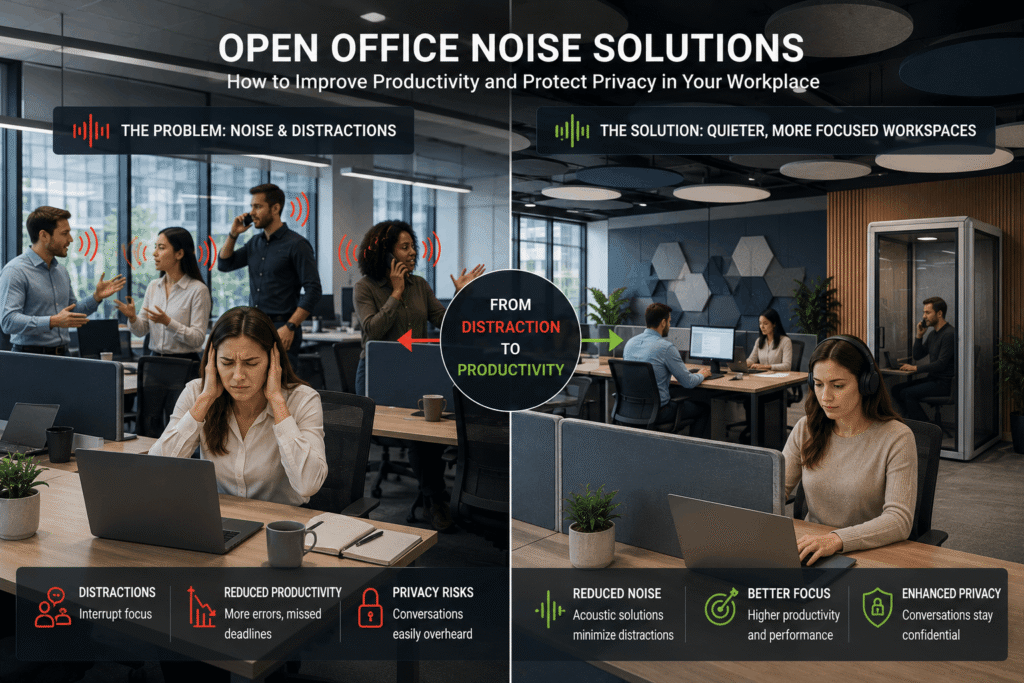
Open office layouts were designed to encourage teamwork and communication. In many workplaces, they do exactly that. But they come with a serious downside: noise. Conversations, phone calls, keyboard clicks, and background chatter fill the space from wall to wall. For employees trying to focus, it can feel impossible.
Open office noise solutions have become one of the most searched topics in workplace design. Businesses across Texas and nationwide are looking for practical ways to reduce distraction, protect speech privacy, and help employees do their best work without tearing down walls or rebuilding their entire office.
This guide explains the real cost of open office noise, the most effective open office noise solutions available today, and how to choose the right approach for your workspace. Whether you manage a corporate headquarters, a call center, or a healthcare facility, the information here applies directly to your environment.
The Real Cost of Noise in Open Offices
Before exploring open office noise solutions, it helps to understand how significant the problem actually is. Office noise is not just annoying. It has real, measurable effects on how people work and how businesses perform.
Productivity Loss
Research consistently shows that noise is one of the leading causes of productivity loss in the workplace. When an employee is interrupted by a nearby conversation, it takes an average of 23 minutes to fully regain focus. In a busy open office, that kind of interruption can happen multiple times an hour.
The math adds up quickly. An employee who loses focus five times in a workday could lose two or more hours of productive time. Multiply that across a team of 50 people and the impact on output becomes significant.
Employee Stress and Dissatisfaction
Chronic noise exposure increases stress levels. Employees in noisy open offices report higher levels of fatigue, frustration, and job dissatisfaction than those in quieter environments. Studies examining tens of thousands of workers across hundreds of buildings have found that lack of speech privacy is the single greatest source of workplace dissatisfaction.
This matters beyond individual wellbeing. Dissatisfied employees are more likely to leave. High turnover is expensive. Effective open office noise solutions can play a meaningful role in retaining talent.
Confidentiality and Privacy Risks
In open offices, conversations carry farther than people realize. Sensitive client discussions, HR conversations, financial data, and strategic plans can be overheard by anyone within range. This is not just uncomfortable. In regulated industries like healthcare, finance, and legal services, it can create compliance problems.
Office acoustic privacy is not a luxury in these environments. It is a business requirement. Open office noise solutions that address speech intelligibility directly help protect sensitive information and reduce liability.
Why Traditional Fixes Often Fall Short
Many businesses try to solve open office noise with the most obvious options. They add cubicle walls, install carpet, hang acoustic tiles, or ask employees to keep quiet. These approaches can help at the margins, but they rarely solve the core problem.
Physical Barriers Have Limits
Cubicle panels and partitions block line of sight, but they do not block sound effectively. Sound waves travel over, around, and through low partitions with ease. Unless you are building full-height walls from floor to ceiling, physical barriers alone are rarely enough.
Acoustic Materials Help But Are Incomplete
Carpet, acoustic ceiling tiles, and wall panels absorb sound energy and reduce reverberation. They make a room feel quieter. But they do not address speech intelligibility. A conversation happening 10 feet away will still be clearly audible even in a well-treated room.
Asking for Quiet Rarely Works Long Term
Policies asking employees to lower their voices or step away for phone calls help somewhat. But they are hard to enforce consistently and can create friction between team members. Behavioral solutions work best when paired with physical and technological open office noise solutions that reduce the problem at its source.
The Most Effective Open Office Noise Solutions in 2026
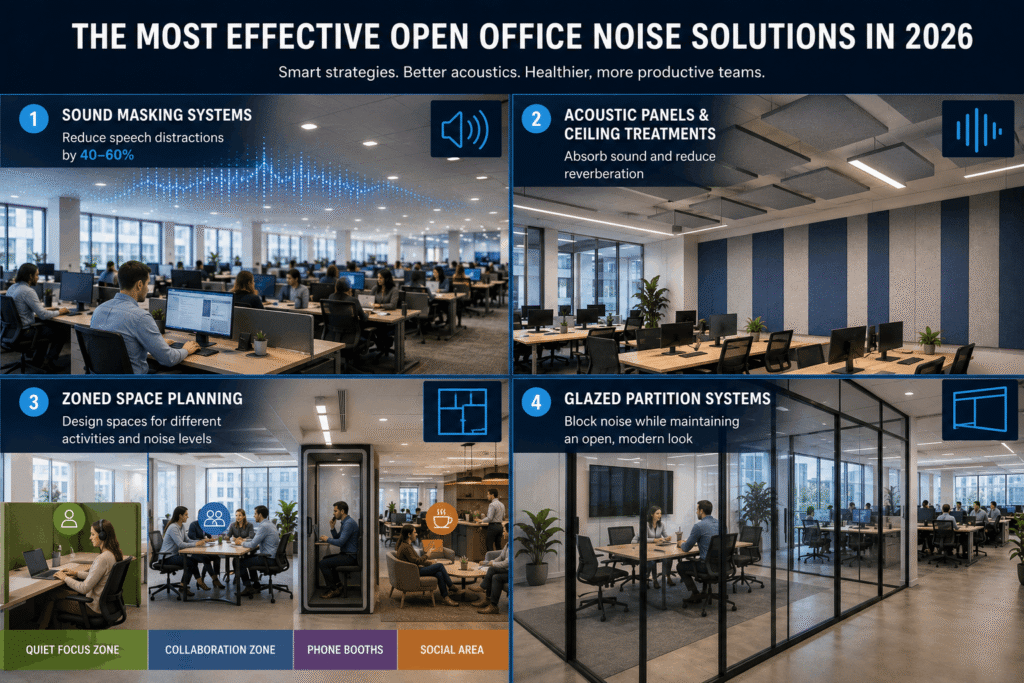
Modern open office noise solutions go beyond simple acoustic treatment. The best approaches combine multiple strategies to address different aspects of the noise problem. Here are the most effective options available to businesses today.
1. Sound Masking Systems
Sound masking is the most widely used and most effective technology-based open office noise solution available. It works by introducing a low-level background sound into the workspace. This engineered sound is specifically tuned to match the frequency range of human speech.
When speech frequencies are already present in the background, nearby conversations become harder to understand from a distance. The result is not a silenced office. It is a workspace where nearby conversations blend into the background rather than demanding your attention.
Sound masking does not work the same way as white noise. White noise contains all audible frequencies at equal levels, which creates a harsh and often irritating sound. A properly tuned sound masking system sounds more like gentle, barely noticeable airflow. Most employees stop noticing it entirely within a few days.
The results are well documented. Sound masking can reduce the distance at which conversations are intelligible by 40 to 60 percent. Employees report better concentration, fewer interruptions, and greater comfort in masking-enabled offices.
ITS designs and installs professional sound masking systems for offices across Texas and nationwide. Learn more about how this technology works on our sound masking systems service page.
2. Acoustic Panels and Ceiling Treatments
Acoustic panels absorb sound energy before it can bounce around a room and create reverberation. They are particularly useful in open offices with hard surfaces like concrete floors, glass walls, and exposed ceilings. These architectural features reflect sound and make the overall noise level feel much worse.
Acoustic panels can be mounted on walls, suspended from ceilings, or placed between workstations as freestanding baffles. They come in a wide range of materials and finishes, so they can improve acoustics without compromising the visual design of a modern office.
Acoustic treatment works best as one layer of a complete open office noise solution strategy. On its own, it improves room comfort. Combined with sound masking and smart space design, it becomes much more effective.
3. Zoned Space Planning
One of the most practical open office noise solutions is smart space planning. Not all work requires the same acoustic environment. Separating activities by noise level reduces conflict between different working styles.
A well-zoned open office typically includes:
• Quiet focus zones: Low-distraction areas for deep, concentrated work. Phone calls and conversations are kept out of these spaces.
• Collaboration zones: Open areas or huddle spaces where teams can communicate freely without disturbing the rest of the office.
• Phone booths and privacy pods: Small enclosed spaces for phone calls, video conferences, and private conversations.
• Social areas: Break rooms and lounge spaces positioned away from focused work areas so casual conversation does not carry into the workspace.
Zoning is most effective during a new build or office renovation. But even in an existing layout, rearranging workstations, adding small enclosures, and establishing clear norms for different areas can make a meaningful difference.
4. Glazed Partition Systems
Full-height glass partitions offer a compromise between open collaboration and acoustic privacy. They maintain the visual openness of an open office while providing a physical barrier that blocks sound more effectively than low cubicle panels.
Acoustic-rated glass partitions are specifically engineered to reduce sound transmission. They are commonly used around conference rooms, executive areas, and focus zones where office acoustic privacy is most important.
5. White Noise and Ambient Sound Systems
Some businesses use simpler ambient sound systems as a lower-cost starting point for addressing open office noise. These systems play gentle background sounds such as soft music, nature sounds, or broadband noise through ceiling speakers to raise the ambient sound level in the space.
These systems are less precise than purpose-built sound masking systems. They can help reduce the contrast between silence and sudden noise. However, they lack the frequency tuning and zoned control that make professional sound masking the preferred open office noise solution for most commercial environments.
Understanding Office Acoustic Privacy in Different Industries
Office acoustic privacy requirements vary significantly by industry. Some businesses have legal obligations around speech privacy. Others have strong business reasons to protect confidential conversations. Here is how different industries approach open office noise solutions.
Healthcare
Healthcare facilities must comply with HIPAA regulations, which include protections for patient privacy. Open reception areas, nursing stations, and administrative offices often lack the acoustic privacy needed to discuss sensitive patient information safely.
Sound masking is increasingly being specified in healthcare facility designs as a direct response to HIPAA requirements. It reduces speech intelligibility enough that nearby conversations cannot be clearly understood by unintended listeners. This helps facilities stay compliant without major construction.
Financial Services and Legal
Lawyers, financial advisors, and insurance professionals regularly handle sensitive client information. An overheard conversation in an open office could expose confidential data or compromise client trust. Office acoustic privacy is not optional in these environments.
Open office noise solutions that specifically target speech intelligibility, such as sound masking combined with acoustic partitions, are the most effective approach for these businesses.
Technology and Corporate Offices
Tech companies and corporate offices often have large open floor plans with rows of desks, standing meetings, and constant collaboration. These environments generate high ambient noise and frequently lack any acoustic treatment at all.
For these businesses, a layered approach works best. Sound masking handles the background level. Acoustic panels reduce reverberation. Designated quiet zones give employees somewhere to retreat when deep focus is required.
Call Centers
Call centers present a unique challenge. The entire business model involves people talking on the phone simultaneously. Open office noise solutions in these environments need to reduce cross-talk between agents so that neither the agent nor the customer on the other end is distracted by surrounding conversations.
Sound masking systems tuned specifically for call center environments are one of the most impactful investments these businesses can make. The return in agent performance and customer experience is measurable and consistent.
Government and Education
Government offices handle confidential records and sensitive policy discussions. Educational facilities need quiet for learning and testing. Both sectors are increasingly turning to professional open office noise solutions to create environments that support their specific working and learning requirements.
How Sound Masking Systems Are Installed in Open Offices
Understanding how professional open office noise solutions are installed helps businesses plan effectively and set realistic expectations. Here is what a professional sound masking installation looks like in practice.
Site Assessment and Acoustic Analysis
Every installation starts with a thorough assessment of the space. The installer measures the room, evaluates existing acoustic conditions, identifies problem areas, and determines the optimal speaker layout. Room shape, ceiling height, materials, and furniture placement all affect how sound behaves.
Speaker Placement and Zoning
Sound masking speakers are typically installed above the ceiling tiles in a plenum system. Sound is projected upward, reflects off the ceiling deck, and returns into the room as a diffused, even sound field. This approach creates consistent coverage across large open areas.
Advanced systems divide a building into zones. Each zone can be tuned independently. Conference rooms may need stronger masking than open desks. Quiet focus areas might need a lower level. Zoned control gives facility managers precise management over every area of the office.
Cabling and Network Infrastructure
Modern sound masking systems are networked devices. They require proper low voltage cabling to connect speakers, controllers, and management software. ITS handles all cabling as part of every installation through our structured network cabling services, ensuring the infrastructure behind your system is clean, certified, and built to last.
System Tuning and Calibration
After installation, the system is tuned using calibrated measurement equipment. The technician adjusts the frequency profile and volume level in each zone until the masking sound blends naturally into the background. Proper tuning is essential. A system that is too loud or poorly tuned defeats the purpose.
Ongoing Management
Most professional systems include a management platform that allows facility teams to adjust settings remotely. If a section of the office is reconfigured, levels can be updated without physically accessing the speakers. Some cloud-based platforms also allow monitoring of system performance in real time.
How to Choose the Right Open Office Noise Solution for Your Business
Every office is different. The right combination of open office noise solutions depends on your space, your team, your industry, and your budget. Here are the key factors to consider.
Identify Your Primary Noise Problem
Not all noise is the same. Are your employees distracted by nearby conversations? Is the issue too much reverberation making the space feel loud? Are confidential discussions being overheard? Identifying the specific problem guides you toward the most appropriate solution.
Consider Your Industry Requirements
If your industry has compliance requirements around speech privacy, such as HIPAA for healthcare or Gramm-Leach-Bliley for financial services, your open office noise solution needs to address those specifically. A professional installer can help you document how the system meets those requirements.
Evaluate Your Physical Space
Ceiling height, floor material, wall construction, and overall room dimensions all affect acoustic performance. A space with high ceilings, concrete floors, and glass walls will need more intervention than a carpeted office with acoustic ceiling tiles. A professional assessment gives you an accurate baseline.
Plan for Scalability
Choose open office noise solutions that can grow with your business. A sound masking system that supports zoned expansion means you can add coverage to new areas as your team grows without replacing the entire system.
Work With an Experienced Installer
Open office noise solutions require proper design, installation, and calibration to perform as intended. Working with an experienced commercial AV and technology provider ensures the system is right for your space from the start. ITS offers full design and installation through our commercial AV systems services, covering sound masking alongside the broader technology infrastructure your office needs.
Integrating Noise Solutions Into Your Broader Office Technology Plan
Open office noise solutions do not exist in isolation. They are most effective when they are part of a broader office technology plan that addresses how people communicate, collaborate, and work throughout the day.
For example, sound masking works best when combined with a strong managed wireless network that supports video conferencing in private pods and huddle rooms. When employees have reliable, fast connectivity in quiet spaces, they naturally migrate toward those areas for focused work and sensitive calls. This reduces the overall noise load in the main open office area.
Similarly, the AV systems in your conference rooms and collaboration spaces affect how much noise spills into the open office. Poor audio systems in meeting rooms lead to louder voices and more distraction for people nearby. A well-designed room with proper acoustics, good microphones, and clear speakers means meetings stay contained and professional.
ITS takes a whole-office approach to technology design. Whether you need sound masking, AV systems, network infrastructure, or security, our team designs solutions that work together. Explore the full range of services we offer at intechsolutionstx.com/services.
Frequently Asked Questions About Open Office Noise Solutions
How much does a professional sound masking system cost?
Costs vary by office size, system complexity, and zoning requirements. Most commercial installations are priced per square foot. A professional site assessment gives you an accurate project estimate based on your specific space and goals.
Will employees find the masking sound annoying?
A properly tuned sound masking system is designed to go unnoticed. Most employees stop being aware of it within two to three days. The sound level is kept low enough that it does not distract from work. It simply raises the background noise floor enough to make conversations less intelligible from a distance.
Can open office noise solutions work in older buildings?
Yes. Sound masking systems can be retrofitted into existing buildings without major construction. Speakers are typically installed above existing ceiling tiles, and cabling runs through existing pathways wherever possible. The installation is minimally disruptive to daily operations.
How quickly can a sound masking system be installed?
Most small to mid-size office installations are completed within one to three days. Larger facilities may take longer depending on the number of zones and the complexity of the cabling infrastructure. ITS works around your schedule to minimize disruption.
Does ITS install open office noise solutions in Texas?
Yes. ITS installs sound masking systems and complete open office noise solutions for businesses across Houston, Dallas, Austin, San Antonio, and statewide. We also handle multi-location deployments nationwide. Visit our Houston sound masking solutions guide for a deeper look at how this technology works in local office environments.
For further reading on workplace acoustics and the science behind speech privacy, the American Society of Heating, Refrigerating and Air-Conditioning Engineers (ASHRAE) publishes acoustic standards for commercial building environments. Their guidelines are widely referenced by architects, facility managers, and AV professionals when designing open office spaces.
The AVIXA (InfoComm International) also provides industry standards for audio performance in commercial spaces, including intelligibility standards that inform how sound masking systems are designed and calibrated.
Create a Quieter, More Productive Office With ITS
Open office noise solutions are not about making your workplace silent. They are about giving your employees the acoustic environment they need to do their best work. That means reducing distraction, protecting speech privacy, and creating a space where focus and collaboration can coexist.
The right combination of sound masking, acoustic treatment, and smart space design can transform a noisy, frustrating open office into a workspace that supports productivity, protects office acoustic privacy, and keeps employees satisfied and engaged.
Integrated Technology Solutions has helped businesses across Texas and nationwide design and install open office noise solutions that deliver measurable results. Our team assesses your space, recommends the right technology, and handles every aspect of installation and calibration.
Contact Integrated Technology Solutions today to discuss open office noise solutions for your workplace. Call us at +1 888-985-5334 or visit our contact page to schedule a free acoustic assessment for your office.
