

Selecting the right network cabling infrastructure is one of the most consequential decisions IT managers and facility planners make. The wrong choice leads to premature obsolescence, costly retrofits, and network performance that cannot keep pace with business demands. Understanding the differences between cat6 vs cat6a vs cat7 cabling options ensures your investment delivers both immediate functionality and long-term value.
The landscape of copper network cabling has evolved significantly over the past decade. What seemed like adequate bandwidth in 2016 is now a bottleneck in 2026. With the proliferation of Power over Ethernet (PoE) devices, 4K video conferencing, cloud-based applications, and IoT sensors, your cabling infrastructure must support far more than basic data connectivity. The choice between Category 6, Category 6A, and Category 7 cable types directly impacts network speed, reliability, power delivery capability, and total cost of ownership.
This guide cuts through marketing hype and technical jargon to help you make an informed decision based on your specific requirements, budget constraints, and future growth plans.
Understanding Cable Category Basics
Network cable categories are defined by standards organizations that specify performance characteristics, testing requirements, and installation practices. The Telecommunications Industry Association (TIA) and International Organization for Standardization (ISO) establish these benchmarks to ensure interoperability and predictable performance.
Each cable category represents a progression in bandwidth capacity, frequency handling, and interference resistance. Higher categories do not simply offer “faster” cables. They provide greater frequency bandwidth, superior crosstalk mitigation, and enhanced signal integrity that enables higher data rates over longer distances.
Key Performance Metrics:
Bandwidth: Measured in megahertz (MHz), this represents the range of frequencies the cable can carry. Higher bandwidth supports faster data transmission rates.
Data Rate: The actual speed of data transfer, measured in gigabits per second (Gbps). This is what end-users experience as network performance.
Maximum Distance: The length over which the cable maintains rated performance. Beyond this distance, signal degradation reduces speed or causes errors.
Shielding: Protection against electromagnetic interference (EMI) and crosstalk between cable pairs. Critical in electrically noisy environments.
Category 6 (Cat6): The Baseline Standard
Category 6 cabling has been the workhorse of commercial networking since the mid-2000s. It represents the minimum acceptable standard for new installations in 2026, though it has significant limitations that make it unsuitable for many modern applications.
Technical Specifications:
- Bandwidth: 250 MHz
- Maximum data rate: 1 Gbps (1000BASE-T) up to 100 meters
- Supports 10 Gbps (10GBASE-T) up to 55 meters only
- Available in UTP (unshielded twisted pair) configuration
- PoE support: Up to PoE+ (25.5W per port)
Best Use Cases:
Cat6 remains viable for basic office environments with modest bandwidth requirements. Small businesses with limited budgets, residential applications, or temporary installations may find Cat6 adequate. It works well for standard workstations, basic IP phones, and legacy equipment connections.
However, Cat6’s limitations become apparent quickly. The 55-meter restriction for 10 Gigabit Ethernet creates planning headaches in larger facilities. Many modern applications exceed this distance, forcing network designers to add intermediate switches or accept reduced performance.
Cost Considerations:
Cat6 cable costs approximately $0.08 to $0.15 per foot for bulk cable. Installed costs range from $150 to $250 per drop depending on labor rates and project complexity. While this represents the lowest initial investment, the limited future-proofing often results in higher total cost of ownership.
Category 6A (Cat6A): The Modern Standard
Category 6A (Augmented) addresses Cat6’s shortcomings and has become the de facto standard for commercial installations. Professional copper cabling solutions almost universally recommend Cat6A for new construction and major renovation projects.
Technical Specifications:
- Bandwidth: 500 MHz
- Maximum data rate: 10 Gbps (10GBASE-T) up to 100 meters
- Full-distance 10 Gigabit support eliminates distance limitations
- Available in both UTP and shielded (F/UTP or S/FTP) configurations
- PoE support: Up to PoE++ (90W per port) and future PoE standards
Why Cat6A Dominates in 2026:
The ability to run 10 Gigabit Ethernet the full 100-meter distance is transformational. This eliminates the network topology constraints that plague Cat6 installations. IT managers gain complete flexibility in equipment placement without performance compromises.
Power over Ethernet capabilities represent another critical advantage. Modern PoE++ devices, including high-performance WiFi 6E access points, PTZ cameras, LED lighting systems, and building automation controllers, require power delivery that Cat6 cannot reliably support. Cat6A’s superior electrical characteristics handle higher power loads without the voltage drop issues that cause device malfunctions.
Installation Considerations:
Cat6A cable has a larger diameter than Cat6 due to enhanced internal structure and shielding options. This affects several installation factors:
Bend Radius: Requires larger minimum bend radius (typically 4x cable diameter) to avoid performance degradation. Tight cable pathways designed for Cat5e or Cat6 may not accommodate Cat6A without modifications.
Cable Management: The increased stiffness makes Cat6A more challenging to work with during installation. Professional installers with structured network cabling experience know the techniques that prevent kinks and maintain proper geometry.
Pathway Fill: Building codes limit how much cable can occupy conduit or cable tray. Cat6A’s larger diameter means fewer cables fit in existing pathways, potentially requiring additional infrastructure.
Cost Analysis:
Cat6A cable costs $0.20 to $0.40 per foot for quality bulk cable. Installed costs range from $200 to $350 per drop. While 25-40% more expensive than Cat6 initially, the extended lifespan and expanded capabilities justify the premium for most commercial applications.
Category 7 (Cat7): Specialized Performance
Category 7 cabling occupies a unique position in the copper cabling hierarchy. It offers superior technical specifications but faces adoption challenges related to connector standards and practical implementation requirements.
Technical Specifications:
- Bandwidth: 600 MHz
- Maximum data rate: 10 Gbps up to 100 meters (same as Cat6A)
- Always shielded: S/FTP (shielded/foiled twisted pair) construction mandatory
- Requires GG45 or TERA connectors (not standard RJ45)
- Enhanced EMI protection for electrically hostile environments
The Connector Dilemma:
Cat7’s biggest limitation is connector compatibility. The TIA standard does not recognize Cat7 using RJ45 connectors, instead requiring proprietary GG45 or TERA connectors. This creates ecosystem challenges since virtually all network equipment uses RJ45 ports.
Some manufacturers market “Cat7” cable with RJ45 connectors, but these installations do not meet official Cat7 specifications and perform similarly to Cat6A in real-world applications. True Cat7 installations require specialized termination hardware and compatible network equipment, both of which are expensive and offer limited manufacturer support.
Appropriate Applications:
Cat7 shines in environments with extreme electromagnetic interference: industrial facilities with heavy machinery, hospitals with medical imaging equipment, broadcast studios, and data centers with dense equipment installations. The comprehensive shielding provides measurable benefits when EMI would otherwise degrade signal quality.
For standard commercial office environments, Cat7’s benefits do not justify the additional cost and implementation complexity. The performance difference compared to shielded Cat6A is negligible in typical applications.
Cost Reality:
Cat7 cable costs $0.50 to $0.90 per foot, with installed costs reaching $400 to $600 per drop when factoring in specialized connectors and termination labor. These premium costs are difficult to justify unless specific EMI challenges demand maximum shielding.
Head-to-Head Comparison: Making the Decision
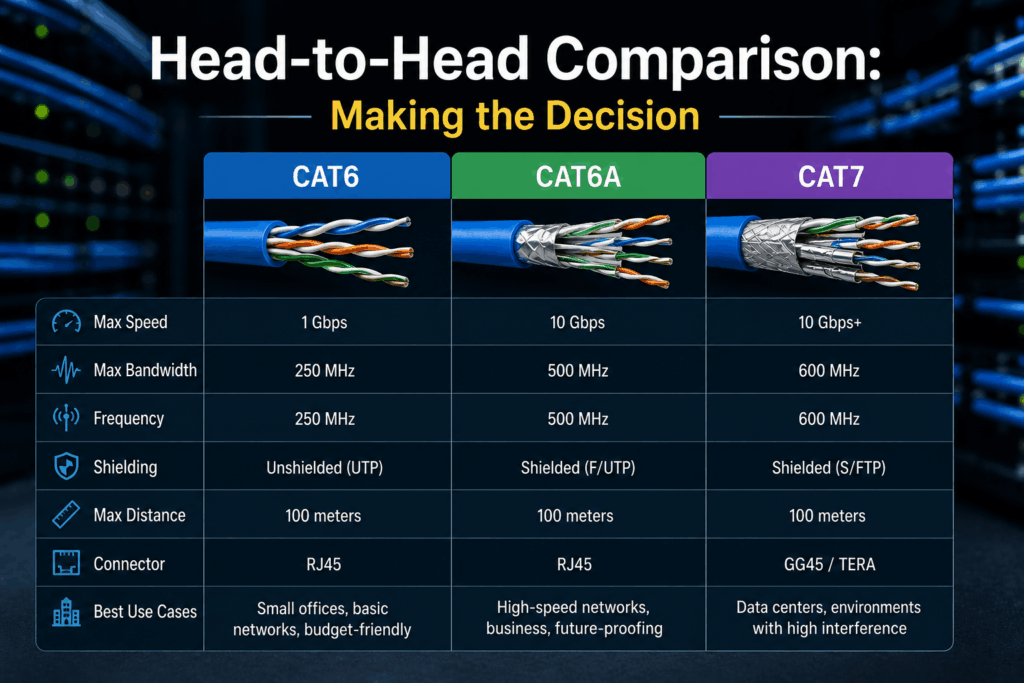
When evaluating cat6 vs cat6a vs cat7 options, several decision factors determine the optimal choice:
Budget-Constrained Projects: Cat6 makes sense only when budget limitations are severe and you accept limited future-proofing. This applies to temporary installations, residential applications, or facilities with planned short-term occupancy.
Standard Commercial Installations: Cat6A represents the sweet spot for 90% of commercial projects. It supports current and foreseeable bandwidth requirements, handles PoE++ power delivery, and maintains performance over full cable distances. Every major manufacturer supports Cat6A, ensuring equipment compatibility and long-term viability.
Specialized High-EMI Environments: Cat7 (or shielded Cat6A as an alternative) is appropriate when electromagnetic interference is a documented concern. Industrial settings, medical facilities, and certain data center installation projects benefit from maximum shielding. However, verify that your active equipment supports the required connectors before committing to Cat7.
Power over Ethernet: The Hidden Variable
Modern network design increasingly relies on Power over Ethernet to simplify deployments and reduce installation costs. Understanding how cable categories handle PoE is essential to long-term success.
PoE Power Levels:
- PoE (802.3af): 15.4W
- PoE+ (802.3at): 25.5W
- PoE++ (802.3bt Type 3): 60W
- PoE++ (802.3bt Type 4): 90W
Cat6 adequately supports PoE and PoE+ for basic devices like IP phones and simple cameras. However, it struggles with higher power levels, particularly over longer cable runs. Voltage drop and heat buildup in cable bundles can cause unreliable device operation.
Cat6A’s superior electrical characteristics make it the preferred choice for PoE++ deployments. The cable’s design dissipates heat more effectively and maintains lower resistance, ensuring stable power delivery even when running maximum wattage to devices like high-performance access points or PTZ cameras integrated with commercial AV systems.
Installation Best Practices Across All Categories
Regardless of which cable category you select, proper installation techniques are critical to achieving rated performance:
Maintain Proper Bend Radius: Sharp bends damage internal cable structure and degrade performance. Use appropriate cable management hardware designed for your chosen cable type.
Avoid Over-Tensioning: Excessive pulling force during installation stretches conductors and separates twisted pairs, causing crosstalk and signal loss.
Test Every Link: Comprehensive certification testing validates that installed cables meet category specifications. This documentation is essential for warranty coverage and troubleshooting.
Label Everything: Clear, consistent labeling saves countless hours during moves, adds, and changes. Professional technology build-outs include detailed documentation as standard practice.
Future-Proofing Considerations
Network infrastructure typically remains in place for 10-15 years or longer. Decisions made today must account for tomorrow’s requirements:
Bandwidth Growth: Industry analysts project 25-30% annual increases in bandwidth consumption. Cat6’s limitations will become increasingly problematic, while Cat6A provides comfortable headroom for foreseeable growth.
PoE Evolution: Power over Ethernet standards continue advancing. Future iterations will likely exceed 100W per port, making Cat6A’s power handling capabilities increasingly valuable.
Emerging Technologies: WiFi 7 access points, 8K video conferencing, and advanced IoT applications will demand infrastructure that Cat6 cannot reliably support. Cat6A positions you to adopt these technologies without cabling upgrades.
ROI Analysis: Total Cost of Ownership
Initial cable costs represent only a fraction of total project expenses and an even smaller portion of lifecycle costs. Labor typically accounts for 60-70% of installation budgets, meaning the difference between Cat6 and Cat6A installed costs is often less dramatic than cable price comparisons suggest.
More importantly, premature infrastructure obsolescence carries hidden costs: lost productivity during retrofits, business disruption, disposal expenses for removed cable, and opportunity costs when network limitations prevent adopting beneficial technologies.
Organizations that invested in Cat6A five years ago are positioned for another 8-10 years of reliable service. Those who chose Cat6 often face bandwidth constraints that force expensive upgrades years ahead of planned refresh cycles.
Making Your Final Decision
The cat6 vs cat6a vs cat7 decision ultimately depends on your specific context, but clear patterns emerge:
Choose Cat6 if: Budget constraints are absolute, installation is temporary, or requirements are minimal with no growth anticipated.
Choose Cat6A if: You want a future-proof installation that balances performance, compatibility, and cost. This is the recommended choice for the vast majority of commercial projects.
Choose Cat7 if: You have documented EMI challenges that justify the premium cost and can accommodate specialized connector requirements.
For most organizations reading this in 2026, Cat6A represents the optimal investment. It delivers full 10 Gigabit performance, supports current and future PoE standards, and maintains compatibility with all standard network equipment while providing reasonable protection against obsolescence.
Contact Integrated Technology Solutions to discuss your network cabling project. Our BICSI-certified technicians will assess your specific requirements, recommend the optimal cable category for your application, and deliver a professionally installed system that supports your organization’s success for years to come.
