
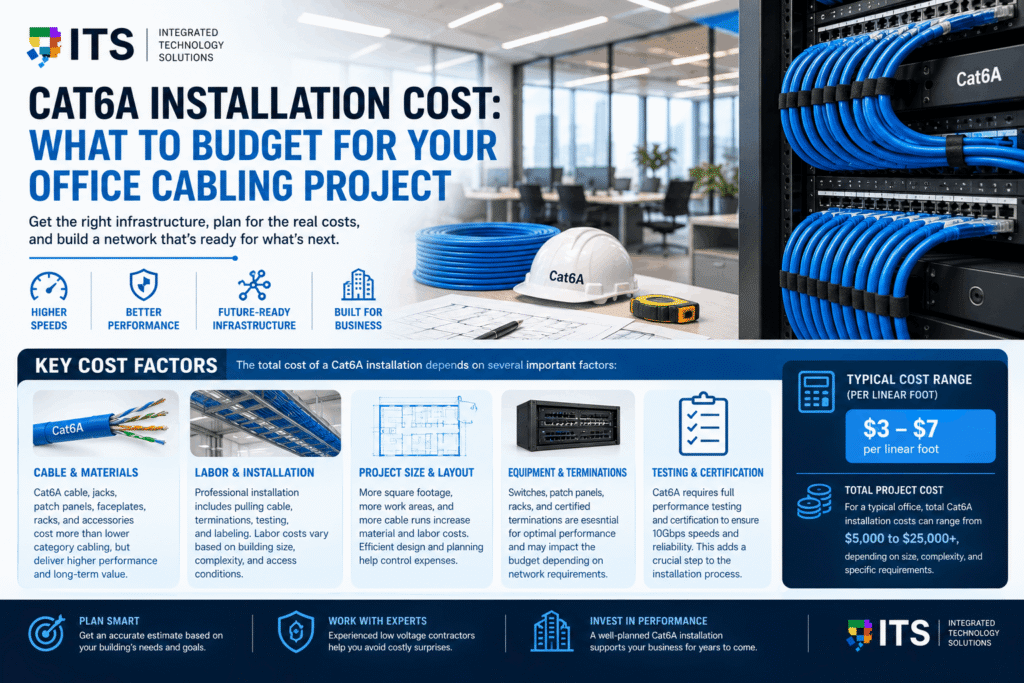
Planning a new office network? Your Cat6A installation cost is one of the biggest questions on your mind. It should be. Cabling is the backbone of your office. It carries your phones, your Wi-Fi, your security cameras, and every file your team touches. Get the budget wrong, and you either overspend or end up with a network that cannot keep up.
This guide breaks down real numbers. You will learn what drives your Cat6A installation cost up or down. You will also get a simple network cabling price estimate you can use to plan your next project. We wrote this guide for office managers, IT directors, and business owners across Texas and beyond who want a clear, honest answer before they call a contractor.
Too many businesses skip this planning step. They call one contractor, get one number, and hope for the best. Then the invoice comes in higher than they expected. A little research now saves a lot of stress later. By the end of this guide, you will know what a fair price looks like, what drives that price up, and what questions to ask before you sign a contract.
What Is Cat6A Cabling and Why It Matters for Your Office
Cat6A stands for Category 6 Augmented. It is a type of copper network cable. It supports speeds up to 10 Gigabits per second. It also handles that speed over the full 100-meter run most offices need.
Older cable types like Cat5e and Cat6 still work. But they slow down over longer distances. Cat6A does not. It gives your office room to grow. It also handles Power over Ethernet better, which matters if you use Wi-Fi access points, security cameras, or VoIP phones that draw power through the cable itself.
Most new commercial buildings in Texas now use Cat6A as the standard. It costs a bit more than Cat6. But it protects you from another rip-and-replace project in a few years. That is why your Cat6A installation cost today often saves you money down the road.
Cat6A Installation Cost: The Real Numbers
Let’s get to the part you came here for. What does Cat6A installation cost actually look like?
For most commercial offices, you should budget $150 to $350 per cable drop. A drop is one cable run from a wall jack or ceiling point back to your network closet. This price includes the cable, the jack, the patch panel port, labor, and testing.
That range is wide because a lot of factors change the final price. We will walk through each one below. But first, let’s break the cost into its two main parts: materials and labor.
Average Cost Per Drop
Here is a simple breakdown for a standard office drop:
- Cable and jack: $30 to $60 per drop
- Patch panel port and rack space: $10 to $25 per drop
- Labor to run, terminate, and test: $100 to $250 per drop
- Testing and certification: $10 to $20 per drop
Add it up, and you land right in that $150 to $350 range. Offices with easy ceiling access and short cable runs sit at the low end. Offices with tight spaces, long runs, or older buildings sit at the high end.
Material Costs Explained
Materials are the easy part to estimate. A box of 1,000 feet of Cat6A cable typically costs between $250 and $500, depending on the brand and whether it is shielded or unshielded. Shielded Cat6A costs more but performs better near electrical equipment.
Jacks, faceplates, and patch panels add a smaller cost per drop. None of these prices swing wildly. What really moves your Cat6A installation cost is labor.
Labor Costs Explained
Labor is where most of your budget goes. Skilled technicians pull cable through walls and ceilings, terminate each end, and test every run to make sure it meets ANSI/TIA-568 standards. This work takes training and time.
According to the U.S. Bureau of Labor Statistics, skilled electrical trade workers earn a median wage well above $30 an hour. Certified low-voltage cabling technicians often charge similar or higher rates because of the specialized skill involved. A single drop can take 30 minutes in an easy install. It can take two hours or more in a tough one.
This is one reason a proper network cabling price estimate always needs a site visit. No two offices are exactly alike.
What Affects Your Network Cabling Price Estimate
Your final network cabling price estimate depends on more than just the number of drops. Here are the factors that move the number the most.
Office Size and Number of Drops
More drops mean more materials and more labor hours. But bigger projects often get a lower price per drop. Bulk cable pricing drops. Technicians work more efficiently once they are set up on site. A 20-drop office might pay $300 per drop. A 200-drop office might pay closer to $180 per drop.
Building Type and Age
New construction is often cheaper to cable. Walls and ceilings are open. There is nothing to work around. Older buildings cost more. Technicians may need to fish cable through finished walls, work around asbestos-era materials, or route around existing infrastructure that was never documented.
Cable Pathways (Plenum vs. Non-Plenum)
If your cable runs through open air spaces used for heating and cooling, known as a plenum space, your local fire code likely requires plenum-rated cable. Plenum cable costs more than standard riser cable because it resists fire and smoke better. Always check your local code before you budget.
Local Labor Rates
Labor rates shift by region. A project in a major metro area like Houston, Dallas, or Austin may cost more per hour than a project in a smaller town. But metro projects often move faster because local crews know the buildings and permit offices well.
Number of Network Closets
Every drop has to land somewhere. If your office has one central network closet, cable runs may be long, but the design is simple. If your building spreads drops across several floors or wings, you may need more than one closet, known as an intermediate distribution frame. Each added closet means more rack space, more patch panels, and more planning. This adds to your overall network cabling price estimate but often improves performance across a large space.
Timeline and Scheduling
Rush jobs cost more. If you need your office cabled over one weekend instead of two normal work weeks, expect a higher labor rate. Crews may need to work overtime or bring in extra technicians to hit your deadline. If your schedule has flexibility, say so during the quote process. It can lower your final price.
Cat6A vs Cat6 vs Fiber: Which Should You Budget For?
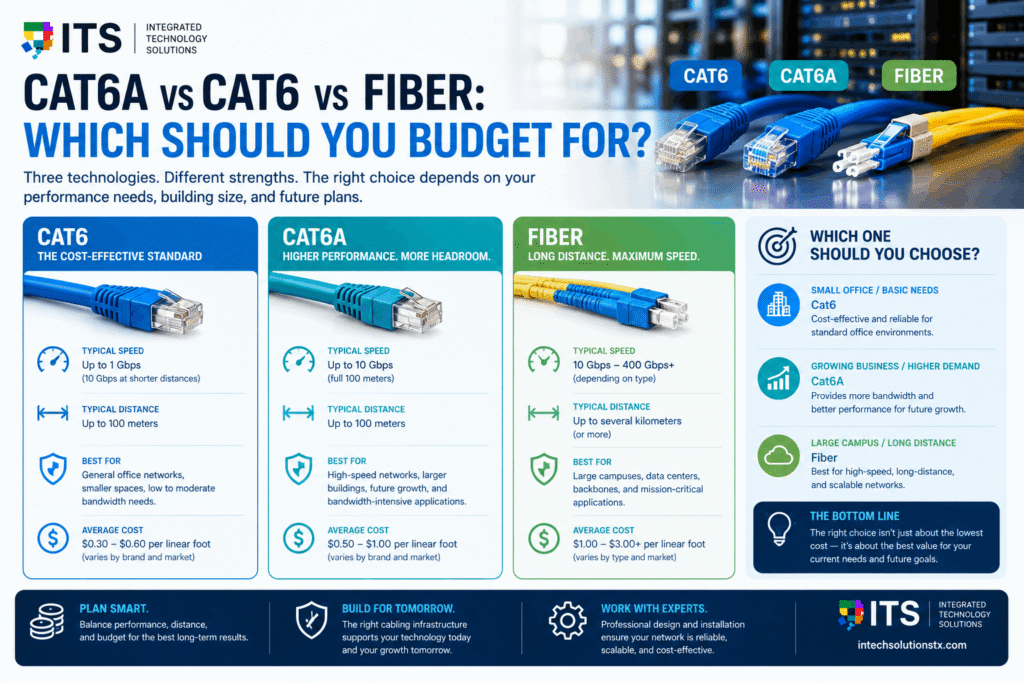
You might wonder if you even need Cat6A. Here is a quick comparison to help you decide.
Cat6 costs less upfront. It handles Gigabit speeds well over standard office distances. It struggles at 10 Gigabit speeds past about 55 meters. If your office is small and your needs are basic, Cat6 can still work.
Cat6A costs more upfront but supports full 10 Gigabit speeds over the entire 100-meter run. It also handles higher Power over Ethernet loads. Most growing businesses choose Cat6A because it future-proofs the network.
Fiber optic cable costs the most per drop but offers the highest speed and the longest distance. Fiber makes sense for backbone runs between floors or buildings, not usually for desk-level drops. Many offices use a mix: fiber for the backbone, Cat6A for the drops to desks and access points. Our team can walk you through copper cabling solutions and help you decide which mix fits your building and your budget.
Hidden Costs to Watch For in a Cabling Project
A low bid can look great on paper. But watch for costs that show up later.
- Patch panel and rack upgrades. Your existing rack may not have room for new ports.
- Permit fees. Some cities require low-voltage permits for commercial cabling work.
- After-hours labor. Working nights or weekends to avoid business disruption often costs more.
- Cable management and cleanup. Poor cable management now means expensive troubleshooting later.
- Testing and certification reports. Always ask if these are included. Some contractors charge extra.
A trustworthy contractor lists these costs upfront. If a quote seems too low compared to others, ask what is missing.
Change orders. Offices change layouts often. A wall moves. A desk cluster shifts. If your drop locations change mid-project, expect a change order fee. Lock in your floor plan before work begins to avoid this.
Old cable removal. Some buildings have decades of abandoned cable sitting in the ceiling. Many fire codes now require this old cable to come out, not just get covered up. Ask if removal is part of your quote or billed separately.
How Long Does a Cat6A Installation Take?
Timeline is almost as important as your Cat6A installation cost. A small office with 20 drops might take two to three days from start to finish. A mid-size office with 75 drops often takes one to two weeks. A large office with 200 or more drops can take three to six weeks, depending on building access and how many crews are on site.
Testing and certification add time at the end of the project. Do not let a contractor skip this step to save a day or two. Untested cable runs can hide problems that show up months later, often after your warranty window has already started.
How to Get an Accurate Network Cabling Price Estimate
Online calculators give you a rough idea. But a real network cabling price estimate takes a site walk. Here is what a good contractor should do before quoting your project:
- Walk the space and count drop locations.
- Check ceiling and wall access.
- Review your local fire code for plenum requirements.
- Ask about your growth plans, not just today’s needs.
- Confirm what testing and documentation you will receive.
If a company quotes your entire office over the phone without a site visit, treat that number as a rough guess, not a real budget. Our guide on structured network cabling services covers what a proper design and install process looks like from start to finish.
Sample Budget: Small vs Mid-Size vs Large Office
These numbers give you a starting point. Your final network cabling price estimate will vary based on the factors above.
Small office (20 drops): Budget range: $4,500 to $7,000
Mid-size office (75 drops): Budget range: $13,500 to $23,000
Large office (200 drops): Budget range: $32,000 to $50,000
These figures include cable, hardware, labor, and testing. They do not include rack and cabinet upgrades, permits, or fiber backbone work, which we would price separately based on your building.
A small office usually runs one central closet with short, simple cable paths. A mid-size office often needs a bit more planning around furniture layout and shared spaces like conference rooms. A large office may need multiple closets, a fiber backbone between floors, and a longer install schedule. Each step up in size changes your network cabling price estimate, but it also brings the per-drop cost down slightly thanks to bulk material pricing and crew efficiency.
Frequently Asked Questions About Cat6A Installation Cost
Is Cat6A worth the extra cost over Cat6? For most offices, yes. The price difference per drop is small compared to the cost of rewiring your building again in a few years. Cat6A gives you full 10 Gigabit speed at 100 meters, which Cat6 cannot guarantee.
Can I install Cat6A cabling myself to save money? We do not recommend it for a commercial office. Improper termination or bend radius can cause the cable to fail certification testing. A failed test means redoing the work, which costs more than hiring a certified team from the start.
Does my Cat6A installation cost include Wi-Fi access points? Not usually. Cabling gets the network connection to the access point location. The access point hardware itself is a separate line item. Ask your contractor to quote both together if you want one combined number.
How often should I update my network cabling budget? Prices shift with material costs and local labor markets. We suggest getting a fresh network cabling price estimate every twelve to eighteen months if you are planning a project, especially given how quickly copper and labor pricing can move.
Tips to Control Your Cat6A Installation Cost Without Cutting Corners
You can manage your Cat6A installation cost without sacrificing quality. Try these steps.
- Plan for growth now. Adding drops later almost always costs more per drop than including them in the original project.
- Bundle projects. If you also need Wi-Fi access points or security cameras, plan the cabling for all of it at once.
- Choose a certified contractor. Rework from a bad install costs far more than paying for quality the first time.
- Ask about phased installs. If your budget is tight, a phased plan lets you cable priority areas first.
- Get multiple quotes. Compare what is included, not just the bottom-line number.
If your current network shows problems already, read our post on signs your network cabling needs an upgrade to see if it is time to act now instead of later.
Why Work With a BICSI-Certified Cabling Partner
Not every cabling company follows the same standards. BICSI is the leading organization that certifies structured cabling technicians and sets best practices for the industry. A BICSI-certified team knows how to design pathways, manage cable bend radius, and test every run so it performs for years, not months.
This matters for your Cat6A installation cost in a real way. A poorly installed network fails tests, causes slow speeds, and often needs expensive rework. A properly installed one just works. If your project also touches heavier infrastructure, our data center installation cost guide breaks down pricing for server rooms and larger builds.
Look for a few simple signs of a quality partner. Ask if their technicians hold current BICSI credentials. Ask what warranty they offer on their labor and materials. Ask to see a sample test report from a past project. A contractor who answers these questions clearly, without hesitation, is usually one you can trust with your budget and your timeline.
Also ask about documentation. A good cabling partner labels every drop, maps every run, and hands you a full set of test results when the job wraps up. This documentation makes future moves, adds, and changes much easier. It also protects you if you ever need to make a warranty claim.
Final Thoughts on Your Cat6A Installation Cost
Your Cat6A installation cost depends on your office size, your building, and your local labor market. Most projects land between $150 and $350 per drop, with materials making up a small piece and skilled labor making up the rest. A clear network cabling price estimate always starts with a site visit, not a guess over the phone.
Cat6A gives your office room to grow. It supports faster speeds, handles more devices, and protects you from another cabling project a few years from now. The right budget today means fewer surprises tomorrow.
Ready to get a real number for your project? Contact Integrated Technology Solutions to request a free quote and get an accurate Cat6A installation cost estimate for your office, backed by 35 years of combined experience and a BICSI-certified team serving Texas and clients nationwide.
