
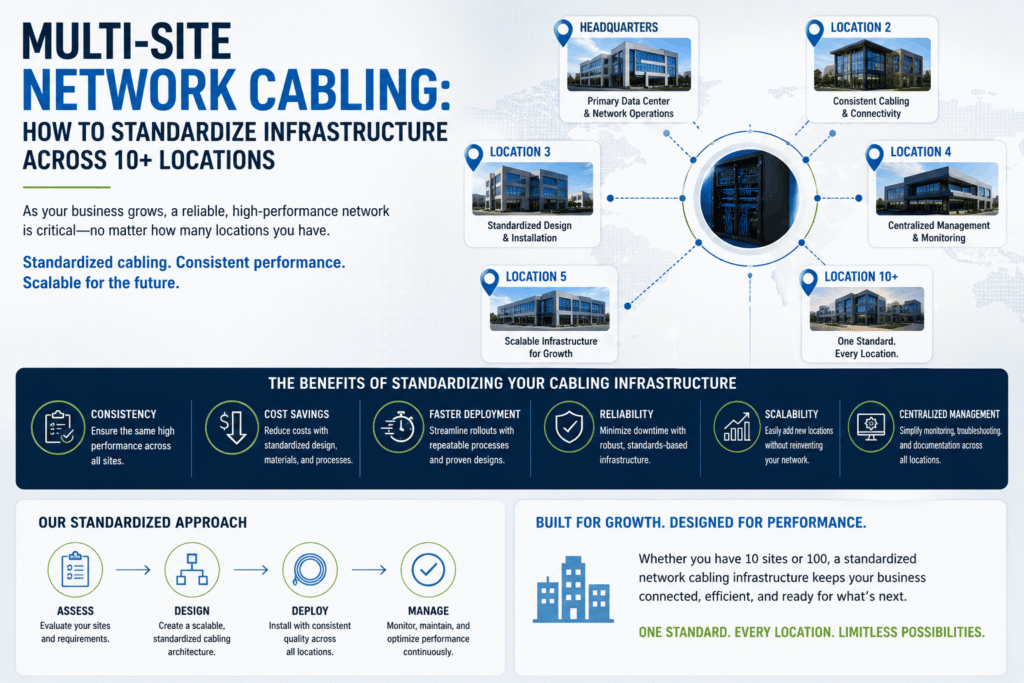
Growing organizations face enormous challenges managing network infrastructure across multiple locations. Each branch office, retail store, or regional headquarters operates with different cabling systems, equipment, and standards. This inconsistency creates support nightmares, increases costs, and limits organizational efficiency.
Multi-site network cabling standardization solves these problems. By establishing consistent infrastructure standards across all locations, you simplify management, reduce expenses, and improve reliability. Organizations with 10+ locations operating different systems spend vastly more on support, training, and maintenance than those with standardized multi-site network cabling approaches.
This comprehensive guide reveals proven strategies for implementing consistent multi-site network cabling across your entire organization. You’ll learn about standardization benefits, implementation challenges, and step-by-step approaches that work in real-world environments.
The Challenge of Multi-Site Operations
Managing network infrastructure across multiple locations seems simple in theory. In practice, it becomes incredibly complex without proper planning and standards.
Common Multi-Site Network Cabling Problems:
Inconsistent Equipment: Different locations use different cable types, brands, and specifications. One site runs Cat5e while another uses Cat6A. Patch cables vary by manufacturer. Connectors come from different vendors.
This inconsistency creates problems:
- Support staff need expertise with multiple systems
- Spare parts inventory becomes massive
- Troubleshooting takes longer
- Performance varies unpredictably
Varying Standards and Practices: Each location developed its own methods over time:
- Different cable labeling systems
- Inconsistent patch panel layouts
- Varying fiber optic solutions
- Non-standard documentation formats
When a technician travels between sites, they work in unfamiliar environments. Tasks take longer. Mistakes happen. Frustration builds.
Documentation Chaos: Information about network infrastructure is scattered:
- Paper drawings in filing cabinets
- Outdated spreadsheets on local computers
- Different naming conventions
- Missing as-built documentation
- Incomplete change records
Finding critical information takes hours. Decision-making slows down. Planning becomes difficult.
Cost and Complexity Explosion: Organizations with inconsistent multi-site network cabling spend:
- 30-50% more on support labor
- 40-60% more on spare inventory
- Significant money on vendor relationships
- Extra time training staff on different systems
These costs compound year after year, creating massive waste.
Support Staff Burnout: IT teams supporting multiple systems burn out quickly:
- Constant travel between locations
- Different equipment at each site
- Inconsistent documentation and procedures
- Pressure to fix problems instantly
- Limited time for proactive work
Quality staff leave. Turnover increases. Knowledge walks out the door.
Multi-site network cabling standardization addresses all these issues through consistent, planned approaches.
Benefits of Standardization
Understanding the specific advantages of multi-site network cabling standardization helps justify the investment to organizational leadership.
Reduced Support Costs:
Standardization dramatically reduces support expenses:
Training Time:
- Non-standardized: 2-3 weeks per new technician per location type
- Standardized: 3-5 days total for all locations
- Ongoing retraining needed for inconsistent systems
- One training program covers all sites
Problem Resolution:
- Non-standardized: Average 4-6 hours to resolve issues
- Standardized: Average 1-2 hours
- Technicians confident in consistent procedures
- Remote support becomes more effective
Travel Requirements:
- Non-standardized: Frequent specialist travel needed
- Standardized: Local staff handle most issues
- Remote specialists available for rare problems
- Travel costs drop 50-70%
Annual Support Savings: $150,000-$400,000 for typical multi-site network cabling standardization
Improved Reliability:
Consistent infrastructure improves overall network stability:
Downtime Reduction:
- Consistent equipment performs predictably
- Staff respond faster to problems
- Fewer surprise failures
- Better preventive maintenance
Performance Consistency:
- Same bandwidth at every location
- Predictable response times
- Consistent user experience
- Better business continuity
Faster Troubleshooting:
- Known equipment and configurations
- Standard procedures
- Better documentation
- Remote diagnosis possible
Uptime Improvement: 5-15% reduction in downtime across multi-site network cabling
Simplified Inventory Management:
Standardization dramatically reduces inventory complexity:
Reduced SKU Count:
- Non-standardized: 200+ different items stocked
- Standardized: 30-50 core items needed
- Bulk purchasing becomes possible
- Inventory turns faster
Lower Carrying Costs:
- Less capital tied up in stock
- Faster inventory movement
- Reduced obsolescence
- Better vendor relationships
Emergency Response:
- Consistent spare parts always available
- Quick replacement from standard stock
- Field technicians carry relevant equipment
- Minimal delay for repairs
Annual Inventory Savings: $50,000-$150,000
Enhanced Scalability:
Multi-site network cabling standardization enables rapid growth:
New Location Deployment:
- Standardized approach reduces planning time
- Installation follows proven procedures
- Training requires minimal custom work
- Initial cost predictability
Equipment Addition:
- New technology integrates smoothly
- Consistent specifications match existing infrastructure
- Vendor relationships streamline procurement
- Quality assurance remains consistent
Change Management:
- Established procedures apply everywhere
- Change documentation standardized
- Rollback procedures proven and consistent
- Risk minimization across locations
Typical New Location Timeline: 4-8 weeks with standardized multi-site network cabling (vs. 8-12 weeks for non-standardized)
Improved Compliance and Security:
Standardization strengthens your security posture:
Consistent Security Standards:
- Same security protocols everywhere
- Unified access controls
- Consistent encryption standards
- Regular security updates coordinated
Audit Readiness:
- Complete documentation available
- Consistent labeling and tracking
- Standardized change procedures
- Easier compliance demonstration
Risk Reduction:
- Fewer attack vectors
- Easier breach detection
- Consistent incident response
- Better threat management
Better Vendor Relationships:
Standardization improves business partnerships:
Volume Discounts:
- Bulk purchasing power increases
- Better pricing through consistency
- Long-term contracts become viable
- Equipment financing possible
Priority Support:
- Vendors prioritize consistent customers
- Better service levels
- Faster escalation paths
- Technical partnership benefits
Product Roadmap Alignment:
- Better understanding of future needs
- Early access to new technology
- Partnership on upgrades
- Strategic planning together
Combining these benefits, organizations typically achieve 35-60% total cost savings through multi-site network cabling standardization over 3-5 years.
Planning Your Standardization Strategy

Successful multi-site network cabling standardization requires careful planning before implementation begins.
Phase 1: Assessment and Analysis (4-6 weeks)
Current State Documentation:
Visit each location and document:
- Cable types and quantities at each site
- Equipment and manufacturers
- Documentation quality and format
- Support procedures and processes
- Performance issues and complaints
- Support staff experience levels
Create a comprehensive inventory:
- Spreadsheet of equipment by location
- Photos of current installations
- List of support problems
- Documentation samples
- Vendor contact information
Gap Analysis:
Compare current state to best practices:
- Identify inconsistencies
- Evaluate compliance gaps
- Assess performance shortfalls
- Note documentation deficiencies
- List compatibility issues
Stakeholder Interviews:
Talk to key people at each location:
- IT managers about local needs
- Support staff about problem areas
- Users about performance issues
- Finance about budget constraints
- Executives about strategic direction
This input informs your standardization approach.
Phase 2: Standard Design Development (6-8 weeks)
Establish Design Standards:
Define specifications for all components:
Cable Standards:
- Decide on Cat6A or fiber backbone
- Specify cable types and grades
- Define cable pathways
- Establish termination standards
- Create labeling system
Equipment Standards:
- Select approved patch panel types
- Specify switch specifications
- Identify approved fiber optic components
- Define mounting hardware
- Establish connector standards
Documentation Standards:
- Create template for as-built drawings
- Establish labeling conventions
- Define change management procedures
- Create equipment inventory format
- Establish contact information database
Procedure Standards:
- Define installation procedures
- Establish testing protocols
- Create troubleshooting guides
- Establish change procedures
- Create escalation procedures
Create Standardization Documents:
Develop comprehensive reference materials:
- Standard design guide (20-30 pages)
- Installation procedures manual (15-20 pages)
- Testing and certification procedures (10 pages)
- Troubleshooting guide (20-30 pages)
- Configuration templates (various)
Get Executive Approval:
Present plan to leadership:
- Benefits and cost savings
- Implementation timeline
- Budget requirements
- Risk mitigation approach
- Success metrics
Without leadership buy-in, standardization fails.
Phase 3: Pilot Implementation (8-12 weeks)
Select Pilot Location:
Choose carefully:
- Medium-sized location (not too large)
- Relatively self-contained infrastructure
- Cooperative management team
- Representative of typical locations
- Good documentation baseline
Full Implementation:
Install new infrastructure following standards:
- Remove old non-standard equipment
- Install standard multi-site network cabling
- Implement standard procedures
- Deploy standard documentation
- Train staff thoroughly
Comprehensive Testing:
Validate everything works:
- Performance testing
- Troubleshooting procedures
- Documentation accuracy
- Procedure effectiveness
- Staff competency
Lessons Learned:
Document what worked and what needs adjustment:
- Procedure refinements
- Equipment adjustments
- Training improvements
- Timeline updates
- Cost adjustments
Phase 4: Full Rollout (6-18 months)
Prioritize Locations:
Order implementation based on:
- Support cost (highest first)
- Infrastructure age (oldest first)
- Staffing capability (easiest first)
- Geographic clustering (groups together)
- Budget availability
Implement Each Location:
Follow proven procedures from pilot:
- Install standard multi-site network cabling
- Configure standard equipment
- Establish standard documentation
- Train local staff
- Validate compliance
Track Progress:
Monitor implementation against plan:
- Timeline adherence
- Budget tracking
- Quality metrics
- Staff satisfaction
- User impact
Manage Change:
Handle inevitable adjustments:
- Document deviations
- Assess impact
- Update standards if needed
- Communicate changes
- Maintain consistency
Phase 5: Optimization and Maintenance (Ongoing)
Performance Monitoring:
Track metrics across all locations:
- Uptime percentages
- Resolution times
- Support ticket volume
- User satisfaction
- Cost per location
Continuous Improvement:
Update standards as needed:
- Technology upgrades
- Process refinements
- Procedure improvements
- Documentation updates
- Training enhancements
Quality multi-site network cabling standardization involves ongoing attention and adjustment.
Key Components of Standardized Infrastructure
Successful multi-site network cabling standardization addresses multiple infrastructure layers consistently across all locations.
Backbone Infrastructure:
Fiber Optic Standards:
Establish consistent fiber specifications:
Single-Mode Fiber (OS2):
- Long-distance inter-building connections
- Campus backbone connections
- Future-proof capacity
- 10+ kilometer reach
- Consistent across all locations
Termination Standards:
- LC connectors for new installations
- MTP connectors for high-density
- Ceramic ferrule alignment
- Documented termination procedures
- Regular cleaning protocols
Testing Requirements:
- OTDR testing for verification
- Insertion loss measurements
- Power loss documentation
- Annual re-certification
- Detailed test reports
Professional fiber optic installation ensures consistent backbone quality across multi-site network cabling deployments.
Horizontal Distribution:
Copper Cable Standards:
Establish consistent cabling at each location:
Category 6A Specification:
- 500 MHz bandwidth
- 10 Gigabit support
- 90-watt PoE++ capability
- Shielded or unshielded options
- Consistent across all sites
Installation Standards:
- Maximum 90-meter horizontal run
- Minimum bend radius requirements
- Cable support spacing
- Organized cable pathways
- Professional terminations
Documentation:
- Every cable documented
- Consistent labeling system
- Electronic and paper records
- Photos of installations
- Change tracking
Equipment Standards:
Patch Panels:
Standardize patch panel specifications:
Physical Format:
- Same manufacturer at all locations
- Consistent panel height and depth
- Compatible with standard rails
- Tool-less termination systems
- Built-in cable management
Numbering System:
- Consistent port numbering
- Same format everywhere
- Electronic port tracking
- Color-coded for clarity
- Documented mapping
Switches and Equipment:
Establish consistent active equipment:
Switch Standards:
- Same brand and model lines
- Consistent port configurations
- Similar management interfaces
- Compatible firmware versions
- Standard licensing models
Redundancy Standards:
- Consistent backup equipment
- Standardized failover procedures
- Tested recovery processes
- Documentation of procedures
- Regular testing schedule
Network Standards:
IP Addressing:
- Consistent subnet planning
- Standardized VLAN design
- Reserved address ranges
- Consistent naming conventions
- Documentation requirements
Wireless Standards:
- Same access point models
- Consistent SSID naming
- Standard security protocols
- Unified management platform
- Regular firmware updates
Security Standards:
- Consistent firewall rules
- Unified access control
- Standard VPN configurations
- Regular security audits
- Incident response procedures
Professional structured network cabling specialists design these standards for multi-site network cabling deployments.
Documentation and Knowledge Management
Documentation often determines standardization success or failure. Incomplete documentation undermines even the best technical standards.
Documentation Requirements:
Physical Documentation:
Create comprehensive printed materials:
Site-Specific Guides (per location):
- 20-40 page document per site
- Local contact information
- Equipment inventory
- Cable routing diagrams
- Rack and patch panel layouts
- Power distribution details
- Environmental controls
- Emergency procedures
Standard Procedures Manual:
- 50+ page comprehensive guide
- Installation procedures
- Testing protocols
- Troubleshooting steps
- Change management process
- Escalation procedures
- Emergency contacts
- Vendor information
Laminated Quick Reference Guides:
- Basic troubleshooting
- Emergency contacts
- Procedure summaries
- Cable identification
- Common port mappings
Digital Documentation:
Create searchable electronic records:
Central Repository:
- Cloud-based or on-premises storage
- Version control system
- Search capability
- Role-based access
- Backup procedures
Key Documents:
- As-built drawings in CAD format
- Network topology diagrams
- Equipment inventory database
- Contact directory
- Change log
- Performance baselines
- Vendor information
Photo Documentation:
- Equipment installations
- Cable routing
- Patch panel layouts
- Control locations
- Rack configurations
- Damage or issues
Include before/after photos of standardization implementation.
Interactive Knowledge Base:
Create searchable, organized information:
Structure:
- Organized by location
- Cross-referenced topics
- Search functionality
- Regular updates
- User feedback option
Content:
- Procedure videos
- Equipment guides
- Troubleshooting flowcharts
- Contact information
- Common questions
Maintenance and Updates:
Documentation requires ongoing attention:
Regular Review:
- Quarterly documentation audit
- Update for changes
- Fix errors or inaccuracies
- Add lessons learned
- Incorporate feedback
Version Control:
- Track all changes
- Maintain version history
- Clear revision dates
- Approval signatures
- Change justifications
Accessibility:
- Multiple document formats
- Mobile-friendly versions
- Printed copies available
- Regular backup procedures
- Disaster recovery plan
Comprehensive documentation transforms multi-site network cabling standardization from a technical project into an operational foundation.
Training and Change Management
Technology alone doesn’t ensure standardization success. People must understand and support the changes.
Training Programs:
Staff Training:
Develop location-specific training:
Classroom Training:
- 3-5 day intensive courses
- Hands-on equipment training
- Procedure walkthroughs
- Case study discussions
- Practical troubleshooting exercises
Topics:
- Standard architecture overview
- Equipment operation and maintenance
- Troubleshooting procedures
- Change management process
- Documentation requirements
- Emergency procedures
Format Options:
- In-person at central location
- Remote training via video
- Local training with traveling expert
- Hybrid approach combining methods
On-Site Training:
Train staff at their locations:
Hands-On Sessions:
- Equipment at actual location
- Real network interaction
- Practical problem-solving
- Local documentation review
- Staff shadowing
Duration:
- 2-3 days per location
- Split sessions if needed
- Follow-up refresher sessions
- Q&A and problem solving
Ongoing Education:
Maintain competency over time:
Monthly Updates:
- New procedures or equipment
- Lessons learned from incidents
- Best practices sharing
- Performance improvements
- New tools or systems
Annual Refresher:
- Full-day comprehensive training
- New staff onboarding
- Competency assessment
- Updated procedures
- Case study discussions
Change Management Process:
Planned Change Procedure:
Establish consistent change management:
Request Phase:
- Submit change proposal
- Describe scope and impact
- Identify risks and mitigation
- Plan implementation timing
- Document baseline
Review Phase:
- Multi-site network cabling expert review
- Risk assessment
- Impact on other locations
- Resource requirement review
- Approval decision
Implementation Phase:
- Execute according to plan
- Monitor for problems
- Document changes made
- Validate success
- Communicate completion
Post-Implementation Phase:
- Verify stability
- Gather user feedback
- Update documentation
- Capture lessons learned
- Plan next actions
Emergency Change Procedure:
For urgent, unplanned situations:
Immediate Response:
- Implement necessary fix
- Notify stakeholders
- Document what was changed
- Stabilize situation
Follow-Up:
- Root cause analysis
- Permanent solution planning
- Documentation updates
- Prevention measures
- Stakeholder communication
Resistance Management:
Address inevitable resistance:
Understand Concerns:
- Listen to staff perspective
- Acknowledge valid concerns
- Provide clear information
- Show respect for experience
- Address specific worries
Show Benefits:
- Demonstrate efficiency gains
- Share cost savings
- Highlight reduced stress
- Show career development
- Celebrate successes
Provide Support:
- Adequate training time
- Documentation and resources
- Patient mentoring
- Peer support networks
- Recognition for adoption
Successful multi-site network cabling standardization requires managing the human side as much as the technical side.
Implementation Timeline and Budgeting
Realistic planning requires understanding typical timelines and costs for multi-site network cabling standardization.
Typical Implementation Timeline:
Months 1-2: Planning and Design
- Current state assessment
- Standard development
- Executive approval
- Budget finalization
Months 3-4: Pilot Implementation
- Pilot location selection
- Full pilot deployment
- Testing and validation
- Procedure refinement
Months 5-18: Full Rollout
- Phased implementation by location
- Staff training
- Documentation updates
- Performance monitoring
Months 18+: Optimization
- Continuous improvement
- Standard refinement
- Advanced features
- Technology upgrades
Total Duration: 12-18 months for organizations with 10-20 locations
Budget Considerations:
Planning and Design (Months 1-2):
- Assessment and analysis: $15,000-$25,000
- Standard development: $20,000-$35,000
- Documentation creation: $10,000-$15,000
- Phase Total: $45,000-$75,000
Pilot Implementation (Months 3-4):
- Equipment and materials: $25,000-$50,000
- Installation labor: $15,000-$30,000
- Testing and certification: $5,000-$10,000
- Training delivery: $8,000-$12,000
- Phase Total: $53,000-$102,000
Full Rollout (Months 5-18):
- Per-location equipment: $20,000-$40,000 × number of locations
- Per-location installation: $15,000-$25,000 × number of locations
- Training and documentation: $5,000-$10,000 per location
- Project management: 15-20% of hardware costs
Example 15-Location Organization:
- Planning/design: $60,000
- Pilot: $75,000
- Rollout (14 more sites): $700,000-$1,200,000
- Total: $835,000-$1,335,000
Cost Recovery:
Annual savings typically include:
- Support labor reduction: $200,000-$400,000
- Inventory optimization: $50,000-$100,000
- Downtime reduction: $75,000-$150,000
- Vendor discounts: $50,000-$100,000
- Annual Total: $375,000-$750,000
Payback period: 12-36 months for most organizations
This strong ROI justifies multi-site network cabling standardization investment.
Overcoming Common Implementation Challenges
Standardization faces predictable obstacles. Understanding these challenges helps you navigate successfully.
Challenge 1: Resistance from Locations
Local teams sometimes resist standardization, fearing loss of autonomy.
Solutions:
- Involve local leadership in planning
- Demonstrate benefits to each location
- Allow flexibility within standards
- Recognize local knowledge
- Show respect for current practices
Challenge 2: Budget Constraints
Multi-site network cabling standardization requires significant investment.
Solutions:
- Phased approach spreading costs over time
- Grant funding or loan programs
- Vendor financing options
- Prioritize highest-cost locations first
- Demonstrate ROI to secure funding
Challenge 3: Technical Complexity
Different locations have unique technical challenges.
Solutions:
- Allow flexibility within standards
- Create exception procedures
- Engage specialized expertise
- Document deviations
- Plan upgrades for future standardization
Challenge 4: Staff Turnover
Knowledge leaves with departing employees.
Solutions:
- Comprehensive documentation
- Cross-training multiple staff
- Video procedure libraries
- Mentorship programs
- Knowledge capture sessions
Challenge 5: Vendor Variations
Equipment specifications differ by manufacturer.
Solutions:
- Select consistent manufacturers
- Negotiate standardization in contracts
- Create compatibility verification process
- Build flexibility into standards
- Plan for technology evolution
Professional commercial electrical services providers experienced with multi-site network cabling standardization understand these challenges and help navigate solutions.
Measuring Success
Defining success metrics ensures standardization delivers expected benefits.
Key Performance Indicators:
Support Metrics:
- Support ticket volume per location
- Average resolution time
- Technician travel requirements
- Support cost per user
- Staff satisfaction scores
Performance Metrics:
- Network uptime percentage
- Average response time
- Connection reliability
- Performance consistency across locations
- User satisfaction scores
Financial Metrics:
- Support cost per location
- Inventory carrying cost
- Equipment cost per location
- Cost per new location deployment
- Total cost of ownership
Operational Metrics:
- Documentation accuracy
- Procedure compliance rate
- Change management effectiveness
- Incident prevention rate
- Training completion rate
Target Improvements:
Plan for these expected improvements:
Support Costs:
- 30-50% reduction from standardization
- Further reduction over time
- Eventually stabilize at lower level
- Continue improving with optimization
Uptime:
- 5-10% improvement from consistency
- Faster problem resolution
- Better preventive maintenance
- More stable performance
Response Times:
- 40-60% faster problem diagnosis
- 50-70% faster problem resolution
- More effective remote support
- Reduced on-site visits
Deployment Speed:
- New locations deploy 30-40% faster
- Predictable implementation timeline
- Reduced customization needs
- Faster staff onboarding
Your Path to Standardization Success
Multi-site network cabling standardization represents one of the highest-impact investments organizations can make. The combination of cost reduction, reliability improvement, and operational efficiency delivers measurable value year after year.
Organizations managing 10+ locations without standardization operate in chaos compared to those with consistent infrastructure. The difference in support burden, costs, and capability is dramatic. Moving from inconsistent to standardized multi-site network cabling transforms IT operations fundamentally.
Success requires commitment from executive leadership, skilled technical expertise, and patience with the multi-year implementation process. However, the effort pays enormous dividends through operational excellence and financial performance.
The best time to start standardization is today. The second-best time is now. Delay only increases the cost of eventual standardization while leaving money on the table.
Partner with organizations experienced in multi-site network cabling standardization. These professionals understand the technical challenges, change management complexities, and business considerations that make the difference between success and expensive failure.
Contact Integrated Technology Solutions to discuss multi-site network cabling standardization for your organization. Our BICSI-certified team has successfully standardized infrastructure across hundreds of locations worldwide. We’ll assess your current situation, develop a customized standardization roadmap, and guide implementation from planning through optimization. Let us help you transform fragmented infrastructure into a standardized, efficient foundation supporting organizational growth and success.
