
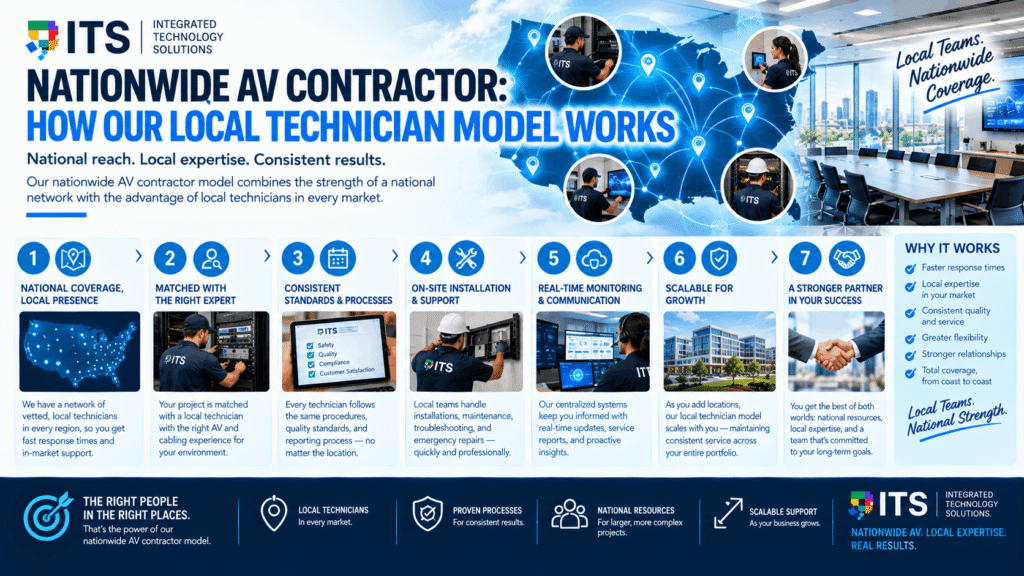
When a business says they need a nationwide AV contractor, they usually picture one of two things. Either a huge company with a call center and a rotating cast of subcontractors, or a small local shop that cannot handle more than one city. Neither option sounds great. ITS was built to be something different.
We serve all 50 states from our Texas headquarters, but we never forget that every project happens in a real building, in a real city, with real people who need things done right the first time. This guide explains how our local technician model actually works, and why it matters if you are choosing a national low voltage installer for your next project.
Businesses with locations across several states often learn the hard way that “nationwide coverage” can mean very different things depending on the vendor. Some find out only after a project goes sideways in a city their main contact has never visited. We built our model specifically to prevent that experience, and this guide walks through exactly how.
What Does “Nationwide AV Contractor” Really Mean?
The term gets used loosely in this industry. Some companies call themselves nationwide because they can ship equipment anywhere. Others call themselves nationwide because they have a sales team that answers calls from any state. Neither of these makes a company truly capable of delivering quality work across the country.
A real nationwide AV contractor needs three things working together. It needs central planning so every site follows the same standards. It needs local hands on the ground who know the building codes and construction practices in that specific region. And it needs a system that connects the two, so nothing falls through the cracks between the home office and the job site.
Without all three pieces, a company is not really a nationwide AV contractor. It is just a business that happens to accept projects outside its home state, with no real structure to guarantee the outcome.
The Problem With Typical National Vendors
Many national vendors solve the coverage problem by subcontracting blindly. They post a job on a contractor marketplace, accept the lowest bid, and hope for the best. This approach creates real risk for the client.
Quality varies wildly from one technician to the next. Documentation often does not match between sites. Communication breaks down because the technician on-site never talks directly to the project manager who sold the job. When something goes wrong, nobody takes clear ownership, and the client is left chasing down answers from multiple parties.
This is the exact problem our model was built to avoid.
How Our Local Technician Model Works
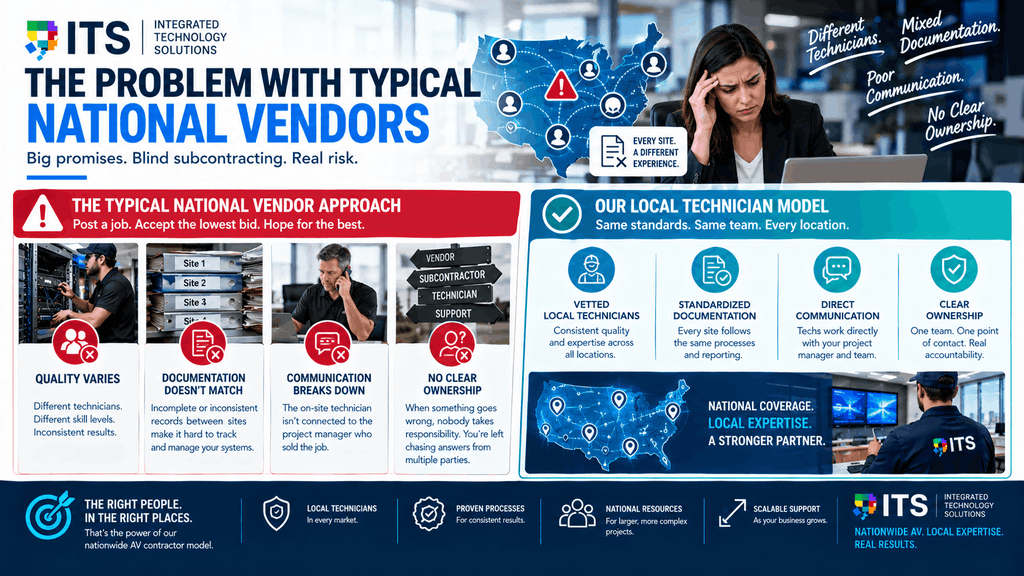
Our approach starts with one simple idea. Every technician who touches your project should meet the same standard, no matter which state they are working in.
Texas Headquarters, Local Hands
Every nationwide AV contractor project we run is planned and managed from our Texas headquarters. Design, scheduling, procurement, and project management all run through one central team. This keeps every site aligned on the same timeline and the same scope.
But the physical work happens through vetted local technicians in each market. This gives us two advantages at once. Clients get central accountability and a single point of contact. They also get technicians who already understand local permitting, local building types, and local scheduling realities.
Vetting and Certification Standards
Not just any technician joins our network. We require proof of relevant certification, a track record of completed commercial work, and references we actually check. Many of our field partners hold BICSI credentials for structured cabling or CTS-I certification for AV installation, the same standards our in-house team follows.
This vetting process weeds out the inconsistency that plagues typical subcontractor marketplaces. A technician working on your project in Ohio follows the same checklist as a technician working in California.
How We Recruit and Onboard Local Technicians
Building this network takes real effort. We do not simply pull names from an online directory. Our team researches established, reputable low voltage contractors in each market we plan to serve, reviews their project history, and conducts interviews before any work is assigned.
Once a technician or firm joins our network, they go through an onboarding process that covers our documentation standards, our safety expectations, and our communication protocols. They also complete a trial project under close supervision before being trusted with larger client work. This process takes longer than simply posting a job and accepting the first bid, but it is the only way we have found to guarantee consistent quality across so many different markets.
We also maintain long-term relationships with our local partners rather than treating them as disposable labor. A technician who has worked with us for years already understands our standards without needing a refresher every time. This continuity benefits every client whose project touches that market.
One Project Manager, Many Markets
Clients with locations across multiple states still get one project manager. That person owns the relationship, tracks every site’s progress, and serves as the single point of contact for questions or issues. You are never told to “call the local guy” and figure it out yourself.
This structure matters most for businesses running simultaneous rollouts across several states. Instead of juggling different contacts for different cities, you have one person who sees the whole picture.
Consistent Documentation Across Every Site
Every site in a multi-location project produces the same documentation, in the same format. Test results, photos, equipment lists, and completion reports all follow a standard template. This means your facilities team can compare performance across locations easily, and nothing gets lost because one technician used a different reporting style than another.
Why a National Low Voltage Installer Needs Local Technicians
Low voltage work, which includes structured cabling, AV systems, security, and wireless infrastructure, is physical work. It cannot be done remotely. A national low voltage installer without real local coverage either subcontracts blindly or simply cannot serve certain markets well.
Local technicians bring knowledge that a traveling crew cannot match. They know which buildings in their market tend to have older wiring. They know which cities require extra permitting steps. They know how weather, like humidity in the Gulf Coast or snow in the Midwest, affects installation timelines and equipment choices. This local knowledge, combined with national-level standards, is what separates a true national low voltage installer from a company that simply claims nationwide reach.
Quality Control Across All 50 States
Coverage alone does not guarantee quality. Here is how we keep standards consistent no matter where a project happens.
Standardized Training
Every technician in our network receives the same project documentation, the same installation checklist, and the same expectations before work begins. This removes guesswork and keeps every site working from the same playbook.
Remote Oversight and Reporting
Our project managers review progress photos, test results, and status updates throughout every project, not just at the end. This lets us catch problems early, while they are still easy and cheap to fix.
Site Audits and Spot Checks
For larger multi-site rollouts, we conduct random spot checks against our documentation standards. This keeps every technician, in every market, accountable to the same bar of quality, whether or not they expect an audit that week.
Closing the Loop With Client Feedback
Quality control does not stop when a project wraps up. We follow up with clients after major installations to confirm the work matches expectations and to catch any issues before they become bigger problems. This feedback loop also helps us identify which local technicians consistently deliver strong results, so we can route more work their way on future projects in that market.
Benefits for Multi-Site Businesses
Businesses with locations in several states gain real advantages from this model.
- One contract, every state. No need to manage separate vendors for different regions.
- Consistent pricing. Standardized labor rates and material costs across your whole portfolio.
- Faster rollouts. Local technicians available in each market mean less travel time and lower trip costs.
- Easier troubleshooting. One documentation standard means your team can compare any two sites side by side.
- A single point of accountability. If something goes wrong, you know exactly who to call.
If your business is planning a larger multi-site deployment, our nationwide AV rollout process guide walks through the full project timeline from initial design through final punch-list at your last location.
Industries We Support Across the Country
Our local technician model supports clients across a wide range of industries, each with its own requirements.
Retail and franchise chains need identical technology setups across dozens or hundreds of locations, often on tight rollout schedules tied to store openings. Healthcare systems need secure, compliant infrastructure installed consistently across every clinic or hospital campus. Hospitality groups need guest-facing AV and Wi-Fi systems that perform the same way whether a property sits in a major city or a smaller market. Corporate enterprises with offices in multiple states need standardized conference room technology so employees have the same experience no matter which office they work from.
Each of these clients shares the same core need. They want local execution without losing the consistency that only comes from centralized planning and a single accountable partner.
A Real-World Example of the Model in Action
Consider a retail chain opening twelve new locations across eight states within a single quarter. Under a typical blind-subcontracting model, this chain would need to vet twelve different local vendors, track twelve different documentation formats, and manage twelve different relationships, all while trying to keep store opening dates on schedule.
Under our model, that same chain works with one project manager from our Texas headquarters. We assign vetted local technicians in each of the eight states, all working from the same design package, the same equipment list, and the same installation checklist. Every completed site produces the same test results and photo documentation, so the client’s facilities team can confirm consistency across all twelve stores without chasing down different vendors for different formats.
If one store in this scenario sits in a city with unusual permitting requirements, our local technician already knows the process, and our project manager adjusts the timeline for that single site without disrupting the other eleven. This is the real advantage of combining local knowledge with central coordination. A fully remote crew would lose days figuring out local requirements from scratch. A fully decentralized vendor network would have no way to keep all twelve openings aligned on the same schedule and the same standard.
Common Concerns About Nationwide AV Contractors
Businesses considering a nationwide AV contractor often raise a few recurring concerns. Here is how we address them.
Will quality suffer outside of Texas? No. Every technician in our network, regardless of location, follows the same vetting process and the same documentation standards. Our Texas headquarters manages every project the same way, whether the site is down the street or across the country.
Who do we call if something goes wrong at a remote site? Your dedicated project manager, not a general call center. This person knows your project history and can act immediately, rather than routing your call through multiple departments first.
How do you handle different building codes and permit requirements by state? Our local technicians already understand their region’s codes and permitting process. Our central team confirms requirements before work begins, so there are no surprises mid-project.
What if we only need work done in one or two states right now, not all fifty? That is fine. Most clients start with a handful of locations and expand over time. Our model works the same way whether you need two sites covered or fifty, since the same vetting and documentation standards apply from day one.
How do you keep pricing consistent when labor costs vary so much by region? We build regional labor cost differences into our proposals upfront, so you see one transparent number per site rather than a surprise later. This keeps your budget predictable even when a project spans both high-cost and lower-cost labor markets.
What to Ask Before Hiring a Nationwide AV Contractor
If you are comparing providers for a multi-state project, ask these questions before signing a contract.
- Do you use employees, vetted local partners, or an open marketplace of subcontractors?
- What certifications do your field technicians hold?
- Will we have one project manager, or a different contact for each site?
- How is documentation standardized across locations?
- Can you provide references from a multi-state project similar in size to ours?
A contractor who cannot answer these clearly is likely relying on the blind subcontracting model that causes most national rollout problems. Our low voltage systems guide covers the full range of systems a national low voltage installer should be able to handle under one roof, from structured cabling to AV to access control.
Why Choose Integrated Technology Solutions as Your Nationwide AV Contractor
Integrated Technology Solutions brings 35 years of combined leadership experience to every project, backed by a Texas-based team and a nationwide network of vetted technicians. We hold memberships and follow standards set by groups like the National Systems Contractors Association, AVIXA, and BICSI, the leading organizations in our industry. Our BICSI certified cabling approach applies the same standard whether we are working in Houston or a city we have never visited before.
Businesses across the country trust us with multi-site AV, structured cabling, and low voltage infrastructure projects because we treat every location, big or small, with the same level of care. Our commercial audio visual systems and national cabling services are built on one principle: local hands, national standards, and one team accountable for the result. Whether your next project involves one new office or a rollout spanning a dozen states, the same process and the same quality expectations apply from the very first site to the last.
Final Thoughts on Our Nationwide AV Contractor Model
Choosing a nationwide AV contractor is not just about having coverage on a map. It is about consistency, start to finish. Our local technician model combines central planning from our Texas headquarters with vetted, certified technicians in every market we serve. This is how we deliver the same quality in all 50 states, whether you need a single conference room upgrade or a full rollout across dozens of locations.
As a trusted national low voltage installer, we built our entire model around one idea. You should never have to choose between local expertise and nationwide consistency. With ITS, you get both, backed by a team that has already solved the hard part of scaling technology projects across the country.
Ready to talk about a multi-state project? Contact Integrated Technology Solutions today to learn how our nationwide AV contractor model can support your business, wherever your locations are. We will walk you through our vetting process, our documentation standards, and a realistic timeline for your specific markets before you commit to anything.
